

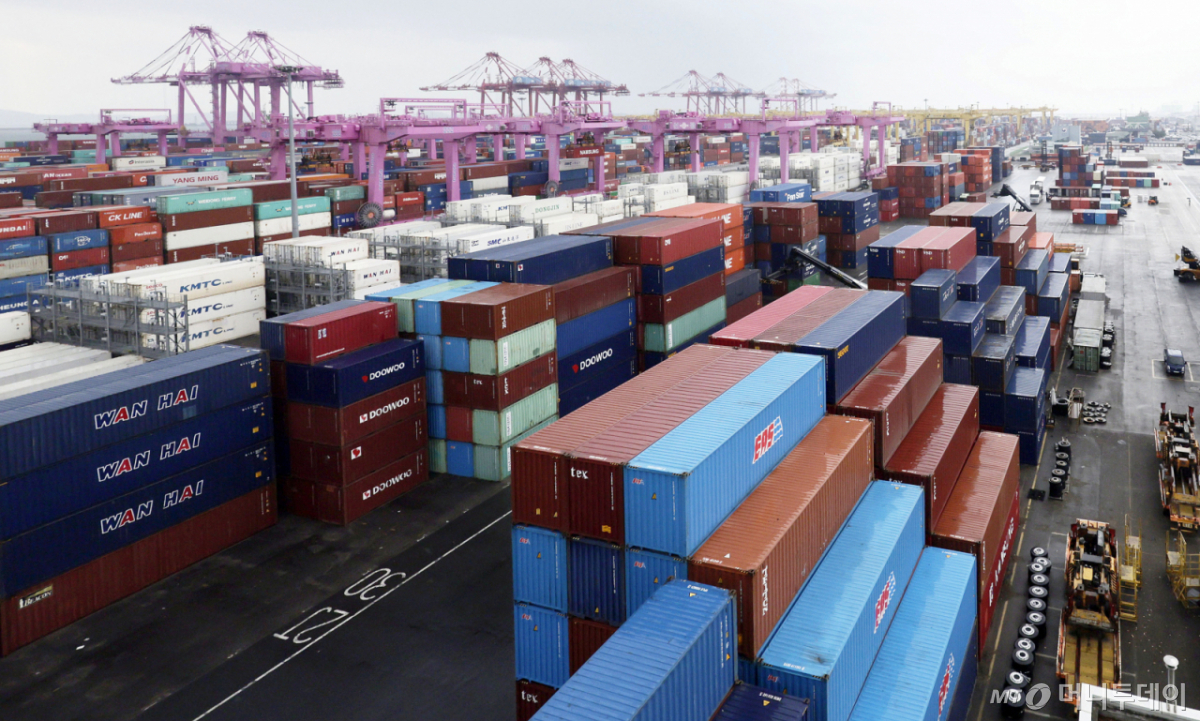
As Korea has entered the era of $1 trillion in annual exports, an analysis revealed that exports have driven more than half of the country’s domestic economic growth.
In a report titled “How Much Have Exports Driven Our Economic Growth: The Contribution of Exports to Growth Seen Through the Import-Adjusted Method,” published on the 25th by the Korea Chamber of Commerce and Industry (KCCI), the chamber stated, “Exports have been the core engine driving Korea’s economic growth through the creation of substantial domestic value-added.”
According to the report, Korea’s exports grew at an average annual rate of 16.6% from 1960 until last year. This is nearly double the global export growth rate (8.6%) over the same period. Korea’s share of world exports expanded from 0.07% (ranked 82nd) in 1964 to 2.69% (ranked 8th) last year. The time it took for the scale of exports to increase tenfold, from $100 billion to $1 trillion, was 31 years, similar to major exporting countries such as the United States (31 years) and Germany (30 years). It is evaluated that this achievement holds significant meaning, particularly given that it was accomplished amid external uncertainties such as slowing global economic growth following the Global Financial Services Commission era, the spread of protectionism, and geopolitical conflicts.
To grasp the actual contribution of exports to economic growth, the KCCI applied the “Import-Adjusted Method.” This method calculates the contribution to growth based solely on value-added created domestically by excluding imports from the increases in exports, consumption, and investment.
Based on this, an analysis of the contribution to economic growth from 1961 to 2024 showed that the contribution share of exports was 27.1%, ranking second only to private consumption (40.6%). Investment and government consumption were recorded at 25.4% and 6.8%, respectively. Over the past six decades, exports have served as a core pillar of Korea’s economic growth alongside private consumption and investment.
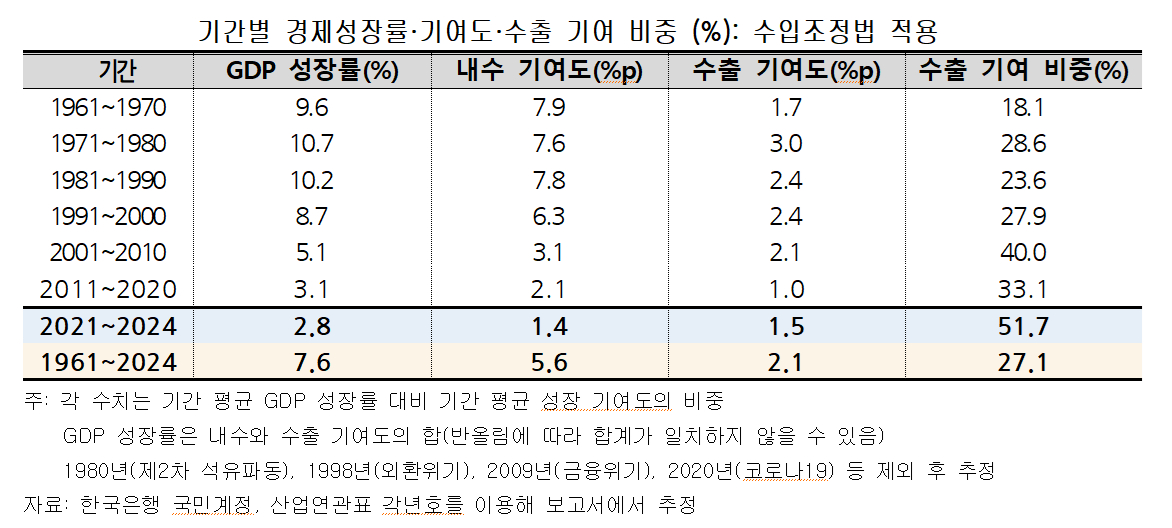
By period, from the early 1960s when an export-oriented growth strategy was introduced until the 1990s, private consumption and investment drove more than two-thirds of overall economic growth. Entering the 2000s, as China’s accession to the World Trade Organization (WTO) coincided with the spread of global value chains (GVC), the contribution share of exports to growth rose significantly to 40%. In the 2010s, it fell to 33.1% due to the aftermath of the Global Financial Services Commission era and a slowdown in the expansion of global value chains. However, from 2021 to 2024, it increased to 51.7%, driven by post-pandemic export recovery and expanding demand for AI (artificial intelligence) and semiconductors.
However, as industrial upgrading has entered a mature stage, the generational shift in export products is slowing down. The “Export Structure Change Index,” which indicates the degree of change in the composition of export products, decreased from 0.4 to 0.6 in the 1960s to around 0.1 in the 2020s. The top 10 products, accounting for approximately 60% of total exports, have also seen little change since the 2000s. In particular, the share of semiconductors in total exports expanded from 24.4% last year to over 40% in January–October this year.
The report presented policy tasks for sustained export growth, including △diversification of the export structure through manufacturing innovation, △expansion of the domestic ripple effects of exports, △diversification of export markets, and △balanced growth of exports and domestic demand. It explained that while enhancing export competitiveness by cultivating next-generation key products and transitioning to AI (artificial intelligence), it is necessary to strengthen domestic supply chains so that expanded exports lead to increased domestic value-added and job creation. Furthermore, it emphasized the need to reduce trade risks associated with dependence on the U.S. and China by pioneering emerging markets, and to induce simultaneous growth of exports and domestic demand through improving domestic investment conditions and revitalizing private consumption.
Lee Si-wook, Head of Economic Research at the KCCI, stated, “When expanded exports lead to domestic investment and jobs, the tangible sense of growth will also increase,” adding, “The task ahead is to broaden export products and markets through manufacturing innovation and ensure that the warmth of exports spreads to partner companies and regions.”

 in INDUSTRY

