

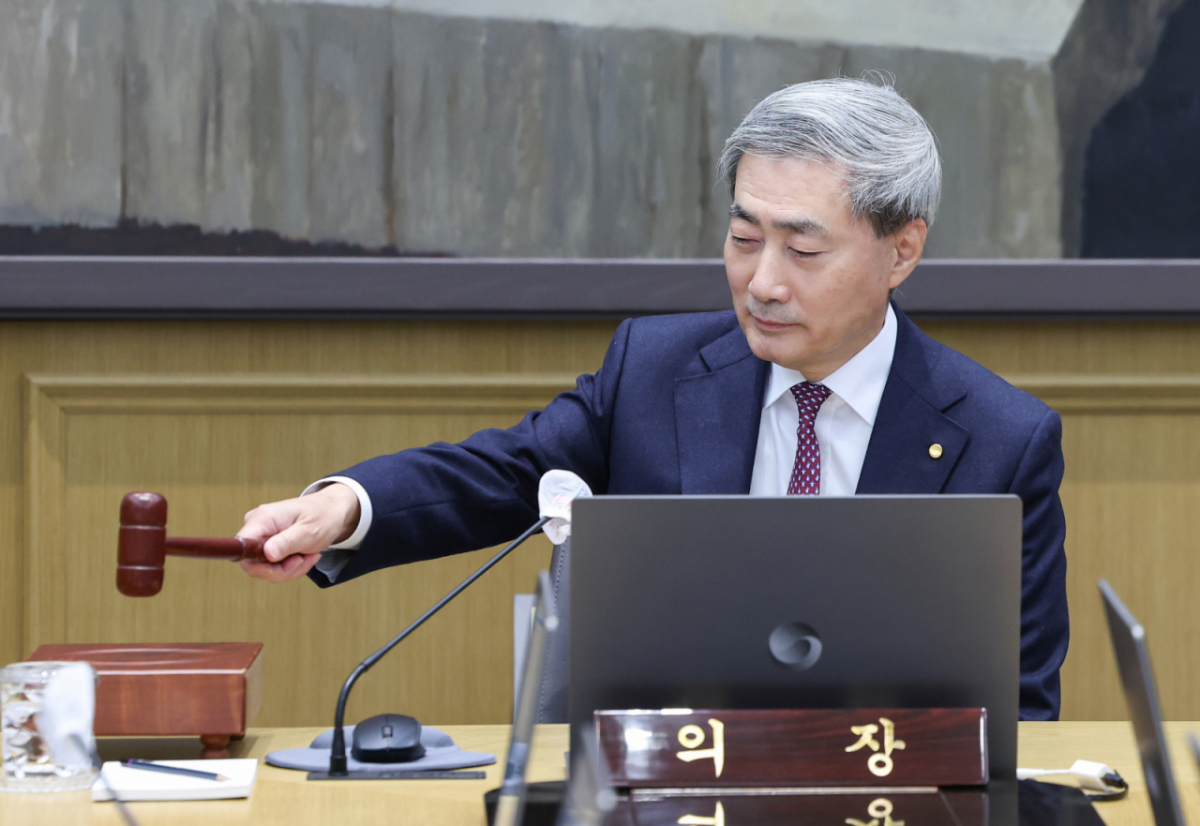
The Bank of Korea’s Monetary Policy Board raised the base rate to 3.25% annually. The decision is interpreted as taking into account the steep growth driven by a semiconductor super-boom and prices that have continued to rise at high levels in the late 2% range.
The central bank revised its forecast for this year’s economic growth rate upward from the previous 3.3% to 3.9% on the day. It also projected that growth in the 4% range would be possible next year.
The bank's rate-setting board decided to raise the base rate by 0.25 percentage points from 3.0% annually to 3.25% annually.
Five out of seven board members supported the interest rate hike. Monetary Policy Board members Hwang Geon-il and Lee Su-hyang submitted a minority opinion in favor of maintaining the rate at 3.0%.
Previously, the Bank of Korea entered monetary tightening in July by raising the base rate, which had been held steady at 2.5% annually for about a year and two months, by 0.25 percentage points.
It then proceeded with “back-to-back hikes” in August, opening the era of a “3% base rate” for the first time in a year and nine months. After pausing once last month, the Bank of Korea carried out an interest rate hike this month, solidifying its monetary tightening mode.
Behind the Bank of Korea’s additional interest rate hike lies the hot growth momentum of the Korean economy and concerns over rising prices.
In fact, South Korea surpassed $1 trillion in cumulative annual exports on the 19th, driven by strong exports centered on semiconductors. Annual exports of $1 trillion rank fourth in the world, following Germany, the United States, and China.
Reflecting this trend, the Bank of Korea revised its forecasts for Korean economic growth rates for this year and next year upward to 3.9% and 4.1%, respectively, on the day.
These figures are higher by 0.6 percentage points and 1.2 percentage points, respectively, compared to the August forecast. Considering that the Bank of Korea’s forecast for this year’s growth rate presented in its economic outlook last November was 1.8%, the perspective on the Korean economy has changed significantly over the past year.
In addition, the continued instability in prices added weight to the Bank of Korea’s tightening stance. The consumer price inflation rate is trending downward at △3.1% in August, △2.9% in September, and △2.8% in October, but it still significantly exceeds the Bank of Korea’s price management target (2.0%).
In particular, supply-side price pressure from geopolitical instability in the Middle East is compounded by demand-side upward pressure from strong exports centered on semiconductors and a recovery in domestic consumption, suggesting that future price burdens will continue to increase.
The board said in its monetary policy direction decision document, “The domestic economy is expected to see strengthened growth momentum while the inflation rate is projected to remain above the target level for a considerable period.”
It explained, “Given that risks from the perspective of financial stability are also continuing, we judged it appropriate to raise the base rate by 0.25 percentage points.”
The board plans to maintain its interest rate hiking stance going forward. In fact, the dot plot, which indicates the Monetary Policy Board members’ interest rate forecasts for six months ahead, was revised upward in three months.
As a result of seven board members anonymously marking three dots each, totaling 21 dots, eight were placed at 3.50%. Seven dots were also placed at 3.75%. The remaining six dots predicted maintaining the current level of 3.25%.
In the previous dot plot in August, 10 dots clustered at 3.25%, and only six dots were marked at 3.50%. The remaining five dots pointed to 3.0%.
The board said, “Future monetary policy will be determined by closely examining price and economic trends as well as the financial stability situation, including the timing of additional hikes.”

 in ECONOMY
