

Financial authorities have fallen into a "total volume regulation dilemma." While maintaining strict total volume management to curb household debt, they have effectively rendered the regulation powerless by allowing exceptions to accommodate residual loan demand amounting to 70,000 households and 26 trillion won in the second half of the year. Critics point out that policy goals—expanding housing supply versus managing household loans—are clashing.
According to financial sector reports on the 29th, the Financial Services Commission held a meeting with five major banks (KB Kookmin, Shinhan, Hana, Woori, and NH Agricultural Cooperative Bank) the previous day, requesting that scheduled residual loan disbursements for the second half proceed without disruption. The Financial Services Commission expects residual loan demand of approximately 70,000 households totaling 26 trillion won to arise in the second half of the year.
The 26 trillion won estimated by financial authorities does not consist entirely of new household loans. A significant portion represents construction loans already disbursed that are being converted into residual loans. Within the banking sector, considering the typical structure of construction and residual loans, actual new credit is estimated to range between 3.7 trillion won and 11 trillion won (approximately 15% to 40%) out of the 26th trillion won. While differences exist depending on individual projects regarding construction loan ratios and final LTV (loan-to-value ratio), officials explain that excluding already disbursed construction loans, the net increase in final residual loans would be around this level.
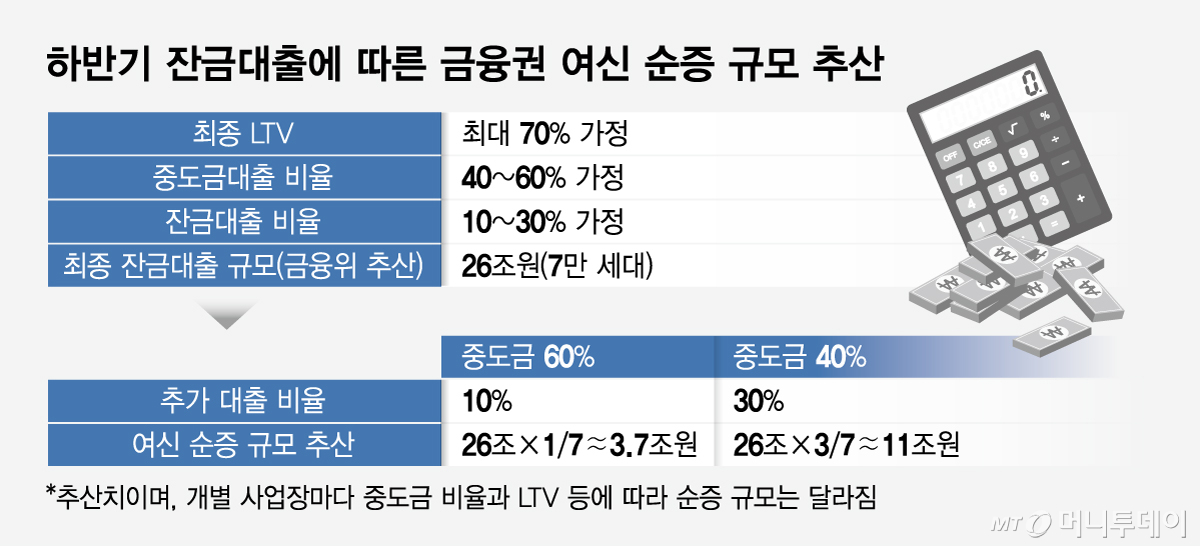
Even with these estimates, new credit could match or exceed the approximately 430 billion won target for household loan growth set by the five major banks this year. In addition to residual loans, financial authorities are also considering exceptions for moving expenses and construction loans related to housing supply expansion. If so-called group loans—including moving expenses, construction loans, and residual loans—are all granted exceptions, even if the total household loan volume management target is technically met, the "exceptions" would inevitably far exceed the "target."
Financial Commission Chairman Lee Eoung-won stated at the National Assembly's Political Affairs Committee session on this day: "(Allowing residual loans as an exception) does not mean a policy shift." He explained, "Residual loans can still be obtained within regulations now, but strict total volume management caused banks to tighten lending." He clarified that allowing residual loans was merely about coordinating with banks to ensure appropriate disbursement, not changing policy.
However, the financial sector evaluates that authorities are effectively caught in a dilemma as the policy purpose of total volume regulation clashes with protecting actual borrowers. Maintaining total volume regulation to manage household debt makes it difficult for homebuyers awaiting occupancy to secure residual payments, while conversely, granting exceptions for residual loans inevitably undermines the effectiveness of total volume management.
Controversy over equity is also raised. Pre-sale complexes where thousands of households move in simultaneously receive exception treatment because they were designated as planned loans at the time of pre-sale, whereas individual buyers purchasing existing homes remain subject to total volume regulation constraints. The difference between these two cases lies in whether the home purchase was planned one or two years ago versus contracted this year.
A financial sector official noted: "Total volume regulation existed one or two years ago as well; the only change is whether President Lee Jae-myung raised his voice at a symposium or not." He pointed out, "Even among actual borrowers, eligibility for loans has changed depending on whether they are individuals or groups."

 in FINANCE
