

Ahead of the announcement of the fund-type defined contribution pension system, the government is expected to limit the number of trustee entities to fewer than 10. While the government aims to prevent a proliferation of funds through a pre-approval system, some segments of the financial sector are raising concerns that this could lead to a structure dominated by large corporations.
According to the financial sector on the 11th, the working group on fund-type defined contribution pension plans under the Ministry of Employment and Labor has recently decided to limit the number of approved trustee entities to between 5 and 8.
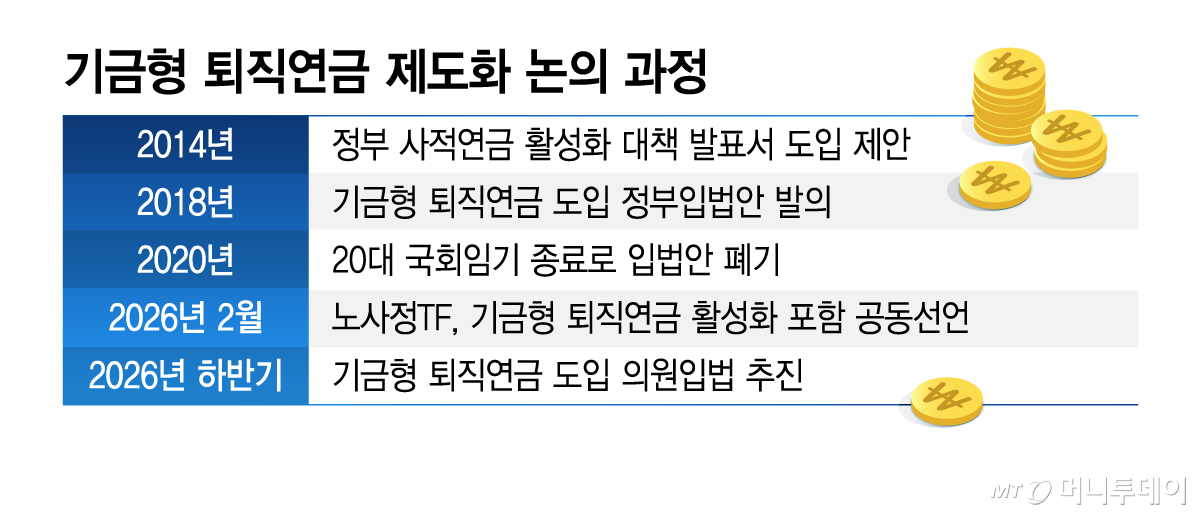
The fund-type defined contribution pension system is a structure where trustee institutional investors collect and manage retirement pensions from multiple companies, moving away from the current contract-based model. In Korea, legislation was introduced in 2018 but was discarded due to the expiration of the National Assembly's term. However, in February this year, a task force (TF) involving labor and management agreed to introduce "fund-type defined contribution pensions" into the DC (defined contribution) type, and legislative work is now underway. The Ministry of Employment and Labor, the lead ministry, plans to release guidelines next month covering detailed provisions such as pre-approval for trustee entities, capital contribution requirements, and regulations to prevent conflicts of interest.
The financial sector is closely monitoring the scale of pre-approval for trustee entities. Under the fund-type defined contribution pension structure, once a trustee entity sets the overall framework—including target returns, risk limits, and investment guidelines—assets are managed by OCIOs (outsourced chief investment officers) or professional asset managers selected by the trustee entity to align with these parameters. The role of trustee entities is assigned to public institutional investors, employer unions, or financial companies depending on the fund type.
The government's move to limit the number of trustee entities to fewer than 10 aims to prevent a proliferation of funds. In Australia, where the Superannuation model for fund-type defined contribution pensions originated, the number of funds dropped significantly from 232 in June 2015 to 77 as of the June 2025 fiscal year-end. An official familiar with discussions on fund-type defined contribution pensions stated, "The goal is to consolidate fund sizes to achieve economies of scale, so it would not be appropriate for small and medium-sized funds to proliferate." They added, "Given Australia's experience, there is no need to follow the same path."
As expectations grow that trustee entities will be selected primarily among large institutional investors, some small and medium financial companies are objecting, calling this regulation a measure that deprives participants of their choice.
An official from the wealth management (WM) division of one financial company pointed out, "The problem with the contract-based defined contribution pension structure was its focus on attracting new funds, prioritizing marketing over qualitative growth such as returns." They further criticized, "Selecting trustee entities based on large companies alone would not mean anything other than continuing to prioritize marketing as in the past."
The reason for the financial sector's opposition is that with retirement pension reserves surpassing 550 trillion won, the market size for fund-type defined contribution pensions is expected to grow proportionally. According to a 2024 report by the Korea Development Institute of Capital Markets, retirement pension reserves are projected to reach 1,172 trillion won by 2040.

 in FINANCE
