

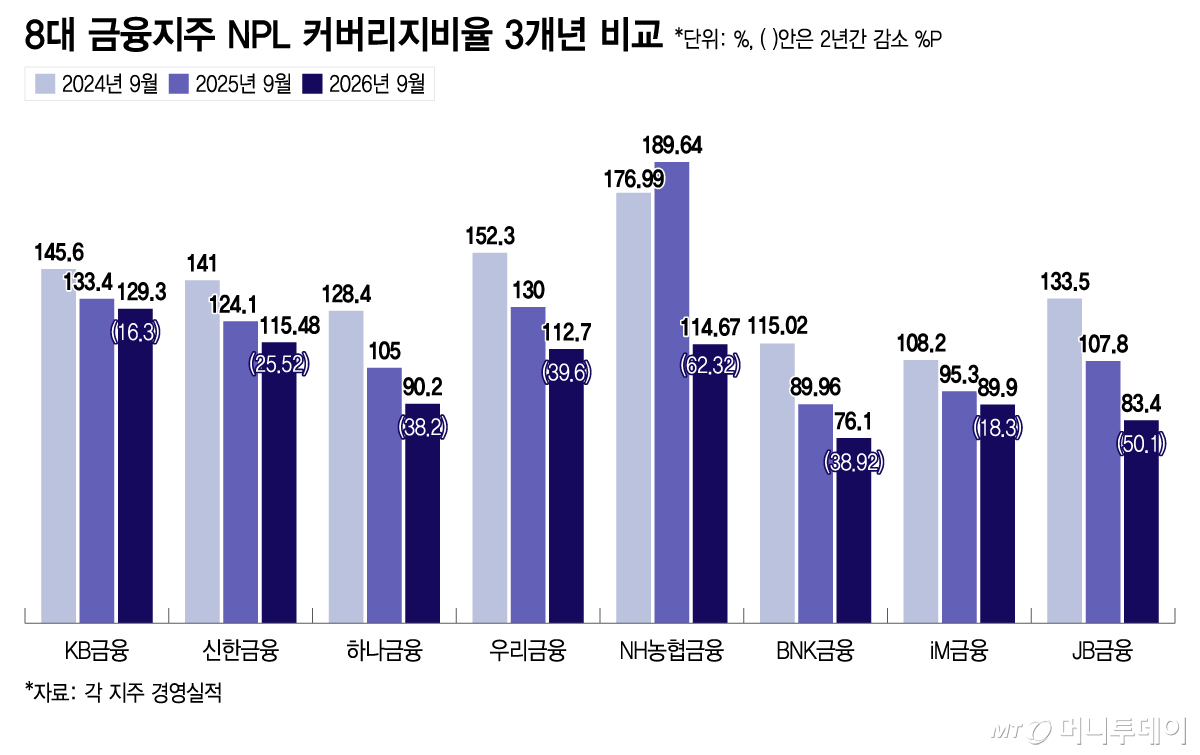
While financial holding companies are expanding shareholder returns based on record-high earnings, the loss defense shield against non-performing loans (NPLs) is becoming increasingly thin. The level of allowance for loan losses accumulated relative to NPLs across all eight major financial holding companies has declined compared to two years ago. Concerns are also emerging that additional loss burdens could grow as the NPL sale market contracts. With corporate lending expected to expand in line with the government's productive finance policy, there is a need for balance between shareholder returns and soundness management.
According to financial industry sources on the 1st, the NPL coverage ratios of eight major bank-affiliated financial holding companies—KB, Shinhan, Hana, Woori, NH Nonghyup, BNK, iM, and JB—as of the end of September last year all fell below levels at the same time in 2024.
The NPL coverage ratio is an indicator showing how much money a financial institution has set aside to cover losses against non-performing loans (NPLs) that have become difficult to recover after lending. If the allowance for loan losses accumulated is 15 billion won when NPLs stand at 10 billion won, the coverage ratio becomes 150%. Financial regulators recommend that financial institutions maintain this ratio above 100%.
Among the eight major financial holding companies, JB Finance recorded the largest decline over two years. It fell by 50.1 percentage points (p), from 133.5% at the end of September 2024 to 83.4% this year. Woori Finance and Hana Finance also declined by 39.6%p and 38.2%p, respectively. As of the end of September this year, four financial holding companies—Hana, BNK, iM, and JB—had coverage ratios below 100%.
By bank, the situation for regional banks is even worse. The NPL coverage ratios as of the end of last September were 80.0% for Gwangju Bank, 81.5% for Jeonbuk Bank, 81.9% for Gyeongnam Bank, and 88.6% for Busan Bank, all falling below the level recommended by financial regulators.
Expanding dividends… Financial holding companies also face difficulties selling non-performing loans (NPLs)
In contrast, dividends from financial holding companies have been steadily expanding. The total annual cash dividends of the eight major financial holding companies increased by 1.1571 trillion won (22.7%) over two years, from 5.0976 trillion won in 2023 to 5.4280 trillion won in 2024, and then to 6.2547 trillion won last year. During the same period, KB Finance increased dividends by 34.4%, Woori Finance by 33.6%, and BNK Finance by 39.5%. NH Nonghyup Finance, a non-listed company, also expanded dividends paid to its major shareholder, the National Agricultural Cooperative Federation, from 700 billion won to 760 billion won.
The competition among financial holding companies for shareholder returns continued in this year's third-quarter earnings announcement as well. KB Finance decided on a third-quarter dividend per share of 1,167 won, a 25.5% increase from the same period last year. Shinhan Finance resolved to make additional treasury stock purchases worth 450 billion won, planning to expand its total shareholder return scale for this year to approximately 3 trillion won. Hana Finance also decided on an additional share buyback and cancellation of 250 billion won.
Regional financial holding companies are also moving to expand shareholder returns. Although BNK Finance's cumulative net profit for the first three quarters of this year decreased by 19.2% from the same period last year, it increased the dividend per share from 120 won to 150 won. It plans to expand its share buyback scale to 120 billion won this year. JB Finance is also continuing dividends and share buybacks and cancellations with the goal of achieving a total shareholder return ratio of 50% this year.
The issue is that, unlike the expansion of shareholder returns, market conditions for clearing non-performing loans (NPLs) are deteriorating. As the NPL sale market contracts, financial institutions have found it difficult to dispose of non-performing assets in a timely manner, and if sale prices fall, they must also bear additional losses.
In fact, Hana Finance cited the contraction of the NPL sale market as a burden on soundness management. Kang Jae-shin, Chief Risk Officer (CRO) of Hana Finance, stated during an earnings announcement conference call on the 23rd last month that "due to the contraction of the NPL asset sale market, sales of non-performing assets were insufficient through the third quarter," adding that "we plan to conduct sufficient asset sales in the fourth quarter." However, he also mentioned the possibility that the credit cost ratio could rise in this process.
Non-performing loan risks grow with productive finance… Financial regulators watch year-end allowance accumulation
In a situation where clearing non-performing loans (NPLs) is not easy, financial holding companies' burden of soundness management is expected to grow further as corporate lending expands under the government's productive finance policy. The introduction of the stress buffer capital system promoted by financial regulators is also being delayed. While this measure considers factors such as funding supply capacity due to the expansion of productive finance, the need to manage loss-absorbing capacity in the banking sector is actually increasing.
Financial regulators are also expected to closely examine the level of allowance accumulation and capital adequacy of financial holding companies in year-end settlements. Whether sufficient capital has been secured against non-performing loans despite the expansion of shareholder returns is expected to be a key area of scrutiny.
A financial regulator official said, "While some financial holding companies are increasing dividends, their allowances for loan losses are decreasing," adding that "since losses can occur in the process of selling non-performing loans (NPLs), it is necessary to formulate medium- and long-term dividend plans considering the possibility of future corporate lending defaults."

 in FINANCE
