

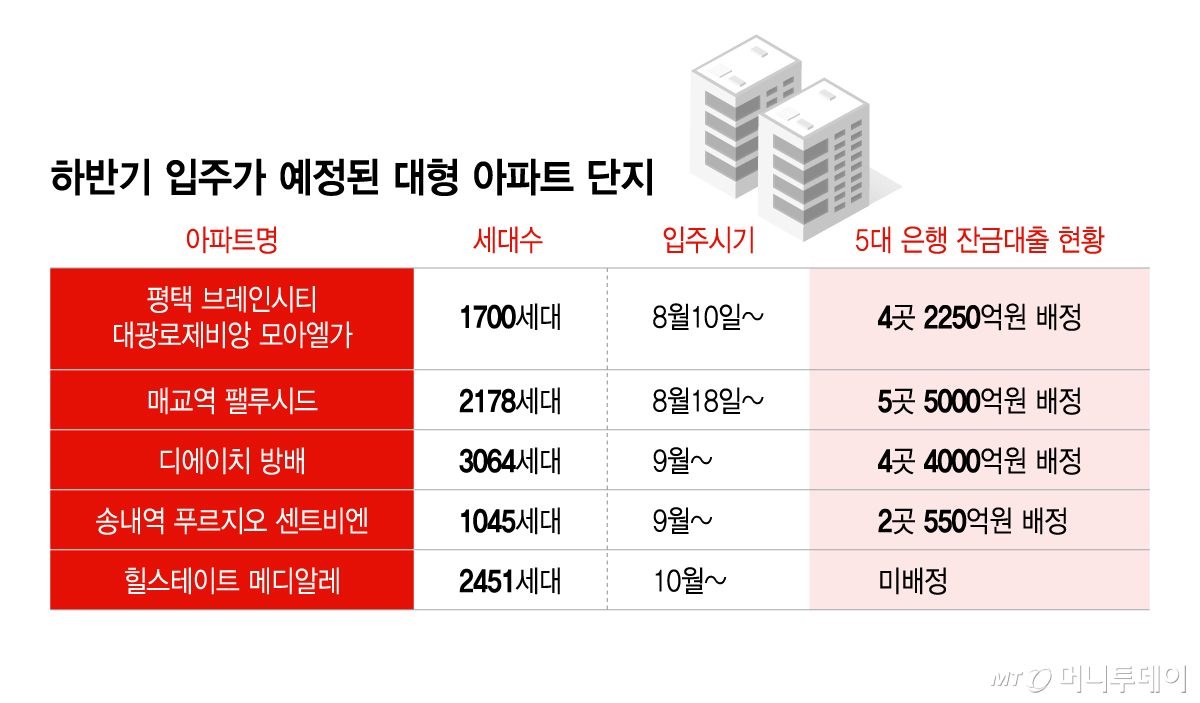
The banking sector has requested that financial authorities specify loan limits for each apartment complex regarding mass balance loans ahead of occupancy in the second half. With the overarching policy of managing total household debt, banks are merely watching each other's moves, causing growing anxiety among prospective residents.
According to the financial sector on the 14th, at an expanded meeting on household debt oversight convened by the Financial Services Commission that morning, banks conveyed their view that financial authorities need to present in advance the feasible scale of loans for major complexes requiring mass lending in the second half.
A financial sector official attending the meeting said, "As seen in the case of Paluside, many opinions were raised suggesting it is better for authorities to determine whether each complex can receive loans and how much," adding, "I understood this as an effort to manage while aligning with the increased total volume and to prevent banks from engaging in excessive posturing at the expense of actual homebuyers."
The Financial Services Commission adjusted this year's household debt management target upward from 1.5% to 3% through its the 13th measures. It specifically stated that while managing mass loans including balance loans within a 3% growth rate, it would negotiate with the banking sector to manage mass loan targets separately. Consequently, voices have been raised in the banking sector calling for concrete guidelines on how to manage mass loans to be issued as soon as possible.
Regarding the banking sector's proposal on this day to "set balance loan limits per complex," financial authorities including the Financial Services Commission and the Financial Supervisory Service are understood not to have given an explicit answer. In the future, financial authorities plan to continue additional consultations with the banking sector, incorporating today's proposals, to discuss concrete handling methods for mass loans.
The banking sector is recently citing a case where five major banks jointly allocated an additional 50 billion won in balance loans for 'Maegyo Station Paluside' in Suwon, Gyeonggi Province. On the 28th, the Financial Services Commission held a meeting with deputy presidents of the five major banks and requested that they provide a total of 50 billion won in balance loans for the Paluside complex, which is set to begin occupancy on August 18. This reflects the same argument: financial authorities should issue a definite 'guideline' for large complexes scheduled for the second half.
Banks worry that if individual banks independently supply balance loans, there is a risk of concentration in specific complexes. They explain that if loan competition becomes overheated, it could lead to exceeding total volume targets or, conversely, some banks significantly falling short of their limits. As the banking sector delays loan limit allocations while watching each other's moves, complaints from consumers regarding balance loans ahead of occupancy are surging rapidly, centered around nearby bank branches.
A banking sector official explained, "If financial authorities step in to provide guidelines so that all banks present a unified stance, uncertainty among prospective residents will also disappear."
Financial authorities currently estimate the scale of complexes scheduled for occupancy in the second half at 70,000 households and 26 trillion won. In reality, large-scale complexes are set to open one after another in the second half. Starting with 1,700 households at Pyeongtaek Brain City Daegwang Rose Bian Moaelga, where occupancy began sequentially from the 10th, complexes including Maegyo Station Paluside (2,178 households), DH Bangbae in September (3,064 households), Songnae Station Purijeo Centbien (1,045 households), and Hillstate Mediale in Eunpyeong District in October (2,451 households) are approaching occupancy.
Additionally, on this day, banks conveyed the opinion that there is a need to leave room for supplementary measures regarding 'non-resident single-homeowners with speculative intent.' The previous day, the Financial Services Commission viewed a single-homeowner holding an apartment in the Seoul Capital Area or regulated zones as having speculative intent if they were renting the property to someone other than family members and neither they nor their spouse had ever actually resided in that home. However, since ambiguous cases may arise depending on specific instances, it was suggested that room for interpretation should be retained.
Meanwhile, no concrete plan regarding how much of the '3% increase' would be allocated to each financial company was discussed on this day. On the 12th, Shin Jin-chang, secretary-general of the Financial Services Commission, explained, "Based on first-half trends, some financial companies may face penalties," adding, "Differences at the individual financial company level are only natural."

 in FINANCE
