

As the COFIX (Cost of Funds Index) rate rises while bank bond yields fall, an inversion phenomenon is expanding in which variable-rate home loans from banks carry higher interest rates than fixed-rate ones. With approximately 66% of new home loans being processed at variable rates, borrowers' interest burdens are increasing.
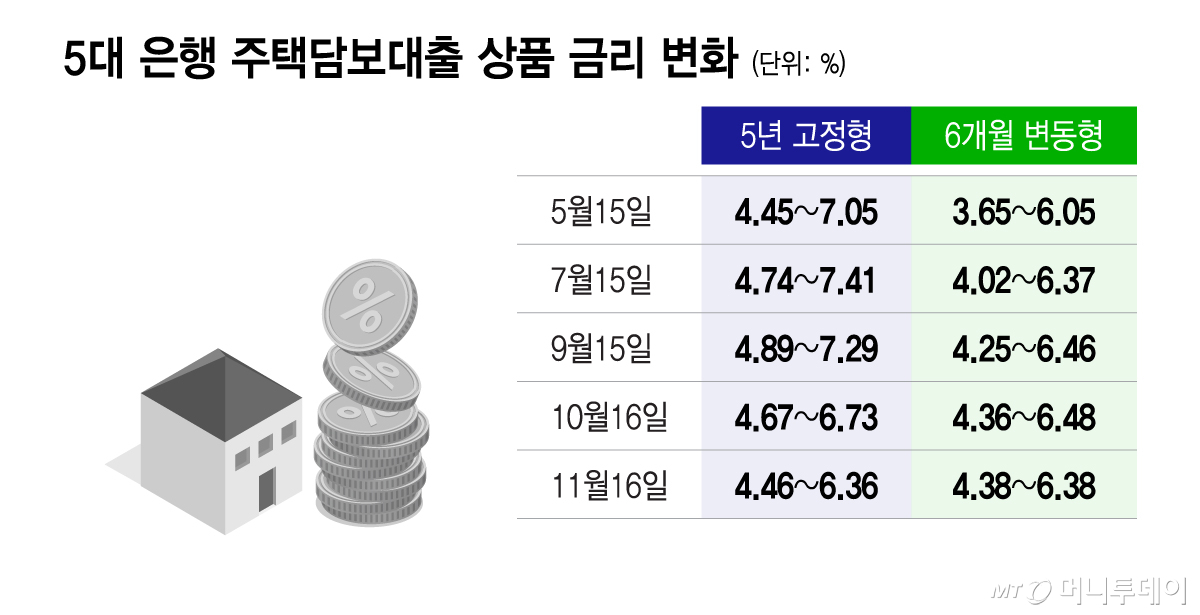
According to financial industry sources on the 16th, the upper limit for variable-rate home loan interest rates at the five major banks—KB Kookmin, Shinhan, Hana, Woori, and NH Nonghyup—reached an annual 6.38%, surpassing the fixed-rate upper limit of 6.36%. Typically, fixed-rate products, which can reduce interest rate fluctuation risk, are set at higher rates, but recently an "inversion" has occurred where variable-rate products have become more expensive.
The interest rates for these two product types have been moving in opposite directions since last September. The five-year fixed-rate home loan interest rates at the five major banks fell from 4.89% to 7.29% on September 15, to 4.67% to 6.73% on October 16, and to 4.46% to 6.36% on the 16th.
In contrast, the six-month variable-rate interest rates moved from 4.25% to 6.46%, then to 4.36% to 6.48%, and finally to 4.38% to 6.38% over the same period, with the lower bound rising by 0.13 percentage points over two months.
The diverging directions of fixed and variable rates are due to differences in interest rate calculation benchmarks and reflection timing. Fixed rates reflect changes in bond market interest rates relatively quickly. In contrast, COFIX reflects the costs of deposits, savings, and bank bonds actually raised by banks in the previous month. Even if long-term financial bond yields fall, if funding costs rise due to increased deposit rates, variable rates linked to COFIX can increase.
Variable rates are likely to continue rising for a while. The October new transaction-based COFIX announced by the Korea Banking Finance Association on the 16th was 3.62%, up 0.19 percentage points from the previous month. This is the highest level in two years and eight months since February 2024. Following a 0.25 percentage point increase last September, it has risen by a total of 0.44 percentage points over two months. KB Kookmin Bank and Woori Bank will raise variable-rate home loan interest rates linked to this COFIX by 0.19 percentage points starting on the 17th to reflect this.
As competition among banks to attract deposits continues, COFIX is also expected to face additional upward pressure. Shinhan Bank began additional special sales of its "Super SOL Welcome Time Deposit," which offers up to 4.0%, with the same limit after the initial sales limit of 500 billion won was exhausted early last month.
On the other hand, bank bond yields rose until September as expectations for domestic and global interest rate hikes were reflected, but fell after October when the government reduced treasury bond issuance and the stock market fluctuated, increasing demand for relatively safe bonds.
Amid this, new home loan processing is concentrated on variable rates. According to the Bank of Korea, the share of variable-rate home loans based on new transactions in September was 65.8%, up 1.1 percentage points from the previous month. The fixed-rate share decreased to 34.2%. As periods have emerged where even the initial interest rate for variable rates, which carry interest rate fluctuation risk, is higher than that of fixed rates, borrowers' choices have become more complex.
A banking industry official said, "Variable rates had the advantage of applying lower interest rates than fixed rates in exchange for bearing the risk of rising rates, but recently that difference has almost disappeared," adding, "Existing variable-rate borrowers may also face increased interest burdens when their rates are recalculated."

 in FINANCE
