

The Financial Supervisory Service will revive 'unannounced' on-site inspections targeting bank branches starting this week. High-risk branches, where external parties have been involved in financial fraud or where the risk of financial incidents is deemed high due to inadequate internal controls, were selected as the first targets.
This marks the first time in over 10 years that the FSS has conducted unannounced inspections targeting bank branches rather than headquarters. It is interpreted that the regulator aims to respond proactively with a focus on the field, given that recently surging financial incidents have repeatedly occurred at high-risk branches rather than headquarters.
According to financial industry sources on Monday, the FSS began surprise on-site inspections of one to two high-risk branches each at Shinhan Bank, Woori Bank, NH NongHyup Bank, and IBK Industrial Bank of Korea starting that day. Among the five major banks, all except KB Kookmin Bank and Hana Bank were selected for intensive scrutiny, while among state-owned banks, Industrial Bank of Korea became the first target.
The financial industry analyzes that a number of financial incidents involving external parties have recently occurred at these four banks.
Industrial Bank of Korea, Shinhan Bank, Woori Bank, and others disclosed that they had experienced financial incidents worth 18.2 billion won, 17.3 billion won, and 9.8 billion won, respectively, due to real estate fake sales fraud (external fraud) and other issues.
This was an organized loan fraud in which external real estate developers and brokers simultaneously breached the credit review processes at local branches by presenting fake sales contracts and other documents.
In particular, in the case of Industrial Bank of Korea, it was pointed out during the National Assembly's audit that additional loans were executed due to inadequate internal controls even after reporting financial incidents to the FSS, bringing management negligence issues under scrutiny.
Woori Bank disclosed 14 financial incidents in the first half of this year alone since the introduction of the accountability structure diagram, recording the highest number among the five major commercial banks. Incidents included not only external fraud but also employee embezzlement, most of which occurred at branch counters and were under 1 billion won each.
The FSS's move to conduct unannounced inspections directly targeting branches rather than bank headquarters or credit management systems is the first in about 10 years since 2015. In 2015, following the 'Financial Supervision Renewal and Operational Direction,' the regulator effectively abolished 'net-style inspections' targeting branches.
While it had conducted inspections of problematic branches during regular inspections after prior notice, it did not separately conduct unannounced checks.
The revival of unannounced branch inspections by the Financial Supervisory Service stems from its assessment that a significant portion of recently surging financial incidents are branch-level accidents resulting from negligence in internal controls.
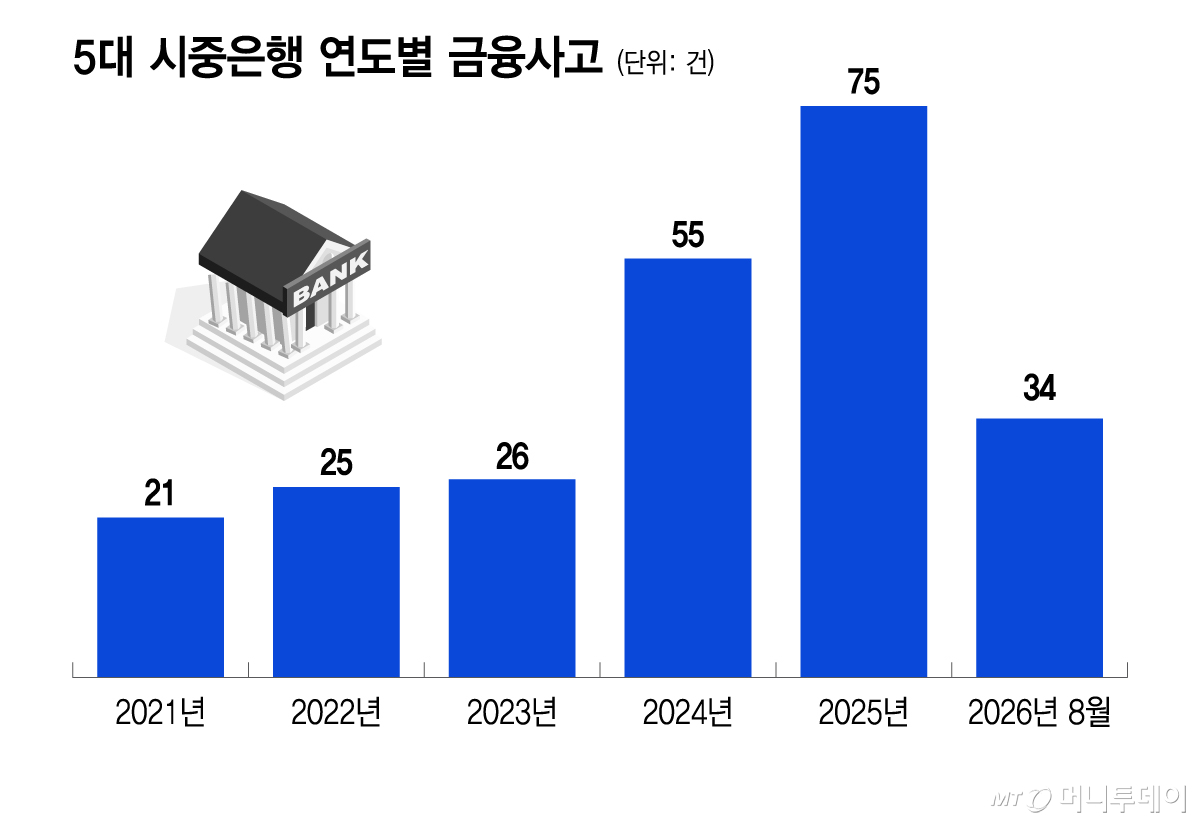
In fact, the number of financial incidents at the five major banks surged more than threefold from 21 cases in 2021 to 75 cases in 2025. This year, as of August, it has already recorded 34 cases.
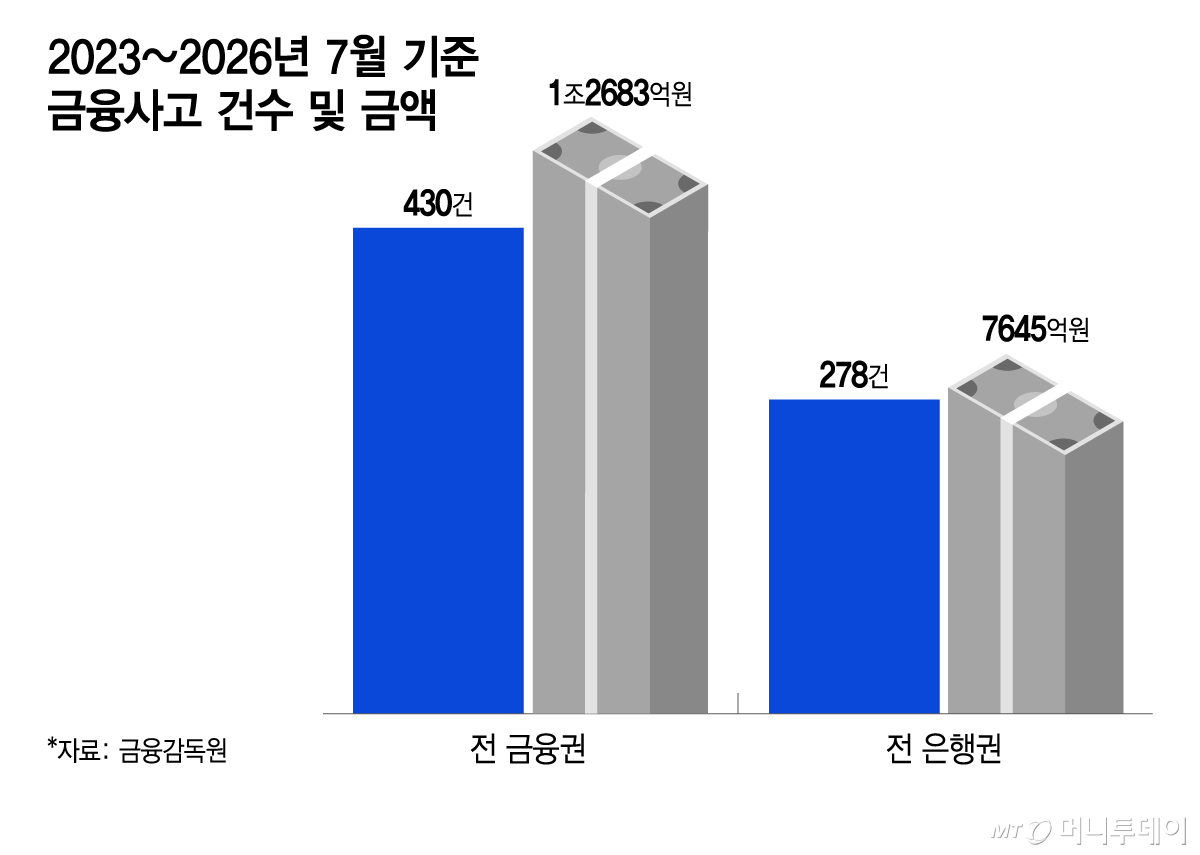
Among the total amount of financial incidents across the entire financial sector from 2023 to July 2026, which was 1 trillion 268.3 billion won, the share of the banking sector (764.5 billion won) exceeded 60%. It is explained that loan frauds involving collusion with internal bank employees and real estate sales frauds involving forged documents have occurred intensively at branches.
FSS Governor Lee Chan-jin also pointed out during the National Assembly's Political Affairs Committee audit on the 19th of last month, "Major incidents are occurring in areas similar to collective loans, such as loan fraud and so-called fake contracts, related to accidents happening at bank counters or external transactions," adding, "We assess that these arise from managing internal control systems from a cost perspective."
It is reported that the Financial Supervisory Service plans to expand the high-risk branch inspections targeting the four banks to the entire banking sector in the future.
It will first thoroughly check whether banks classified as having high-risk branches properly adhered to internal control procedures while handling large-scale credit. Fundamentally, the goal is to prevent financial incidents in advance by strengthening routine internal controls at branches, rather than imposing high-intensity direct sanctions.

 in FINANCE

