

"I'll never trade stocks again," as investors withdraw funds one after another... lump sums are flowing back "to this place."
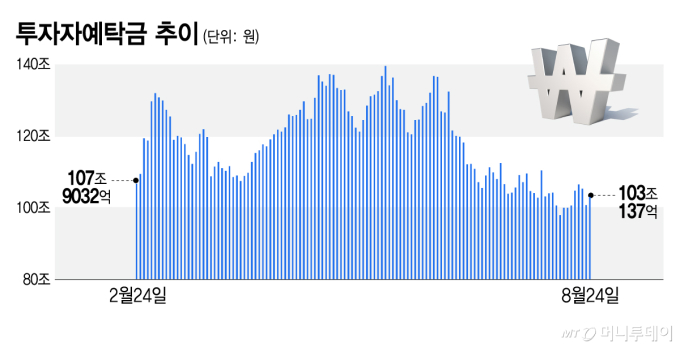
Stock market funds that once neared 140 trillion won have plummeted to the 100th trillion won range. Trading volume, which had surged to just under 200 trillion won, has also been cut by one-third. For two months during which the stock market, which had risen daily and surpassed the 9,000-point level, underwent a correction, liquidity in the stock market has sharply declined, dampening market vitality.
Investors exhausted by the roller-coaster market are reportedly moving their funds from the stock market to banks. The total balance of fixed deposits at the five major banks has surpassed 1 quadrillion won for the first time in history.
According to the Korea Financial Investment Association and others on the 25th, investor deposit balances stood at 103.136 trillion won as of the 24th. Notably, on the 11th, they recorded 97.9289 trillion won, falling below the 100th trillion won mark for the first time in six and a half months since January 26. Investor deposit balances refer to funds deposited by investors with securities firms for trading financial investment products such as stocks. In other words, it represents cash remaining in an investor's securities account and is generally regarded as standby capital for stock investments.
Typically, when stock trading is active, deposit balances increase. Since the beginning of this year, as the KOSPI index has risen daily and broke through the 9,000 mark by June, investor deposits have steadily increased, reaching a record high of 139.6947 trillion won on June 4. Following that, during the continued upward trend, deposits decreased slightly, but they have now dropped sharply amid the market decline in July.
The outstanding balance of credit trading loans, which had risen to the 38th trillion won level by the end of June, fell to around 27 trillion won at the beginning of this month. The outstanding balance of credit trading loans has dropped below 30 trillion won for the first time in six months. This appears to be the result of continuous warnings from financial authorities regarding overheating concerns in the stock market, including proactive management measures taken by the securities industry and strengthened regulations on single-stock leverage ETF (exchange-traded fund) trading.
Especially, the significant contraction in investor sentiment was largely influenced by concerns over AI (artificial intelligence) investments and the possibility of a semiconductor peak-out, which caused the domestic stock market to decline last month. At the end of July, the KOSPI index stood at 5,593.56, down 38.6 percent from its all-time high. Although it rebounded in August amid improving earnings, it has yet to succeed in recovering the 7,000 level.
Trading volume, a key indicator of market liquidity, has also dropped significantly, falling to one-third of its peak level. On the 24th, trading volume in domestic stock markets including KOSPI and KOSDAQ (including Next Trade) reached 63.124 trillion won. Although it had risen to 195.7 trillion won on June 1, it has been declining since falling below 100 trillion won on July 6.
Since the beginning of this month, as the KOSPI index has rebounded, market funds have begun to recover; however, with macroeconomic instability persisting due to geopolitical risks and interest rate uncertainty, a full-scale rebound is not expected. Instead, the market is likely to fluctuate based on specific events. Lee Jae-won, a researcher at Yuanta Securities, stated, "The market is expected to continue in a structure where high interest rates constrain the upside while corporate shareholder returns support the downside." He added, "While rising long-term interest rates and oil prices are familiar negative factors, further increases could burden supply-demand dynamics and valuations."
Investors seek safe-haven assets amid stock market volatility... Deposits rise, followed by increases in dollars and gold.
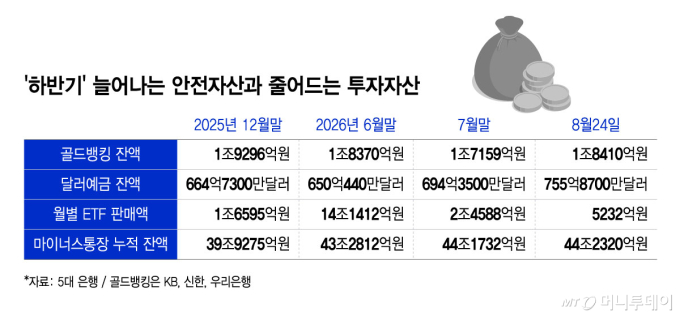
With time deposits at the five major banks surpassing 1,000 trillion won for the first time in history, capital flows toward safe-haven assets are spreading beyond bank deposits to include dollars and gold. As stock market volatility has increased, analysts say investors have paused investments in risky assets such as stocks, leading to a "reverse money move" where funds are being channeled into bank deposits, dollars, and gold.
According to the banking sector on the 25th, demand for safe assets has increased in the second half of this year, while demand for investment assets has declined. Following the milestone where fixed deposits at the five major banks (KB Kookmin, Shinhan, Hana, Woori, and NH NongHyup Bank) surpassed 1 quadrillion won, handling of traditional safe assets such as the U.S. dollar and gold has also risen.
The deposit balances of U.S. dollars at the five major banks increased by $615.2 million, rising from $69.435 billion at the end of last month to $75.587 billion on the 24th. Compared to $65.044 billion at the end of June, this represents an increase of $10.5826 billion over two months. This trend contrasts with the decline observed during the first half of this year from $66.473 billion at the end of last year.
This trend is also evident in gold. The gold banking balances of the five major banks decreased from 1.9296 trillion won at the end of last year to 1.8370 trillion won by the end of June and further to 1.7159 trillion won by the end of July. However, they increased to 1.8410 trillion won on the 24th, rising by 125.1 billion won in less than a month.
Jung Sun-mi of KB Gold & Wise The First Ban Po-sen-teo (Team Lead) stated, "Given the high market volatility and inflation, this is a period where we must focus on safe-haven assets in the medium to long term." She added, "Having experienced such a significant market downturn, funds that were waiting for opportunities have moved into principal-guaranteed products like deposits, while at the same time, there has been consistent demand for dollars and gold as hedge assets."
Indicators related to investment assets have shown a noticeable slowdown in their upward trend. Sales of ETFs (exchange-traded funds) by the five major banks plummeted from 14.1412 trillion won in June to 2.4588 trillion won in July, and as of the 24th of this month, sales reached only 523.2 billion won. This is merely one-fifth of the total sales volume for July. The balance of negative accounts, which had increased by more than 3 trillion won during the first half of the year, rose by just 58.8 billion won from 44.1732 trillion won at the end of July to 44.2320 trillion won on the 24th of this month.
The financial sector diagnoses that as stock market volatility expands, investors are shifting toward cashing out some of their existing assets or postponing additional investments in the stock market, while seeking to protect funds through deposits or find other means to generate returns.
Park Hyung-joong, an economist at Woori Bank, explained that "due to recent significant stock market volatility, funds from disappointed retail investors are flowing into deposits," and added that "demand for gold is also increasing amid expanding market volatility driven by stock market instability and rising bond yields."
Corporate funds are also flowing rapidly into the banking sector. In particular, it is understood that funds from companies with strong export performance in the first half of the year, such as semiconductors, have been heavily deposited into time deposits since July. Additionally, signs are emerging that securities firms, which recorded massive profits in the first half, are increasing their bank deposits in the second half.
A banking official stated, "As corporate surplus funds find it increasingly difficult to actively engage in investments or foreign currency management due to expanded exchange rate volatility, demand has reflected a tendency to remain in won time deposits while monitoring future market conditions." The official added, "At the same time, deposits at securities-affiliated banks are also growing rapidly."
Financial institutions expect that the increase or decrease in time deposits could change rapidly depending on market conditions in the second half of the year. Jung Sung-jin, deputy center manager of the KB Kookmin Bank Gangnam Star PB Center, said, "As time deposit interest rates have reached the high 3 percent range, there is a movement to sort out complex assets and take a break." He added, "There is strong demand for returning to safe assets and then moving back when market conditions improve later."
Stocks fall, prices rise... Shrinking wallets, savings also "plummet"
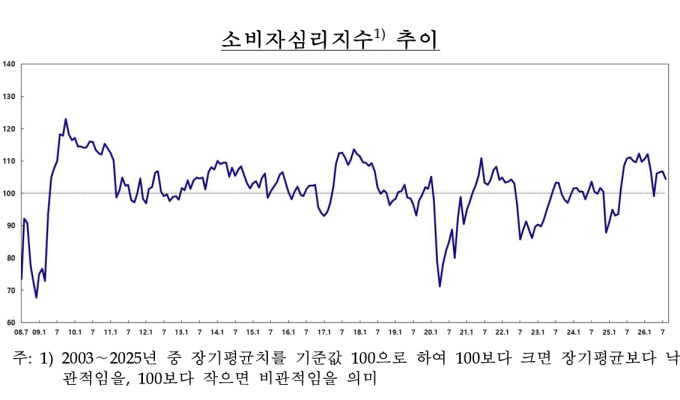
Consumer sentiment fell for the first time in four months amid a correction in the domestic stock market and the impact of accumulated inflation. Expectations for rising housing prices also softened somewhat due to the government's tax reform and measures to increase housing supply.
According to the "August 2026 Consumer Confidence Survey Results" released by the Bank of Korea on the 25th, the Consumer Confidence Index (CCSI) for this month stood at 104.5, a decline of 2.3 points from last month.
The Consumer Confidence Survey Index (CCSI) rebounded from 99.2 in April to 106.1 in May, then continued its upward trend to 106.6 in June and 106.8 in July, but fell this month for the first time in four months. A reading above 100 indicates that consumer sentiment is more optimistic than the long-term average.
The Bank of Korea analyzed that despite sound real economic trends, the domestic stock market is undergoing a correction and cumulative price increases have worsened consumers' perceived economic conditions.
Park Yong-min of the Bank of Korea explained that "although the July consumer price inflation rate fell from 3.2% to 2.8%, living costs had shown a high upward trend for some time, and this impact accumulated, leading to a perceived deterioration in the economy."
He added, "Even if the expected inflation rate declines, consumers may feel burdened when spending if the overall price level remains high." He also noted that follow-up monitoring of respondents revealed recent answers indicating that the current price level is perceived as high.
The six indices comprising the CCSI all fell simultaneously. The Current Economic Conditions CSI dropped to 79, marking a five-point decline from one month ago—the largest drop among the indices. This was influenced by an increase in consumers evaluating current economic conditions pessimistically amid expanding stock market volatility.
The CSI for future game outlooks fell by three points to 89. The current living conditions CSI and the outlook for living conditions CSI each declined by one point to 92 and 97, respectively. The household income outlook CSI dropped by one point to 100, while the consumer spending outlook CSI fell by one point to 109.
The current household savings CSI fell 3 points to 94, reaching its lowest level since May of last year. Team Leader Park stated, "In the consumer sentiment survey, savings include not only bank deposits and time deposits but also stocks and funds," adding that "the decline in stock prices is interpreted as having a negative impact on current household savings."
The Employment Opportunity Outlook CSI fell by three points to 86, attributed to continued declines in employment numbers in the manufacturing and construction sectors, as well as persistent weak youth hiring in industries with high exposure to artificial intelligence (AI).
Team Leader Park stated, "Employment prospects have declined across all age groups, with a slightly sharper drop among those under 40," adding that this appears to be the result of a combination of factors, including companies' strengthened preference for experienced hires, employment adjustments following the pandemic, and workforce displacement due to AI.
Consumer expectations for rising housing prices have declined for the first time in five months. The Housing Price Outlook CSI stood at 125, down two points from last month. This index had risen sharply since March, moving from 96 to 104 in April, 112 in May, 120 in June, and 127 in July.
The Bank of Korea analyzed that expectations for rising housing prices have somewhat eased since August, following the announcement of tax reform and measures to increase housing supply. However, the index itself remains significantly above the baseline of 100, indicating that forecasts predicting a rise in housing prices one year from now remain dominant.
The interest rate outlook CSI fell by one point to 125. A reading above 100 indicates that more consumers expect interest rates to rise in six months compared to the current level.
The expected inflation rate, which forecasts the consumer price index increase over the next year, stood at 2.7%, unchanged from last month. While the ongoing stalemate in the Middle East conflict acted as an upward pressure on prices, expectations of base rate hikes and a downward trend in the won-dollar exchange rate offset this effect. The expected inflation rates for three years and five years ahead also remained at 2.6%, matching the previous month's levels.
Team Leader Park said regarding the impact of the stock market correction on consumption and prices, "It may have a short-term effect on consumer sentiment, but the real economy is currently showing a positive trend centered on exports and investment," adding, "It remains questionable whether it will constrain the ripple effects that reach income and consumption."

 in FINANCE


