

[For more diverse corporate information on the startups featured in this article, visit the Unicorn Factory big data platform ‘Data Lab’.]
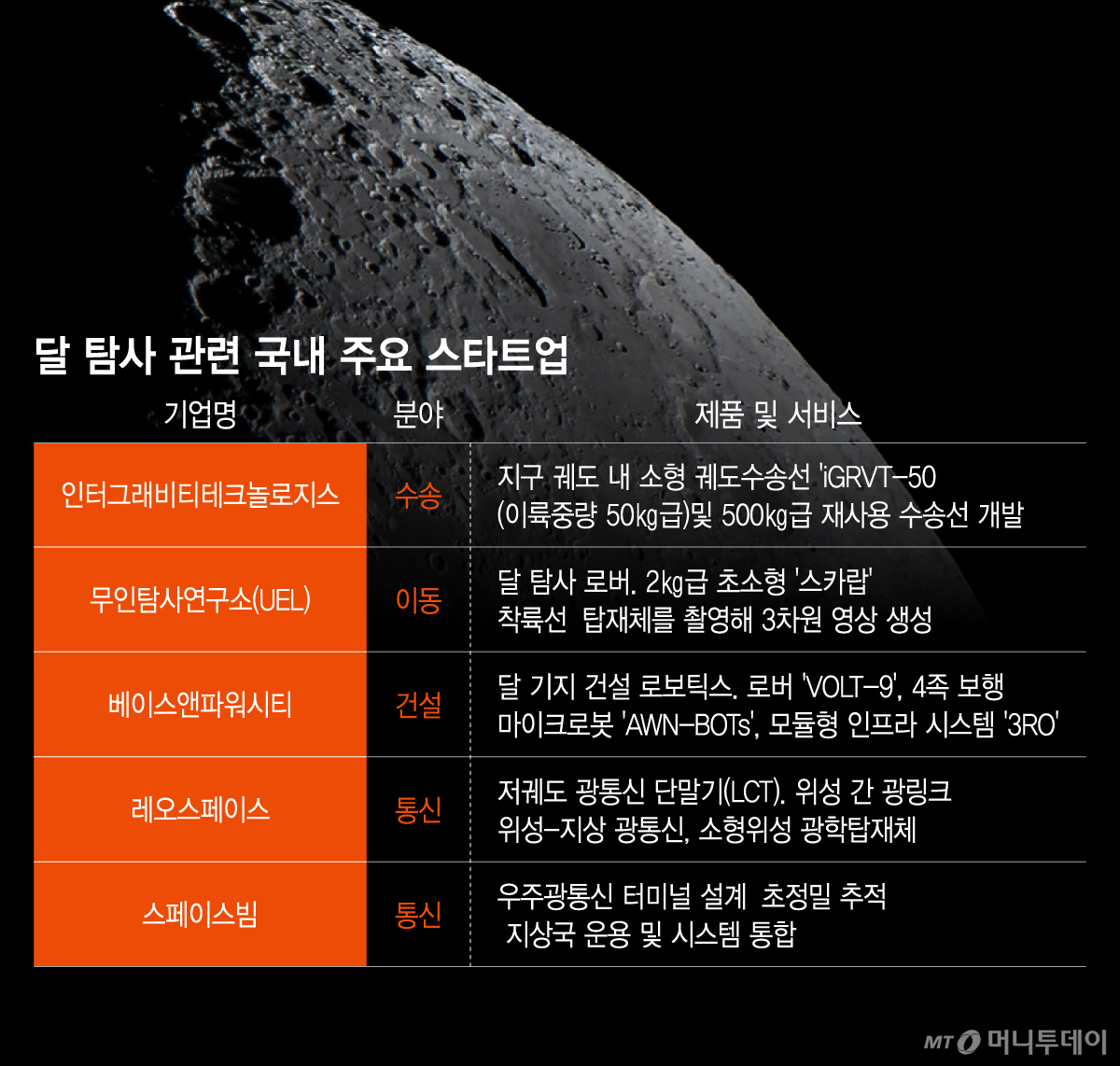
As Hanwha Aerospace pushes forward with the development of an orbital transport vehicle heading to space in 2029, space startups are also accelerating their efforts, dividing roles across transportation, mobility, and communications in line with the lunar exploration timeline set for a 2029 orbital transport vehicle and a 2030 lunar lander.
While large-scale projects commissioned by the state are typically secured by major corporations, startups are building early demonstration track records in areas where ownership has yet to be determined, such as small orbital transport vehicles, ultra-small rovers, and optical communication payloads.
Intergraviity Technologies completed combustion tests of two 20-newton-class thrusters at its test site in Taean, Chungcheongnam-do Province, last May. The company recorded a cumulative burn time of 500 seconds through individual and simultaneous ignition tests. This process serves to verify the operational reliability of the orbital transport vehicle model and the feasibility of integrated system operations. It is an achievement secured within just over a year after Lee Gi-ju (CEO), who had worked on launch vehicles and engines at the Aerospace Research Institute for 12 years, founded Intergraviity in April 2024.
Intergraviity’s primary goal is to launch its 50-kilogram-class takeoff weight ‘iGRVT-50’ in 2027 to verify orbital insertion precision and propulsion systems in space. Unlike Hanwha Aerospace’s lunar orbital transport vehicle, which travels to the moon, this is a commercial transport vehicle that moves satellites within Earth orbit.
The company plans to launch a 500-kilogram-class reusable transport vehicle before 2029. Last year, Intergraviity was consecutively selected for the Ministry of SMEs and Startups’ technology startup support programs, Deep Tech Tips and Scale-up Tips, and raised an 8 billion won Pre-Series A investment in April this year. In May, the company participated in the Korea Aerospace Research Institute’s ‘Lunar Orbital Communication Satellite Corporate Consultation,’ followed by the ‘Corporate Consultation for Expanding Lunar Economic Territory’ in July.
Unmanned Exploration Laboratory (UEL) signed a Payload Service Agreement (PSA) with Japan’s iSpace in March last year for the transportation of a lunar exploration rover. Accordingly, UEL’s rover ‘Scarab’ will be carried on iSpace’s ULTRA lander, which is scheduled to launch toward the moon in 2028, and is expected to become Korea’s first lunar surface exploration rover. Scarab is an ultra-small micro-rover weighing approximately 2 kilograms. It performs a mission of using two cameras to photograph the remaining payloads that arrived with the lander that carried it, creating three-dimensional video.
UEL received an 12.1 billion won Pre-Series A investment in August last year, securing demonstration funds for 2027–2028. Last month, the company partnered with simulation firm Simtural to begin work on implementing lunar environments in virtual space to generate data for rover artificial intelligence (AI) training.
Base and Power City unveiled a process simulating lunar surface operations by a quadruped walking robot and a rover at ‘Aerotech 2026,’ held last month at the Changwon Convention Center in Gyeongsangnam-do Province. The products revealed at the time were the rover ‘VOLT-9,’ the microbot ‘AWN-BOTs,’ and the modular infrastructure system ‘3RO.’ Base and Power City is jointly developing exploration and construction robotics with Hyundai Motor Group, targeting lunar base construction, and has also been selected for the European Space Resource Innovation Center program.
In the communications sector, an optical communication terminal passed ground verification this year. LeoSpace, which manufactures equipment for laser communication between satellites, is transitioning to the orbital demonstration stage. The company raised an 8 billion won Series A investment in June last year, surpassing 10 billion won in cumulative investment within just over four years of its founding, with Context and AP Satellite joining as strategic investors.
Space Beam began joint development of an optical communication payload for high-speed data transmission between the moon and Earth with Green Optics in May last year. This initiative is based on the company’s track record of successfully demonstrating 1Gbps-class laser communication over a distance of 64 kilometers. LeoSpace and Space Beam sat side by side with AP Satellite, KAI, and Hanwha Systems at the Korea Aerospace Research Institute’s Lunar Orbital Communication Satellite Consultation in May.
An industry official predicted, “If the 2029 communications satellite and 2030 lander projects are opened for public bidding, these startups will have a path to participate as members of major corporate consortiums,” adding, “Since those who build their track record first hold an advantage, related startups will accelerate their demonstration efforts until the public bidding opens.”
[Money Today Startup Media Platform Unicorn Factory]

 in FUTURE
