

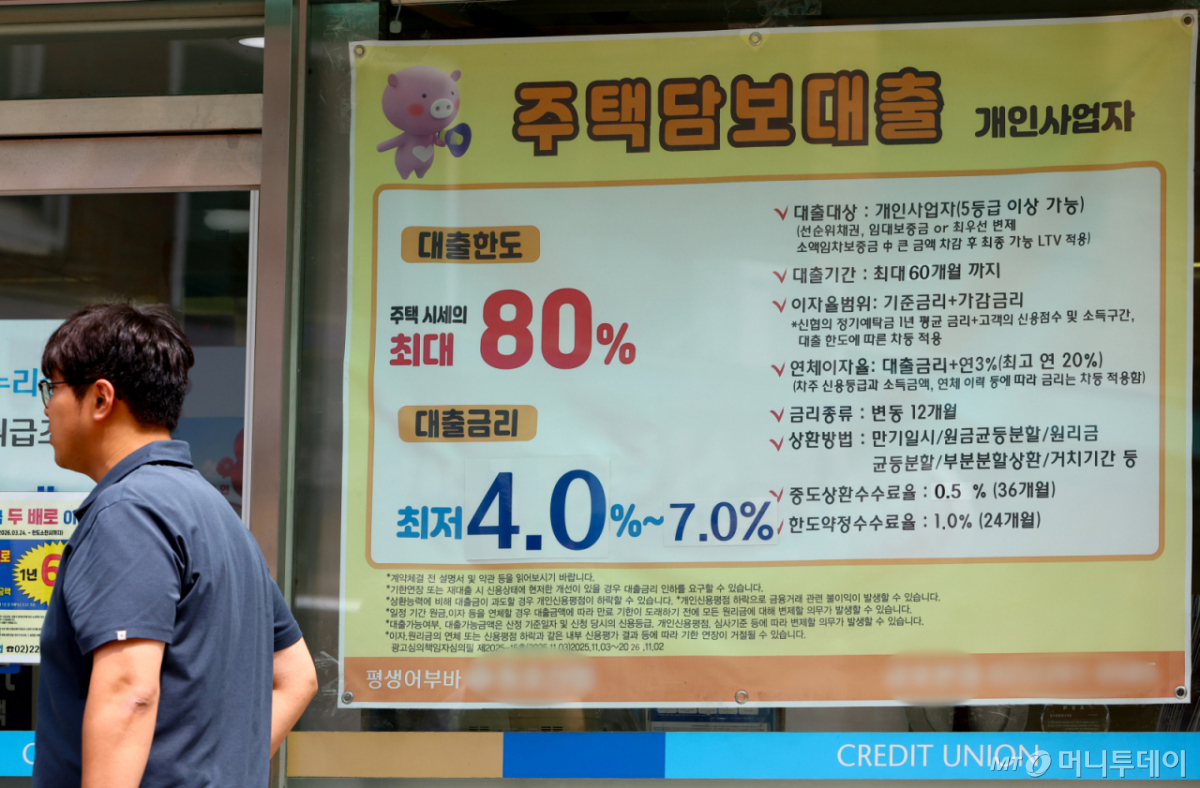
Bank lending rates are preparing to rise again. The Bank of Korea raised its base rate to 3.00%, amid market volatility driven by rising U.S. Treasury yields. Already, the upper limit for mortgage loan rates at five major banks has exceeded 7%, and credit loan rates are on the verge of entering the 6th% range.
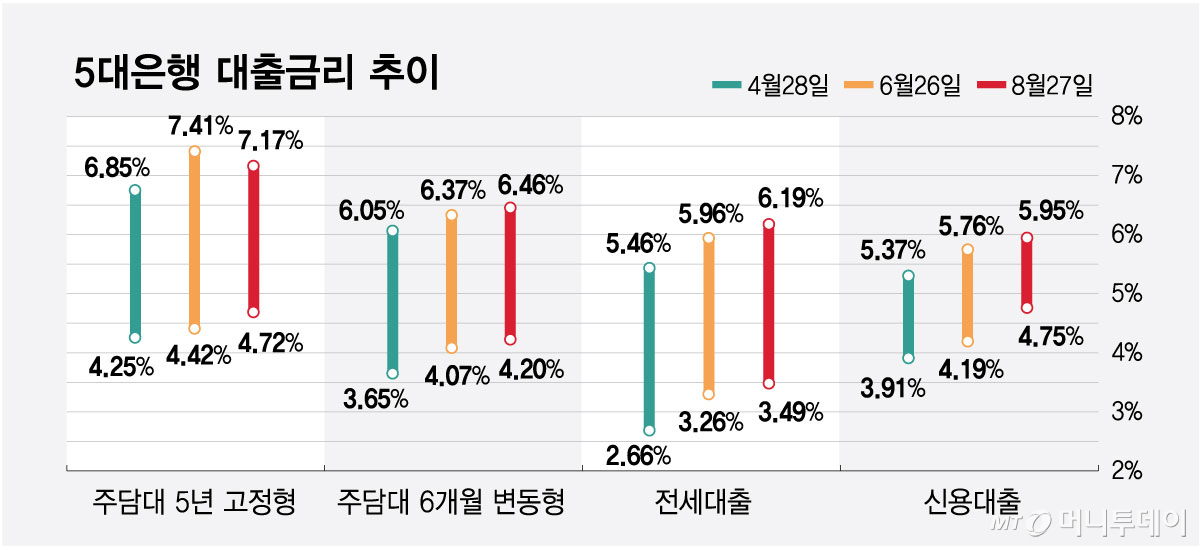
According to the financial sector on the 27th, the five-year fixed-rate mortgage loans at KB Kookmin, Shinhan, Hana, Woori, and NH NongHyup Bank were recorded between 4.72% and 7.17% as of that day. Compared to two months ago (4.42–7.41%), the lower bound rose by 0.30 percentage points (P). The decline in the upper bound was due to NH NongHyup Bank lowering its mortgage loan rates by 0.4–0.5%P after lifting household loan restrictions on the 20th. Compared to four months ago (4.25–6.85%), the lower rate increased by 0.47%P and the upper rate by 0.32%P, indicating a continued upward trend in interest rates since the second half of the year.
In addition, with the Bank of Korea raising its base rate from 2.75% to 3.00% on this day, further upward pressure is expected on loan rates. A bank official stated, "With the base rate hike and rising market interest rates originating from the U.S., it will be difficult for loan rates to drop significantly in the near term," adding, "If additional increases continue, there is a possibility that the upper limit of mortgage loan rates could reach 8%."
If loan rates rise to 8%, borrowers' interest burdens will increase significantly. A simple calculation assuming an average mortgage loan amount of 200 million won borrowed at an 8% rate shows annual interest alone would reach 16 million won, or 1.33 million won per month. Under the principal-and-interest installment repayment method, actual monthly payments would be even higher.
When the base rate rises, there is a possibility that market interest rates will continue to climb further. The five-year bank bond yield, which serves as the benchmark for fixed-rate mortgages, has been trending upward recently due to movements in U.S. Treasury yields. The five-year bank bond yield was 4.531% on the 24th of last month, dropped to 4.243% by the 5th, surpassed 4.4% on the 21st, and closed at 4.359% on the 26th.
Variable-rate mortgage loan rates also face a possibility of further increases. The COFIX rate, which serves as the benchmark for variable-rate mortgages, is influenced by deposit rates; when the base rate rises, banks collectively raise their deposit rates. According to the Bankers Association, based on new transaction amounts in July, COFIX stood at 3.18%, up 0.13%P from the previous month.
Variable-rate mortgage loan rates at the five major banks reached between 4.20% and 6.46% as of this day, climbing to the mid-6% range. Compared to two months ago (4.07–6.37%), both the upper and lower bounds rose by 0.09%P and 0.13%P, respectively.
Notably, in new mortgage loans issued by banks last month, the share of variable-rate loans reached 68.1%, marking the highest level since February 2014, approximately 12 years ago, suggesting borrowers' interest burdens will grow further.
Credit loans are also approaching entry into the 6th% range. The upper limit for credit loan rates at five major banks has already risen to 5.95%. Credit loans have a shorter adjustment cycle than mortgages, meaning market rate changes are reflected immediately.
Household loan management by banks is also acting as a factor driving interest rate increases. Although financial authorities relaxed the annual target for total household loan volume this year, banks must adjust their lending pace to meet yearly targets. If loan demand surges, they may manage rates by reducing preferential rates or increasing additional fees.

 in FINANCE

