

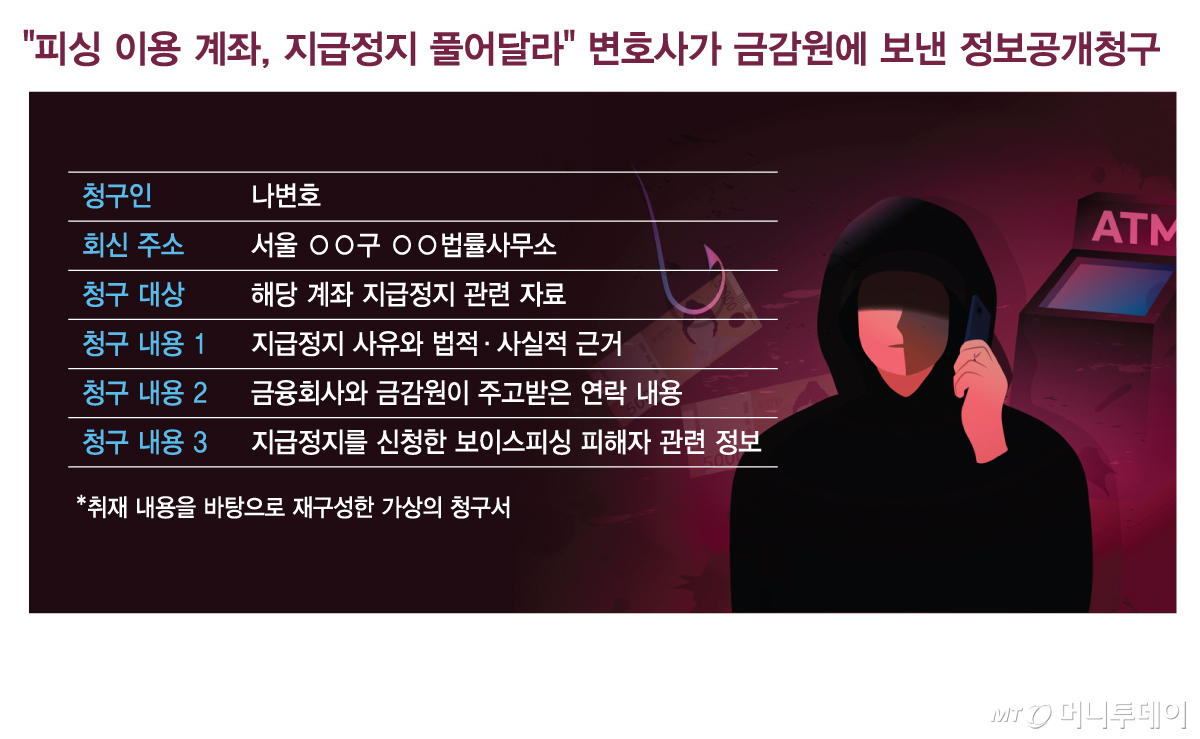
As funds from voice phishing victims are frozen, cases are increasing where the account holders of accounts linked to financial fraud hire lawyers to file complaints with the Financial Supervisory Service demanding that the payment freeze be lifted. In addition to requesting information disclosure on the grounds for the freeze and communication records between financial institutions and the Financial Supervisory Service, some have even requested the identity of the victims who applied for the freeze.
According to financial authorities on the 2nd, at the Financial Supervisory Service's department responsible for responding to financial fraud, one staff member reviews approximately 80 complaints per day on average. While there are cases where account holders who unknowingly had their accounts used in crimes request the lifting of payment freezes, officials note that a significant number of complaints also come from individuals who transferred accounts to voice phishing organizations or from perpetrators of financial fraud.
Some parties seek specific information from the Financial Supervisory Service to lift the freeze on bank accounts where criminal proceeds are locked. They demand documents detailing why an account was frozen, the legal and factual grounds for the freeze, and records of communications between financial institutions and the Financial Supervisory Service during the freezing process. It is reported that some cases even involve requests for information disclosure regarding the identity of the victims who applied for the freeze.
Recently, lawyers have begun appearing directly as representatives. Repeatedly, when checking the name of the information disclosure requester on legal information websites, they are identified as practicing attorneys, and the addresses listed on the requests are law firms or offices rather than private residences.
Inside the Financial Supervisory Service, there is close scrutiny of complaint contents to determine if the purpose extends beyond simple rights protection to pressuring victims into settlements or securing information needed for future investigations or dispute resolution. This is because those involved in financial fraud may be utilizing complaints and the information disclosure system as a means to lift payment freezes on accounts where criminal proceeds are locked.
One account frozen every three minutes... Criminals seeking to recover illicit profits
From the perspective of criminal organizations, whether a payment freeze is lifted determines if they can recover their illicit profits. As victims transfer money across multiple accounts, if financial institutions freeze intermediate accounts suspected as voice phishing conduits, the remaining funds cannot be withdrawn further.
The scale of payment freezes implemented within the financial sector is substantial. According to data submitted by Park Sung-hoon, a People Power Party member of the National Assembly's Political Affairs Committee, the number of payment freezes at the top 20 financial institutions surged 83% from 70,151 cases in July 2024 to 128,374 cases last year. In the first quarter of this year alone, 44,068 cases were processed. This averages about 490 cases per day, or one account frozen every three minutes. In the first quarter of this year alone, 34% of last year's annual total number of payment freezes occurred.
Payment freezes are also a key mechanism for compensating victims. From 2022 through the first quarter of this year, out of 1.7731 trillion won in voice phishing losses, only 398.6 billion won has been refunded, meaning approximately 22.4% of total losses have returned to victims.
Among account holders whose accounts were frozen, some cases involve funds being used for money laundering while conducting second-hand transactions or paying for goods, making it difficult to restrict complaints or objections outright. The Financial Supervisory Service is carefully reviewing the contents of such complaints and information disclosure requests in light of these circumstances.

 in FINANCE
