

The banking sector is also not free from the burden of the government's "strict administrative punishment." More than 97% of accounts affected by the incomplete sales of Hong Kong H-Index-linked equity-linked securities (ELS) agreed to voluntary compensation, and although the Fair Trade Commission determined it was difficult to accurately calculate the damages suffered by borrowers in the Loan-to-Value (LTV) information exchange cartel, fines totaling hundreds of billions of won were anticipated. Excessive fines are reducing the capacity for productive finance that supplies capital to companies and inclusive finance that supports vulnerable groups.
According to the financial sector on the 6th, the Financial Services Commission is reviewing a proposal to impose fines on five banks that sold Hong Kong ELS: KB Kookmin Bank, Shinhan Bank, Hana Bank, NH Agricultural Cooperative Bank, and Standard Chartered Bank Korea. The fine amount was initially around 2 trillion won during the Financial Supervisory Service's prior notification stage but was reduced to 1.4 trillion won after going through the Sanction Deliberation Committee. Later, as the Financial Services Commission requested supplementary information on legal grounds and factual circumstances, the Financial Supervisory Service conducted a rehearing, resulting in the fine being reduced to approximately 600 billion won.
However, opinions within the banking sector still describe the fines as "punitive in level." The five banks sold about 19 trillion won worth of Hong Kong ELS over four years from 2021, earning approximately 200 billion won in commission revenue. They are now facing a situation where they must pay fines amounting to roughly three times their earnings.
There is also dissatisfaction that although financial authorities revised regulations last November to include post-harm relief as a ground for reducing fines, this was not sufficiently reflected. The five banks that sold ELS had already reached voluntary compensation agreements with 162,973 out of a total of 169,594 accounts by June last year, before the fines were notified. As of the end of January this year, agreements on compensation had been reached with 164,845 accounts (97.2%).
Criticism is also raised that the LTV cartel fine is excessive compared to the actual benefits gained by the banking sector. The Korea Fair Trade Commission imposed a total fine of 272 billion won on Kookmin Bank, Shinhan Bank, Hana Bank, and Woori Bank, stating that they exchanged LTV information from 2022 to 2024, generating a total interest income of 6.8 trillion won through real estate collateral loans. However, the Korea Fair Trade Commission admitted that "it is difficult to accurately calculate the damages suffered by borrowers in monetary terms" and acknowledged that the actual scale of profits resulting from the cartel could not be determined. The banking sector argues instead that their profits related to lending decreased because they lowered LTVs through information exchange.
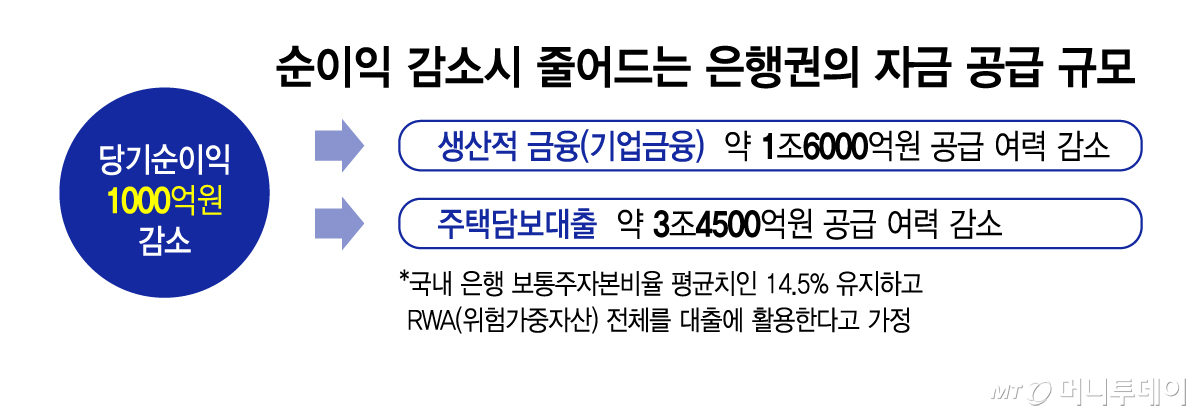
In addition, the deliberation results regarding the banking sector's government bond cartel are expected to be announced soon. Fines may also be imposed. Consecutive fines negatively impact not only bank profitability but also "productive finance," a key government initiative. Assuming a simple scenario where net profit decreases by 100 billion won and domestic banks maintain their CET1 ratio at an average of 14.5%, it would require reducing RWA by approximately 690 billion won or raising additional capital. Converting this to corporate loans with a risk-weighted asset level of around 43% indicates a reduction in lending capacity of about 1.6 trillion won. In particular, SMEs (small and medium-sized enterprises) lacking sufficient collateral or with low creditworthiness, as well as early-stage innovative companies with strong technology but weak financial structures, may be more significantly affected by the contraction in capital supply.
Inclusive finance is also affected by capital capacity. Low-to-medium credit borrowers and small business owners are borrowers for whom banks face significant capital burdens due to their relatively higher risk of loan defaults. If banks adjust their loan assets to meet capital ratio requirements, they may operate more conservatively regarding new loans or maturity extensions for these groups.
A banking sector official stated, "The banking sector has already set aside over 1 trillion won in provisions for ELS and LTV," adding, "Exhausting the banking sector's capital capacity through fines while simultaneously calling for an expansion of productive finance is logically inconsistent from a policy perspective."

 in FINANCE
