

[For more diverse corporate information about the startup featured in this article, please visit the Unicorn Factory big data platform 'Data Lab'.]
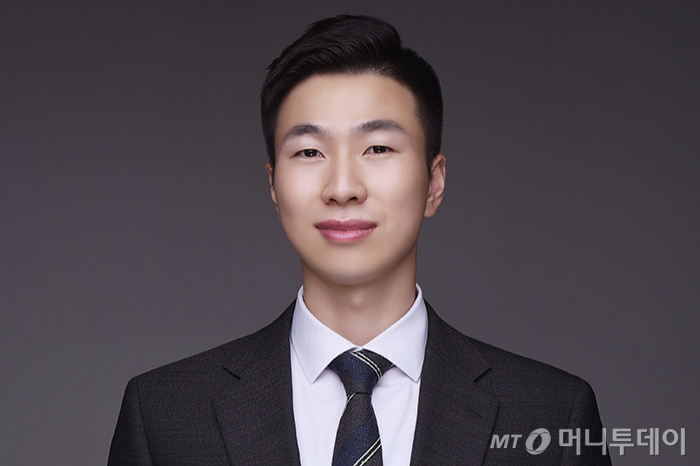
"Whether it is a financial institutional investor or a general enterprise, the core items examined when assessing risk are largely the same. The only differences lie in the applied criteria and figures. If relevant data and judgment criteria are standardized and structured, any institutional investor can input the necessary values to conduct consistent analysis. We aim to become an AI (artificial intelligence) agent company that finds such data and builds the infrastructure."
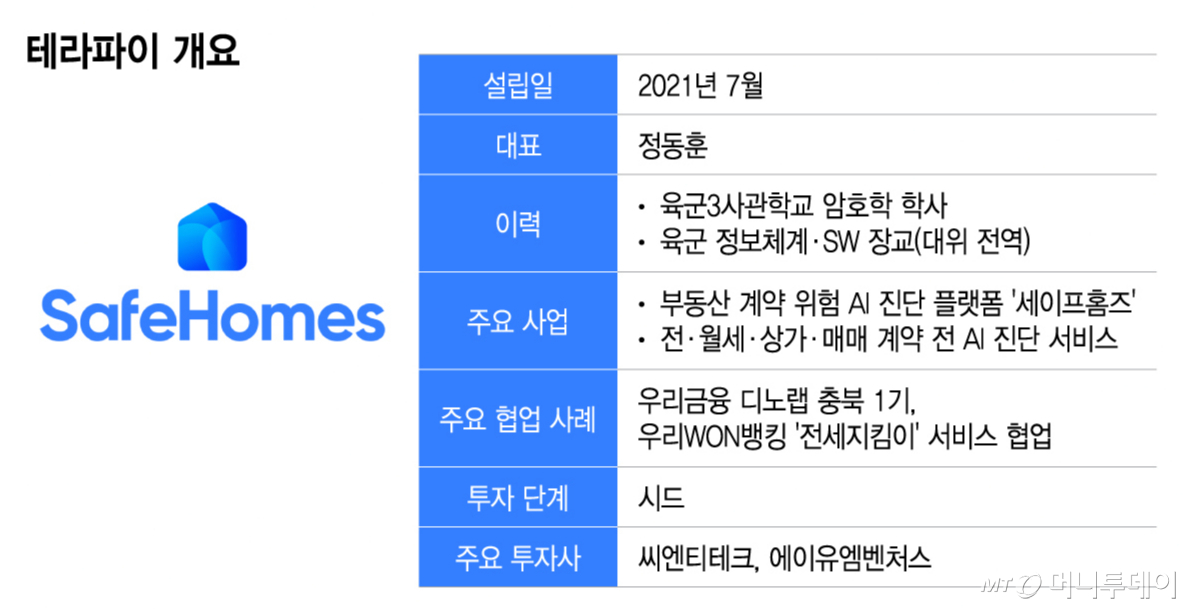
Jeong Dong-hoon of TechRafah Lee (CEO) described the direction the company is heading in these terms. TechRafah is a proptech startup founded in 2021 by Jeong (CEO), a former military officer. The company name combines 'Terra,' meaning land, and 'Fi,' meaning finance. At a time when jeonse fraud prevention services were rare, it launched 'SafeHomes,' which diagnoses risk factors before contract signing. Starting with a service that checks the risks of individual monthly or deposit lease contracts, the company is expanding its business scope to commercial lease management, sales, and corporate real estate management.
TechRafah, a selected company in Woori Financial Group's startup incubation program 'Dinno Lab,' supplied four services through Woori Bank's WON Banking application, starting with 'Jeonse Guardian.' Currently, it operates the △Monthly/Deposit Lease AI Guardian, △Commercial Office AI Guardian, △Real Estate Sales AI Diagnostic Tool, and △Real Estate AI Guide services.
Jeong (CEO) said, "Since the app has a very large user base, inflow through WON Banking is substantial." This year, TechRafah also received an Excellent Collaboration Award at the D-Camp Open Innovation event in partnership with Woori Bank.
Utilizing auction and guarantee incident data… Calculating 'conservative recovery benchmark price'
Jeong (CEO) cited the capability to process and handle diverse real estate data as TechRafah's core competitive strength. The real estate valuation model introduced for commercial and corporate real estate lease management is a prime example. While many companies create Automated Valuation Models (AVMs) that estimate market prices, few calculate recoverable asset prices when problems arise.
TechRafah calculates a 'conservative recovery benchmark price' based on auction, public sale, and guarantee incident data accumulated over 20 to 30 years. It uses the lower of the AI-estimated lower value of the price distribution and the expected auction winning bid as the baseline. The less frequently a building is traded, making it difficult to gauge market prices, the more conservatively it is evaluated. Jeong (CEO) stated, "Existing services find it difficult to diagnose high-difficulty properties such as single-family homes or commercial spaces," adding, "We hold market price models for land, commercial spaces, and housing."
This approach is also applied to real estate sales diagnostics. Even if an apartment has a market price of 1 billion won, if it is expected to be sold at auction for 700 million won, the recovery benchmark price is set at 700 million won. Based on this, the company checks whether the actual transaction price significantly deviates from the appropriate range. It also provides a function that displays areas where prices have surged in a short period using a bubble index.
Commercial space diagnostics include not only pricing but also a feature to determine whether specific business types can operate at a given location. This is because certain industries may be prohibited from entering due to educational environment protection zones or district unit plans. It checks industry-specific usage and licensing conditions, as well as facility requirements such as noise levels, illegal building status, and ventilation.
He noted, "Real estate agents sometimes do not know the regulations or say it is fine because a similar business type existed there before," adding, "Although rare, there are cases where lease contracts are canceled because licensing is not granted even after interior work is completed."
"Final judgment is made by humans; the rest is handled by AI"
Based on this data capability, TechRafah is expanding its scope in the B2B market. Recently, it signed a contract with a major domestic retail company to diagnose and manage lease risks for commercial spaces and offices. It utilized SaaS (Software as a Service) that standardizes and applies different real estate management guidelines for each enterprise. It is also conducting a Proof of Concept (PoC) with one commercial bank to integrate TechRafah's judgment engine into internal operations.
The core foundation for B2B expansion is the technology for structuring real estate information. Based on nationwide building registers and land data, it built a knowledge graph that connects and analyzes real estate risk factors. Diagnostic results are categorized not as simple scores but as 'Proceed,' 'Proceed after action,' 'Additional confirmation needed,' or 'Proceed with restrictions,' presenting the basis for judgment and items requiring further verification. It records the data and criteria used during diagnosis so that the judgment process can be tracked even if conditions change later.
Leveraging its experience in structuring data into AI-friendly formats from existing services, TechRafah is accelerating new business initiatives. Representative examples include 'Market Sensing,' which grasps market trends, and GEO (Generative Engine Optimization), which helps content be well-exposed in generative AI searches. Jeong (CEO) said, "Even if you ask ChatGPT or Gemini to 'recommend an officetel two-room unit,' almost no property information is provided," adding, "We directly applied the technology that processes scattered information so AI can read it here."
In the long term, the goal is to refine this technology and grow into an AI agent company. First, it plans to secure a leading position in the financial and corporate risk agent market by leveraging domestic real estate data, which is difficult for general-purpose AI to handle, as a competitive strength. Jeong (CEO) stated, "If an agent asks 'Is this property okay?' during a bank loan process, our risk agent will answer with supporting evidence, and as these records accumulate, it becomes possible to handle audit responses," adding, "Beyond real estate, we will leap forward into a comprehensive agent company that discovers market demand and customer problems through data and has AI assist from judgment to execution."
[MoneyToday Startup Media Platform Unicorn Factory]

 in FUTURE

