

Amid large-scale hacking incidents leveraging artificial intelligence (AI) targeting the financial sector, it was confirmed that only one figure from the financial industry is among the 56th members of the National AI Strategy Committee (hereinafter referred to as the AI Strategy Committee), which oversees national AI policy. As security threats exploiting AI have become a reality while the AI Basic Act and the AI Strategy Committee place emphasis on cultivating the AI industry, there are calls for more actively reflecting the financial sector’s security experience and voice in national AI policy.
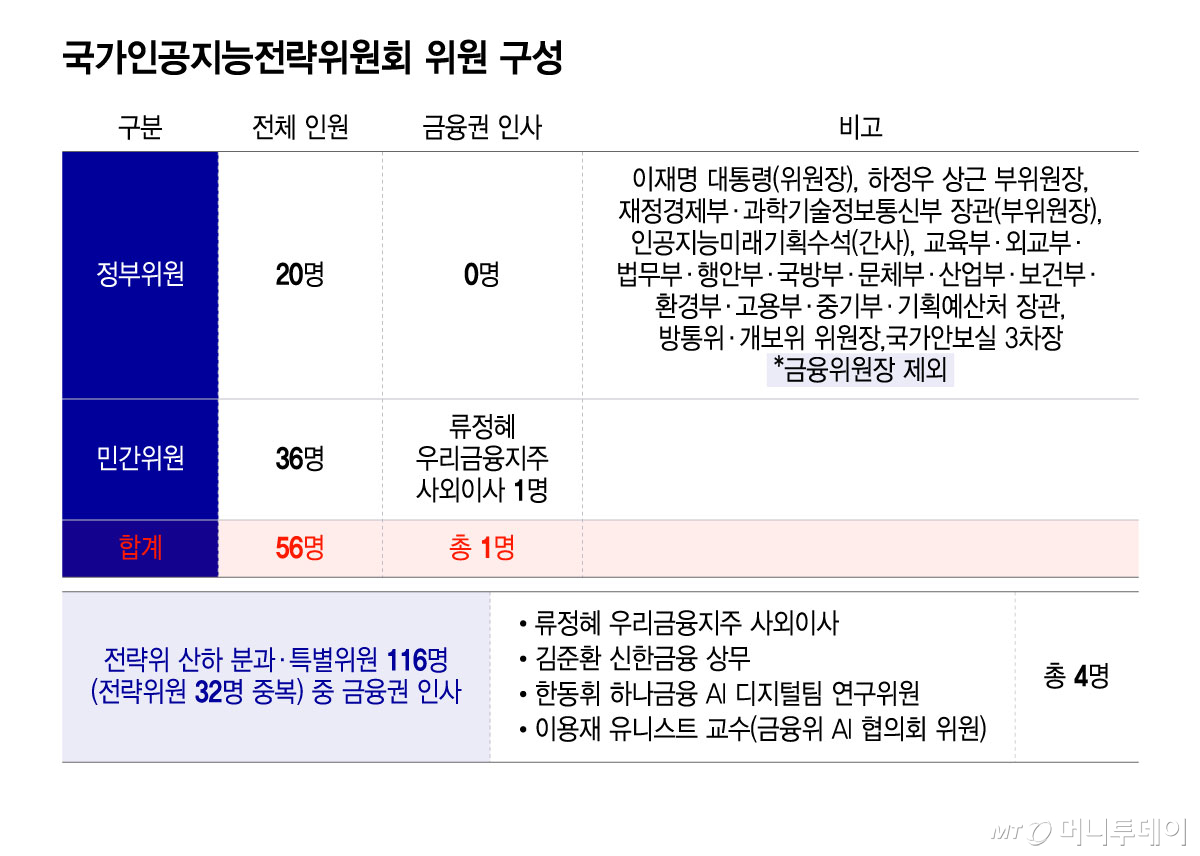
According to the AI Strategy Committee and the financial sector on the 7th, among the current 56 strategy committee members, only one person is employed in the financial industry: Ryu Jeong-hye, an outside director at Woori Financial Group. The head of the financial regulatory authority, the Financial Services Commissioner, is also excluded from the committee.
The AI Strategy Committee consists of 20 government officials and 36 private sector members, including President Lee Jae-myung and Executive Vice-Chairman Ha Jeong-woo. The private sector members are largely composed of experts from industry sectors such as AI, IT (information technology), software, semiconductors, and manufacturing, as well as universities and research institutions. Even Director Ryu, who is currently employed at a financial company, is not a figure with a career built in the traditional financial sector. An IT expert who has been in charge of AI operations at platform companies such as Naver, she joined Woori Financial Group as an outside director this March.
The Financial Services Commissioner is also absent from the government officials. Notably, while the Minister of Justice and the Chairman of the Broadcasting, Media and Communications Commission were not present during last year’s legislative notice period, they were added as government officials in the final enforcement decree, but the Financial Services Commissioner was ultimately not included. It is known that this reflects a perception that views finance as a regulated industry rather than an industry to be cultivated. Even when expanding the scope to subordinate organizations, participation from the financial sector is limited. Among a total of 116 people across 12 organizations, only four are connected to the financial sector. In particular, there are no figures from the financial sector on the Special Committee on Security, which deals with AI security.
The financial sector points out that the AI Basic Act, which stipulates the establishment of the AI Strategy Committee, and national AI policy were originally overly weighted toward industry and technology cultivation, leading to neglect in preparing for security threats such as hacking using AI. The AI Basic Act not only prescribes support for AI technology research, development, and commercialization, but also designates “AI Cluster Zones” aimed at gathering AI companies and research institutions together.
However, content regarding enhancing security capabilities in preparation for cases where AI is exploited as a means of cyberattacks such as hacking, or establishing response systems within individual industry sectors such as finance, was not included in the law or the enforcement decree.
In response, financial authorities have supplemented the gaps in the AI Basic Act with separate guidelines for the financial sector. The “Guidelines on Artificial Intelligence in the Financial Sector” prepared by the Financial Services Commission last June includes plans for financial companies to utilize AI for security purposes to respond to hacking threats leveraging AI. However, as it is merely a guideline from the financial authorities rather than the AI Basic Act and its enforcement decree, it has the limitation of lacking binding force on financial companies. A professional engaged in security operations in the financial sector stated, “The financial industry is becoming a primary target of security threats exploiting AI technology,” adding, “To add security policy to the nation’s overall AI policy, we must actively expand the participation of financial figures, such as the Financial Services Commissioner, in the AI Strategy Committee.”

 in FINANCE
