

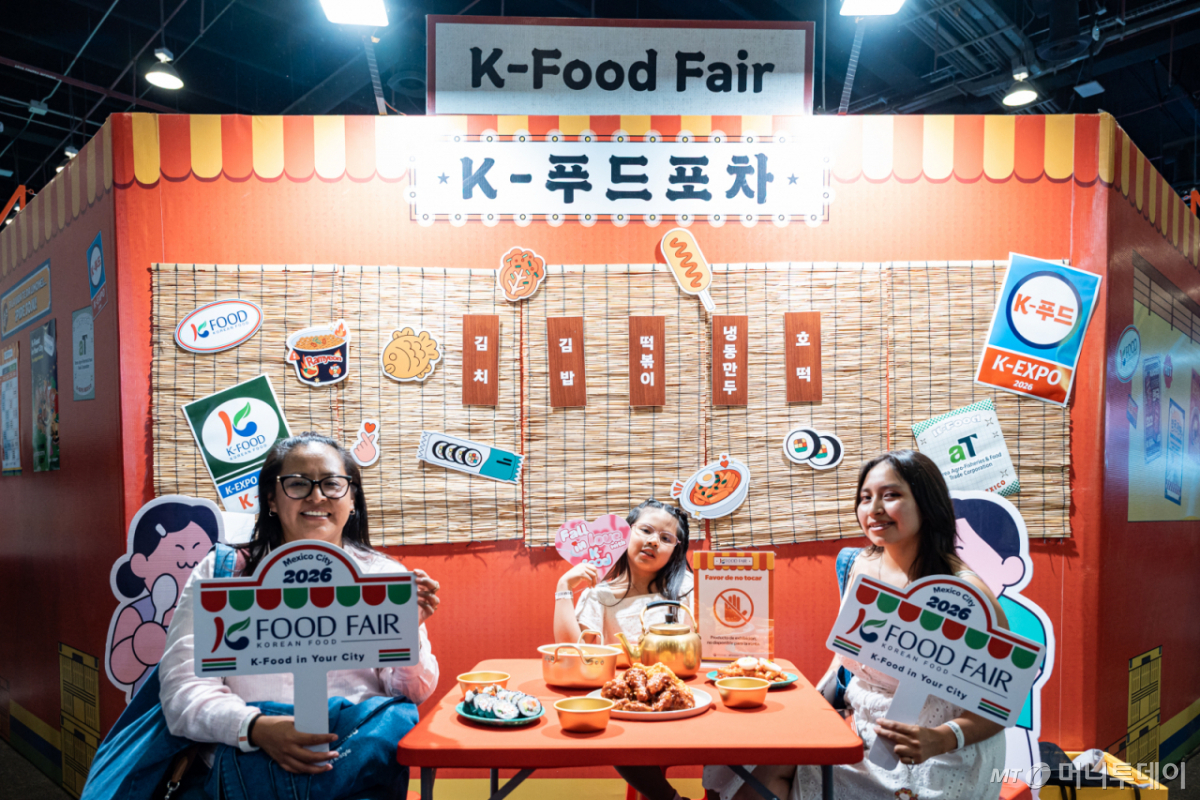
A survey found that more than half of the key consumer demographic in major countries worldwide had purchased K-products (including services), such as K-food, fashion, and beauty, last year. Additionally, a significant portion of these consumers showed high interest in the K-Wave (Hallyu).
According to industry sources on the 14th, results from CJ Group’s ‘Global K-Wave Consumer Survey,’ conducted at the end of last year among 7,100 people (aged 15 to 49) in 12 major countries including the United States, Japan, China, the United Kingdom, and France, showed that 53% of respondents had directly purchased K-products, while 75% answered that they were highly interested in the K-Wave.
These consumers showed particular interest in K-food. In the same survey, 63% reported having experience dining out at K-food restaurants, and 76% expressed interest in K-food. The frequency of dining out for K-food was an average of 2.4 times per month, and 55% of respondents reported eating Korean food as a dine-out meal at least once a month. By country, Vietnam had the highest frequency of K-food dining out at 3.14 times per month. This was followed by the United Arab Emirates (UAE) at 3.02 times, Saudi Arabia at 2.94 times, the United Kingdom at 2.87 times, the United States at 2.69 times, and Japan at 1.42 times. The frequency of cooking and eating K-food at home was an average of 2.8 times per month, which was higher than the dining-out frequency. The proportion of people who eat Korean food at home at least once a month was found to be 59%.
The Ministry of Agriculture, Food and Rural Affairs and the Korea Traditional Cuisine Promotion Institute’s overseas Korean food consumer survey also showed that the rate of visiting local Korean restaurants within the past year rose from 64.6% in 2023 (surveying 9,000 people in 18 cities) to 71.7% in 2025 (11,000 people in 22 cities). This means that approximately seven out of ten foreigners have experienced dining at a Korean restaurant.
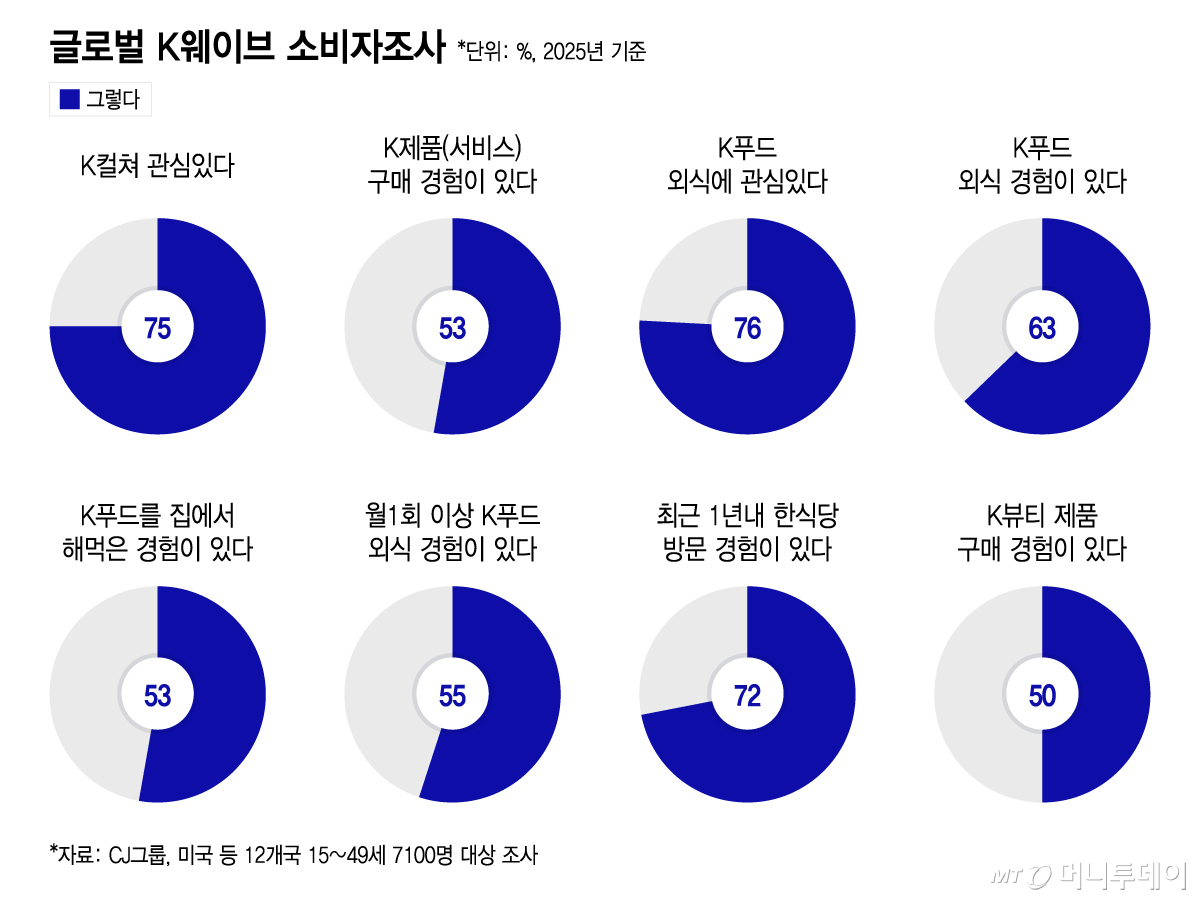
K-beauty is also receiving significant attention from the public. In the same survey, the purchase experience rate for K-beauty was found to be 50%. While previously famous products maintained popularity over long periods, recent trends indicate that new products are leading the market. The market is also expanding from skincare to hair and body care, as well as beauty devices.
Furthermore, while K-beauty’s popularity previously often relied on specific countries such as China or the United States, growth in K-beauty experiences is now continuing across Europe, Australia, and the Middle East. Consequently, domestic K-beauty companies are competing to expand their products and brands into various countries.
The expansion of the global influence of the K-lifestyle confirmed by data is analyzed as being driven not by independent growth of K-industries, but by mutual influence that expands their scope. This reflects a trend where the popularity of K-pop and K-dramas extends to K-food, beauty, and K-fashion.
A CJ Group official stated, “The conversion effect from K-content to K-food and beauty consumption has already been confirmed through both data and on-site observations, and within the flow created by the K-Wave, food, beauty, and fashion are becoming interconnected.” The official added, “At a time when the popularity of K-culture is intensifying further, it is a moment to watch how the K-Wave will translate into specific outcomes.”

 in LIVING

