

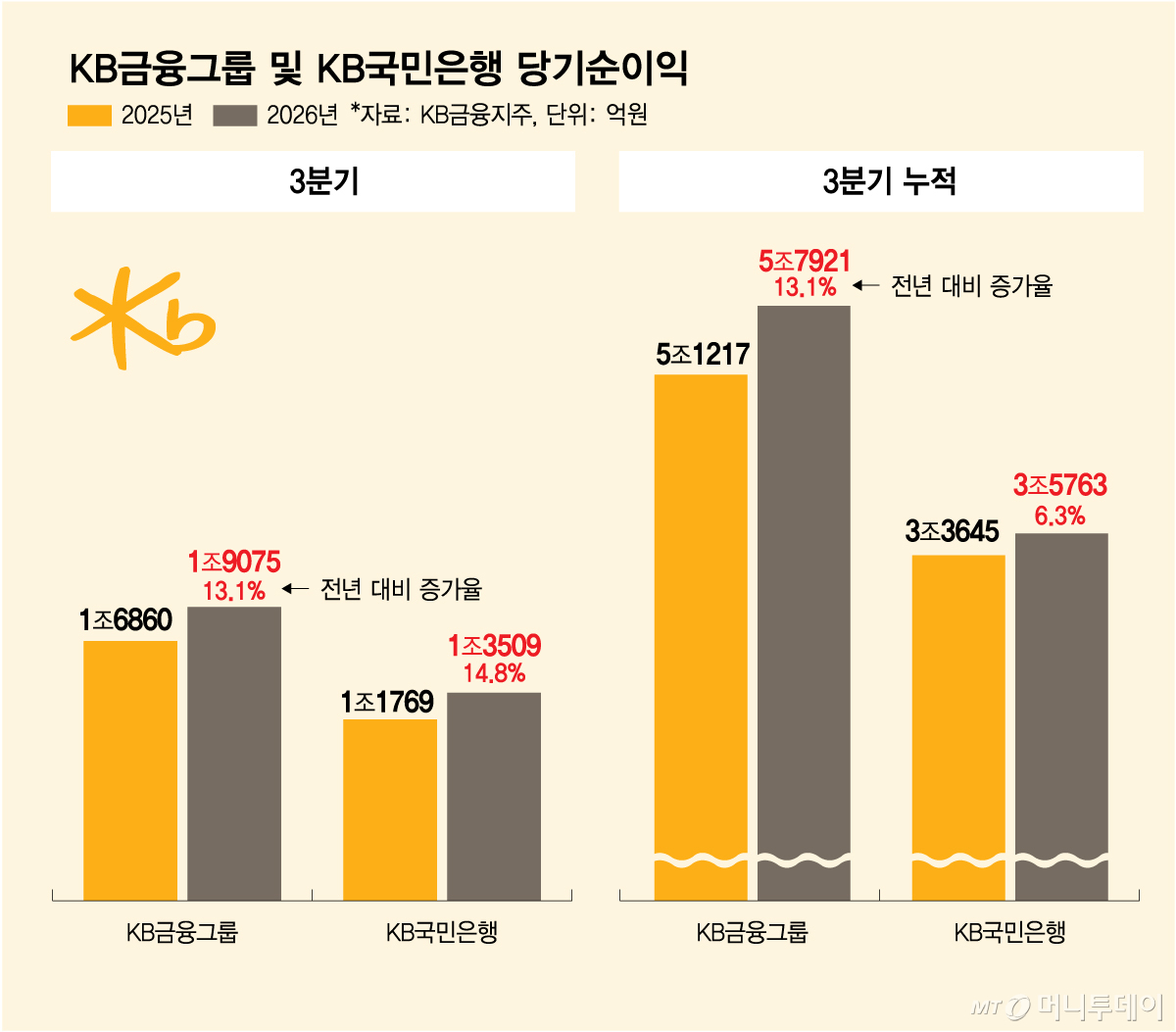
KB Financial Group recorded a cumulative net profit for the first three quarters of this year at 5.7921 trillion won. This figure represents a 13.1% increase compared to the same period last year, making it virtually certain that the financial holding company will become the first in its sector to join the 6th trillion won club on an annual basis.
KB Financial disclosed this through its earnings announcement on Thursday. The standalone net profit for the third quarter of this year was 1.9075 trillion won, a 4.3% decrease from the previous quarter but a 13.1% increase compared to the same period last year.
Net fee income exceeded 1 trillion won for four consecutive quarters, further strengthening the resilience of fee-based earnings and driving the expansion of the group's revenue base and steady profit growth.
Na Sang-rok, an executive in charge of finance at KB Financial Group, said, "Even amid persistent uncertainty in financial markets, KB Financial Group is maintaining stable profit growth by proactively responding to market changes based on its balanced profit-generating capabilities across banking and non-banking segments."
He added, "Going forward, we plan to continue diversifying revenue sources to secure sustainable future growth drivers for the group, while also pursuing a solid management strategy centered on risk management and cost efficiency."
On the same day, the board of directors of KB Financial Group resolved to pay a quarterly cash dividend of 1,167 won per share, totaling 404.9 billion won, an increase of 237 won compared to the same period last year. This reflects the increased annual total dividend amount compared to the previous year and the effects of share buybacks continued throughout the year.
Among the key management indicators released on the day, the group's Common Equity Tier 1 (CET1) ratio and BIS capital adequacy ratio stood at 13.80% and 16.02%, respectively, as of the end of September, maintaining stable capital adequacy.
The group's Return on Assets (ROA) and Return on Equity (ROE) were 0.93% and 13.89%, respectively, on a cumulative basis for the third quarter, showing significant improvements in profitability and capital efficiency compared to the same period last year. The Cost-to-Income Ratio (CIR), an indicator of cost efficiency, recorded 36.4% on a cumulative basis for the third quarter, maintaining a stable trend below 40%, driven by core profit growth and continuous efforts at the group level to improve cost efficiency.
The group's Net Interest Margin (NIM) for the third quarter was 1.92%, while the bank's NIM was 1.72%, each narrowing by 0.02 percentage points from the previous quarter. This is due to increased funding costs amid expanded volatility in the funding market, which narrowed the deposit-loan spread, despite some improvement in the yield on loan assets.
The group's cumulative Credit Cost Ratio (CCR) for the third quarter was 0.40%, an improvement of 6 basis points compared to the same period last year. With sufficient loss-absorbing capacity secured through proactive provisioning at the group level for potential non-performing assets, and combined with active soundness management efforts such as the repayment of non-performing assets, provision charges are being managed stably and continue a downward stabilization trend.
The cumulative net profit for KB Kookmin Bank, a core affiliate, was 3.5763 trillion won for the third quarter, a 6.3% increase compared to the same period last year. This is the result of steady profit growth driven by loan expansion centered on corporate loans, despite the narrowing of the Net Interest Margin (NIM) due to funding cost burdens.
Meanwhile, KB Financial Group has been expanding inclusive finance annually to support the economic recovery of financially vulnerable groups. The group announced that it created a total social value of 903.7 billion won in the third quarter and 2.5663 trillion won on a cumulative basis for the first three quarters.
It is supporting the "1,000 Won Breakfast for College Students" program and the "Sturdy Lunch for Office Workers" initiative for employees of local SMEs, thereby enhancing youth welfare and strengthening the foundation for regional settlement. To strengthen the future competitiveness of SMEs and small business owners and revitalize the regional economy, the group has contributed a total of 10 billion won to the "Large-SME Mutual Cooperation Fund."

 in FINANCE
