

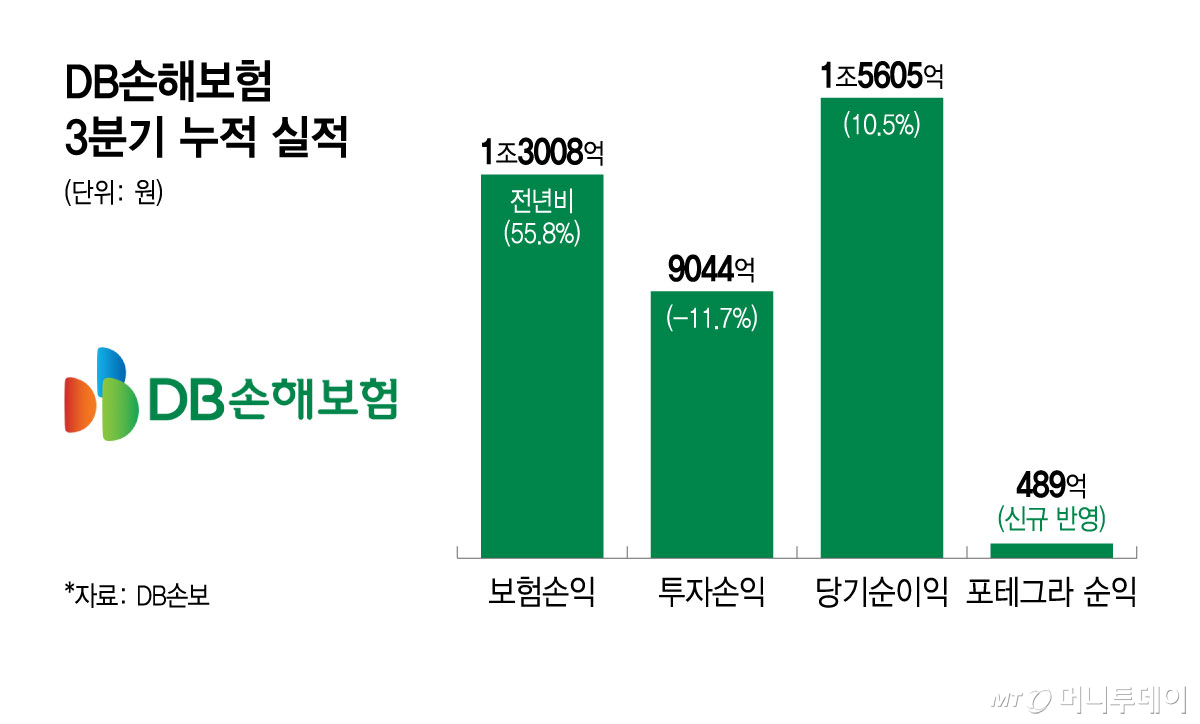
Driven by improved insurance underwriting profit, DB Insurance posted net income exceeding 1.5 trillion won through the third quarter of this year.
Although investment profit declined due to factors such as sluggish stock markets, overall performance was lifted as insurance underwriting profit surged nearly 56%, fueled by stabilized loss ratios in long-term insurance and a return to profitability in auto and general insurance. Notably, results from its U.S. insurance subsidiary, Portegre, were reflected for the first time this quarter.
According to management results announced by DB Insurance on the 12th, cumulative consolidated net income for the period through Q3 of this year was 1.5605 trillion won, up 10.5% year-on-year. Revenue increased 20.0% to 20.9595 trillion won, while operating profit expanded 18.6% to 2.2052 trillion won.
The improvement in results was led by the core insurance business. Cumulative insurance underwriting profit through Q3 of this year rose 55.8% year-on-year to 1.3008 trillion won, an increase of approximately 465.9 billion won compared to the same period last year.
In contrast, investment profit decreased by 11.7% to 904.4 billion won. Despite the decline in investment profit, the substantial rise in insurance underwriting profit allowed total net income to maintain double-digit growth.
This trend was also clearly evident in Q3 standalone results. Consolidated net income for Q3 increased 35.3% year-on-year to 444 billion won. Insurance underwriting profit surged 302.6% from the same period last year to 467.3 billion won.
Meanwhile, investment profit fell by 53.6% to 151 billion won. The deterioration in profitability in the investment segment was offset by improvements in the core insurance business.
The recovery in profitability of long-term insurance contributed significantly to the improvement in insurance underwriting profit. Standalone long-term insurance profit for Q3 increased 35.5% year-on-year to 309 billion won.
This was due to stabilized loss ratios, driven by a reduction in losses from differences between expected and actual insurance benefits, coupled with institutional improvements such as strengthened management of non-covered medical expenses, premium adjustments, and measures to enhance profitability.
Auto insurance and general insurance also both turned profitable. Auto insurance profit came in at 15.5 billion won, reversing a loss of 55.8 billion won in Q3 last year.
This improvement was attributed to better loss ratios as seasonal factors such as heavy rain decreased compared to the previous year. The cumulative auto insurance loss ratio through Q3 fell by 6.2 percentage points year-on-year to 84.3%.
General insurance profit also turned positive at 6.2 billion won. The cumulative loss ratio improved by 3.6 percentage points year-on-year to 71.9%. Adjustments to reinsurance strategies and strengthened underwriting (insurance contract acceptance review) contributed to the profitability improvement.
In contrast, the investment segment was affected by unstable financial market conditions, including stock market declines. The standalone investment profit decline rate for Q3 reached 53.6%, resulting in a year-on-year decrease in cumulative investment profit as well.
However, overseas insurance operations maintained stable profitability. The net income for the period from Portegre, which was included this time, was approximately 48.9 billion won.
Contractual Service Margin (CSM), a key indicator of future profits, also maintained its upward trend. As of the end of September, held CSM on a gross written premium basis was 13.4 trillion won, an increase of 836.6 billion won from the end of last year.
While new contract CSM decreased year-on-year due to reduced sales of protection insurance, held CSM continued to grow net as improved retention rates resulted from strengthened management of cancellations and policy conversions.
The solvency ratio (K-ICS), a capital adequacy indicator, stood at 212.0% as of the end of September. This maintained a stable level within the appropriate capital adequacy management range of 180–220% outlined in the corporate valuation enhancement plan announced in August.
A DB Insurance official stated, "We aim to strengthen the profitability of our core insurance business in the remaining fourth quarter while securing new profit sources in the U.S. and Europe with Portegre as a stepping stone." The official added, "We will also focus on the stable operation of overseas businesses and securing synergies with existing operations."

 in FINANCE
