

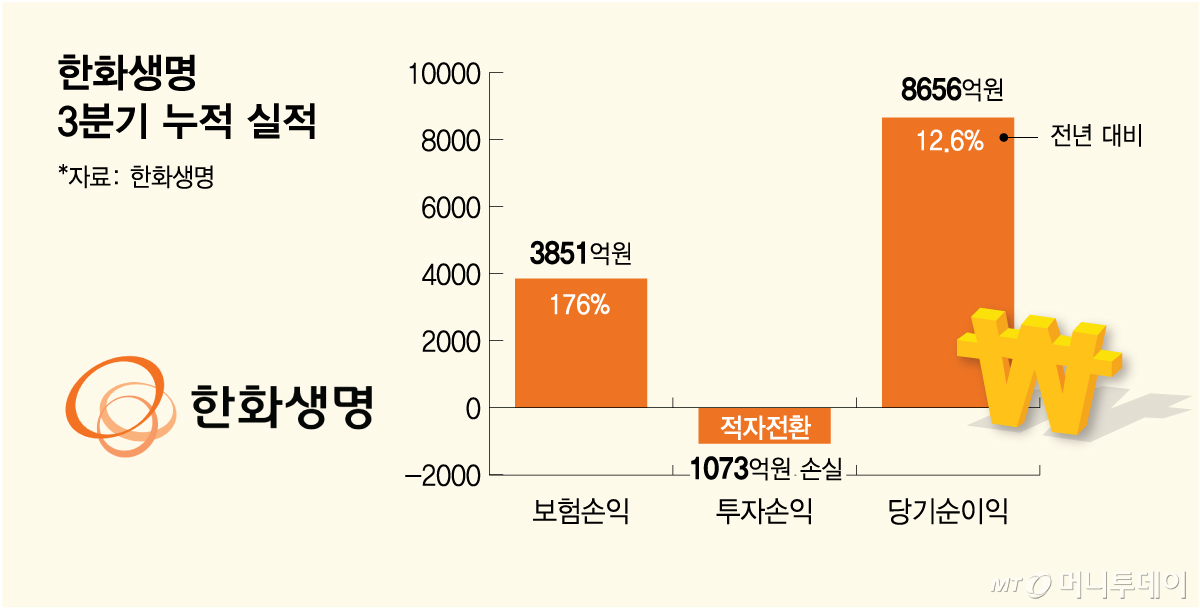
Driven by improved insurance underwriting profits, Hanwha Life Insurance recorded a cumulative net profit exceeding 860 billion won for the first three quarters of this year. Although investment losses turned negative amid increased volatility in exchange rates and the stock market, overall performance was lifted as insurance underwriting profits surged 176%, fueled by improved profitability centered on protection insurance products.
According to management results released by Hanwha Life Insurance on the 12th, the company's cumulative consolidated net profit for the first three quarters of this year reached 865.6 billion won, a 12.6% increase from 769 billion won in the same period last year. Significant improvements in the profitability of its core insurance business drove the growth in results. Cumulative insurance underwriting profits for the first three quarters of this year were 385.1 billion won, surging 176% compared to the same period last year. This figure is 40.7 billion won higher than the full-year insurance underwriting profit of 344.4 billion won recorded last year.
This outcome reflects the success of the product portfolio restructuring and profitability-focused sales strategy that have been pursued since last year. The company expanded sales of protection insurance, including medium- and long-term payment whole life insurance and health insurance, while reducing losses from differences between expected and actual insurance payouts through improved management of benefit payments and refinement of actuarial assumptions. The conversion of loss-making contracts into profitable ones also contributed to the improvement in insurance underwriting profits.
In contrast, the investment division performed poorly. Cumulative investment losses for the first three quarters of this year amounted to 107.3 billion won, reflecting the impact of increased volatility in exchange rates and the stock market. In particular, foreign currency valuation losses occurred on previously issued overseas hybrid capital securities due to exchange rate fluctuations. However, the company explained that these hybrid capital securities are issued and repaid in U.S. dollars, meaning that exchange gains or losses incurred before repayment are distinct from actual asset management performance.
Losses also emerged in variable insurance accounts due to increased stock market volatility. The company explained that a "hedge mismatch" occurred because the value changes of assets related to variable insurance and hedging transactions did not align, resulting in discrepancies in profits and losses.
Overseas subsidiaries showed balanced growth. Cumulative profits from overseas subsidiaries for the first three quarters of this year totaled 146.6 billion won. The Vietnam subsidiary recorded a profit of 46.7 billion won, Noh Bank 46.1 billion won, and Velocity 38.8 billion won. Domestic subsidiary Hanwha Life Financial Services also posted a profit of 88.3 billion won, a 10.2% increase from the same period last year.
Contractual Service Margin (CSM), a key indicator of future profits, also increased significantly. Cumulative new contract CSM for the first three quarters of this year was 2.086 trillion won, up 40.0% from 1.4898 trillion won in the same period last year. This result stems from strengthened sales of high-profitability protection products, such as medium- and long-term payment whole life insurance and health insurance. The CSM balance at the end of September was 9.4144 trillion won, an increase of 486 billion won from 8.9284 trillion won at the end of the first half.
The solvency ratio (K-ICS), a key capital adequacy indicator, rose by 3.0 percentage points to 171.0% as of the end of September, compared to 168.0% at the end of the first half. This was influenced by factors such as an increase in CSM for existing contracts and a reduction in basic assumption risk due to improved differences between expected and actual insurance payouts.
A Hanwha Life Insurance official stated, "Although non-recurring factors related to financial market volatility, including exchange rates and stock prices, were reflected, our core competitiveness has been further strengthened based on the expansion of new contract CSM and increased insurance underwriting profits." The official added, "We will continue to enhance corporate valuation by improving the fundamental strength of insurance underwriting through profitability-focused product portfolio management and expected-actual difference management, while expanding synergies with domestic and overseas subsidiaries."

 in FINANCE
