

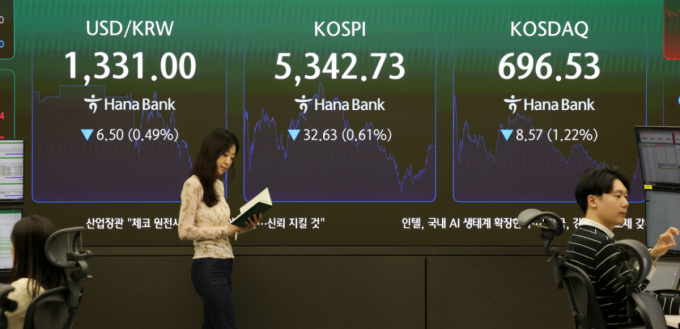
The KOSPI index failed to rise despite the overnight strength in U.S. tech stocks, closing lower on the 12th. Investor sentiment was dampened as news spread that NVIDIA’s board of directors is pushing for the dismissal of Chief Executive Officer (CEO) Jensen Huang, amid concerns over supply and demand volatility coinciding with options expiration day. Attention now turns to whether market sentiment will shift following the earnings release by AI cloud company Nebius later that evening.
On the 12th, the KOSPI closed at 5,342.73, down 32.63 points (0.61%) from the previous trading session. The KOSPI index fluctuated between a 0% and 1% range immediately after the opening bell before showing weakness toward the close.
On the KOSPI (based on Korea Exchange data) that day, retail investors and institutional investors made net sales of 204 billion won and 691 billion won, respectively. Among institutional investors, financial investment firms, which include retail investor trading in exchange-traded funds (ETFs), recorded net sales of 975.3 billion won. Other corporations, reflecting SK hynix’s share buyback volume, made net purchases of 524.2 billion won. Foreign investors bought a net 370.5 billion won worth of shares, extending their streak of consecutive net purchases to three trading days. The futures market also recorded net buying that day. Given that foreign investors had been net sellers in the futures market for the previous two trading days, trading trends were closely watched on the options expiration day, and they ultimately shifted to net buying.
The KOSPI closed lower Thursday despite gains in U.S. technology stocks overnight, as reports that Nvidia's board was preparing to oust CEO Jensen Huang unsettled investors.
Concerns over volatility ahead of options expiration also weighed on sentiment. Markets are now looking to earnings from AI cloud company Nebius later in the day for signs of a possible turnaround.
The benchmark KOSPI fell 32.63 points, or 0.61 percent, to close at 5,342.73. The index fluctuated between gains and losses of up to 1 percent throughout the session before turning lower near the close.
On the main bourse, individual and institutional investors were net sellers of 204 billion won and 691 billion won worth of shares, respectively.
Within institutional trading, financial investment firms, which include individual investors' ETF transactions, recorded net sales of 975.3 billion won.
Other corporations, a category that reflects SK hynix's share buybacks, were net buyers of 524.2 billion won. Foreign investors purchased 370.5 billion won worth of shares, extending their net buying streak to three consecutive sessions. They were also net buyers in the futures market.
Foreign investors' futures trading drew attention ahead of Thursday's options expiration, particularly after they were net sellers over the previous two sessions. They ultimately shifted to net buying.
Overnight, U.S. stocks rallied, led by technology shares, on strong earnings from CoreWeave and robust demand in Anthropic's IPO bookbuilding. On Nov. 11 (local time), the S&P 500 rose 98.45 points, or 1.31 percent, to 7,619.38, while the Nasdaq Composite gained 400.31 points, or 1.60 percent, to 25,466.19. The Dow Jones Industrial Average advanced 254.60 points, or 0.49 percent, to 52,486.49.
CoreWeave surged 24.7 percent, marking its biggest one-day gain in more than three months. The company reported third-quarter revenue of $3.661 billion, up 168 percent from a year earlier. It raised its full-year revenue forecast to between $13 billion and $13.3 billion and said it expects to turn profitable in the first half of 2028. Buoyed also by the Anthropic effect, semiconductor stocks rallied, with Micron rising 11.9 percent, SanDisk 13.7 percent, AMD 7.3 percent and Intel 7.5 percent.
However, reports involving Nvidia emerged before the Korean market opened, preventing the KOSPI from capitalizing on the U.S. tech rally. According to The Wall Street Journal and The New York Times, allegations have surfaced that Huang, who has faced controversy over an alleged affair with a woman accused of spying for China, was also involved in a relationship with a female executive at Nvidia.
Following the reports, Nvidia shares erased their gains and fell more than 8 percent in after-hours trading. Investors grew concerned that the company could face sanctions if it had rerouted GPU exports to China. They also worried that Huang's departure could disrupt the AI infrastructure investment boom he has helped drive.
"The KOSPI remained weak as investors digested uncertainty surrounding the scandal involving Nvidia CEO Jensen Huang," said Lee Kyung-min, head of FICC at Daishin Securities. "Although sentiment toward AI semiconductor investment had improved, the market was taking a breather after a short-term rebound over the previous two sessions. Heavy net selling by institutions, particularly financial investment firms, widened losses during the session."
Among KOSPI sectors, IT (information and communications) services fell by more than 3%. Insurance dropped in the 2% range. Chemicals, real estate, construction, metals, finance, and machinery/equipment all declined by more than 1%.
Transportation equipment/parts, manufacturing, distribution, textiles/apparel, electrical/electronics, and paper/wood remained slightly lower. Non-metals, medical/precision instruments, general services, and pharmaceuticals closed slightly higher. Electric/gas and transportation/warehousing rose in the 1% range. Entertainment/culture climbed by more than 2%.
Among top KOSPI market capitalization stocks, Samsung Electro-Mechanics fell in the 4% range. Hyundai Motor dropped by more than 2%. SK hynix and LG Energy Solution declined in the 1% range. SK Square and KB Financial Group were slightly lower, while Samsung Electronics and Samsung C&T closed slightly higher. Defensive stocks classified as such, including Samsung Biologics Co., Ltd., Samsung Life Insurance, and Celltrion, rose in the 1% range.
The KOSDAQ closed at 5,342.73, down 32.63 points (0.61%) from the previous trading session.
In the KOSDAQ market, foreign investors made net sales of 353.4 billion won. Retail investors and institutional investors made net purchases of 307.4 billion won and 43.7 billion won, respectively.
Among KOSDAQ sectors, metals and pharmaceuticals fell in the 2% range. Distribution, finance, textiles/apparel, transportation/warehousing, machinery/equipment, manufacturing, chemicals, and transportation equipment/parts all declined by more than 1%.
Shuffling among top market capitalization stocks appeared in the KOSDAQ market. Alteogen and Jusung Engineering fell in the 3% range. Ecopro BM and Samchundang Pharmaceutical dropped by more than 2%. Ecopro, Iotech, and HLB declined in the 1% range.
During intraday trading that day, as Ecopro’s drop widened, it temporarily ceded its second-place spot to Ecopro BM, which had previously held third place in market capitalization. HLB closed at 10th place in market capitalization, pushed down by Rino Industrial, which closed slightly higher. Rino Industrial moved up one notch to 9th place. Simmtech rose in the 1% range.
Market attention turns to the earnings release of AI cloud company “Nebius.” With a mix of bullish and bearish factors in the stock market—including CoreWeave’s strong third-quarter results, the success of Anthropic’s IPO, and NVIDIA’s board pushing for the dismissal of CEO Jensen Huang—attention is focused on whether Nebius’s earnings will improve investor sentiment.
Im Jeong-eun and Tae Yoon-sun, researchers at KB Securities, said, “Foreign investors have made net purchases in the KOSPI market for three consecutive trading days, buying a cumulative total of approximately 1.7 trillion won, but this remains limited compared to the cumulative net sales of over 1 trillion won this month. It is necessary to pay attention to changes in AI investment sentiment following Nebius’s earnings release this evening.”
In Seoul’s foreign exchange market that day, the won/dollar exchange rate closed daily trading at 1,330.7 won, down 2.9 won from the previous session’s closing price.

 in STOCK
