

As the average interest rate on housing loans in the banking sector has surged to its highest level in 15 years, the Bank of Korea resumed base rate hikes after three months, which is expected to increase the interest burden for borrowers.
With the upper limit of variable-rate mortgage rates at the five major banks already exceeding 6.5% annually, and the possibility of additional tightening next year remaining open, there are predictions that mortgage rates in the 7% range could become a reality.
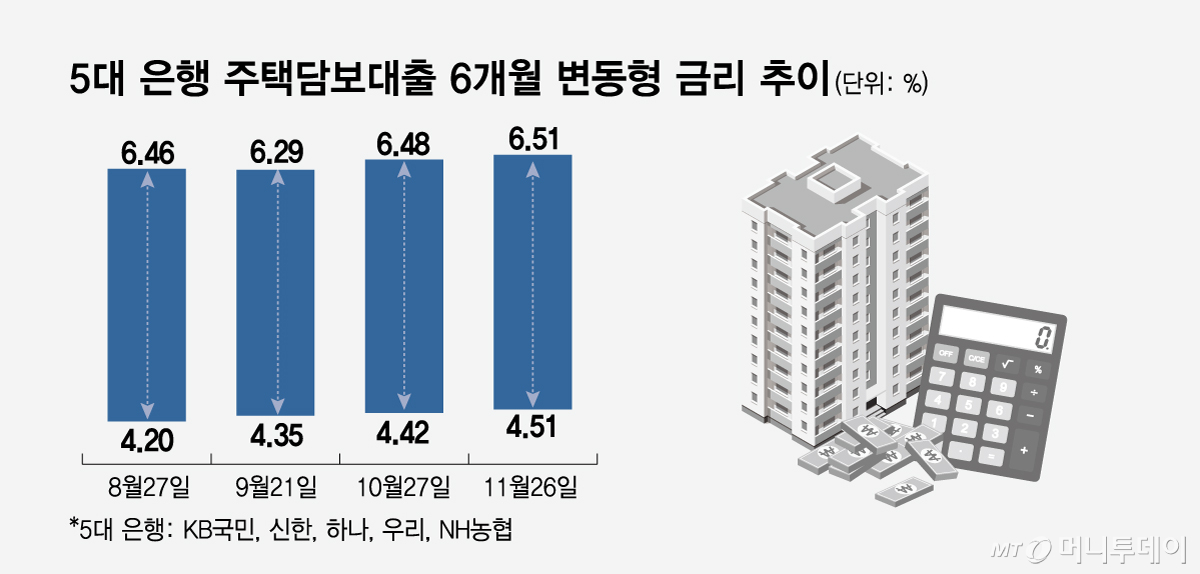
According to financial industry sources on the 26th, the variable (six-month) mortgage interest rates at the five major banks—KB Kookmin, Shinhan, Hana, Woori, and NH Nonghyup—as of that day were recorded at 4.51% to 6.51% annually.
Compared with August 27, when the Bank of Korea implemented its previous base rate hike (4.20% to 6.46% annually), the lower and upper bounds rose by 0.31 percentage points (P) and 0.05 P, respectively.
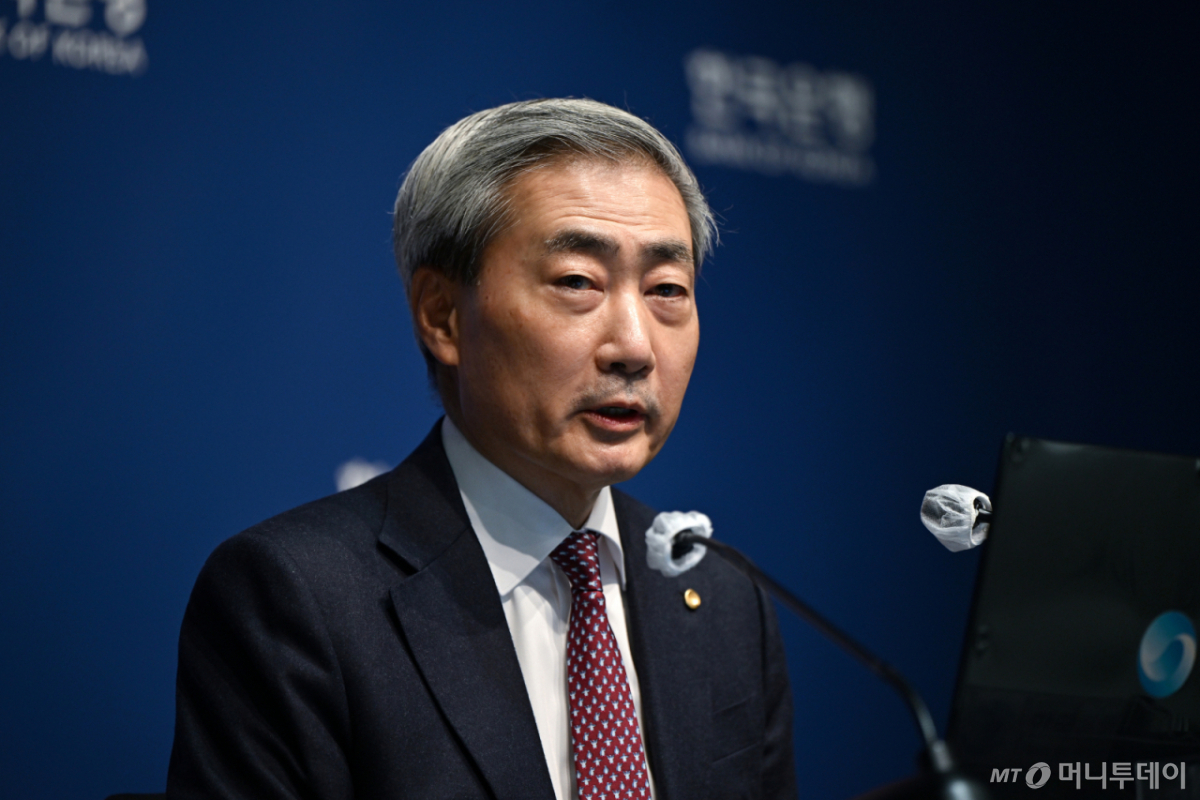
The Bank of Korea Monetary Policy Board held its final monetary policy direction meeting for the year on the day, raising the base rate from 3.00% to 3.25% annually by 0.25 P. This is the third hike this year, following increases in July and August. The base rate has risen by 0.75 P over four months.
The average interest rate on household loans in the banking sector has already surpassed 5% annually. According to the Bank of Korea, the household loan interest rate for new transactions at deposit banks last month was 5.02% annually, up 0.06 P from the previous month.
It exceeded 5% for the first time since November 2023. Mortgage rates rose by 0.1 P from the previous month to 4.98% annually, marking a sixth consecutive monthly increase and reaching their highest level in 14 years and seven months.
As banks' funding costs rise, upward pressure on variable loan interest rates is also intensifying. The COFIX (Cost of Funds Index), which serves as the benchmark for calculating variable mortgage rates based on new transactions, hit its highest level in two years and eight months at 3.62% annually last month.
It rose by 0.44 P over two months, with increases of 0.25 P in September and 0.19 P in October. The COFIX based on outstanding balances and the COFIX based on new outstanding balances also rose by 0.11 P and 0.14 P, respectively.
COFIX is an indicator that reflects funding costs such as deposits and bank bonds from eight domestic banks. Despite a slight decline in market interest rates last month, COFIX rose as banks continued to increase fixed deposit rates.
KB Kookmin Bank and Woori Bank raised their new variable mortgage rates by 0.19 P each on the 17th, reflecting the increase in COFIX. If banks further raise deposit rates due to this base rate hike, there is a high possibility that COFIX will also rise further.
With speculation emerging about the possibility of additional base rate hikes in the first half of next year, it cannot be ruled out that the upper limit of mortgage rates could reach 7% annually. Although banks have recently eased loan restriction measures for total household loan management, rising interest rates are expected to act as a hurdle for homebuyers seeking funds.
The burden is also increasing not only for new borrowers but also for existing borrowers facing interest rate resets. For a borrower with an outstanding loan balance of 400 million won, if the current base rate hike of 0.25 P is directly reflected in the loan interest rate, the annual interest burden will increase by 1 million won. If the loan interest rate rises by 0.5 P from the current level, they will have to pay an additional 2 million won in interest annually.
As stock market volatility has recently expanded, the burden is also expected to weigh on so-called "margin investing (investing with debt)ers" who took out credit loans to invest in stocks. According to the Korea Banking Finance Association, the average interest rate on new credit limit loans (minus accounts) at the five major banks last month was 5.69% annually based on new transactions, up 1.12 P from a year earlier (4.57% annually).
Experts advise that existing borrowers need to check their loan interest rate types and repayment capacity, keeping in mind the possibility of additional rate hikes.
Ham Young-jin, head of Woori Bank's Real Estate Research Lab, stated, "If your existing loan has a variable interest rate and you are concerned about further rate increases, you can consider converting to a fixed or hybrid interest rate to reduce uncertainty in the interest burden," adding, "You must comprehensively consider the difference between the current loan rate and new refinancing rates, prepayment penalties, and future interest rate trends."

 in FINANCE

