

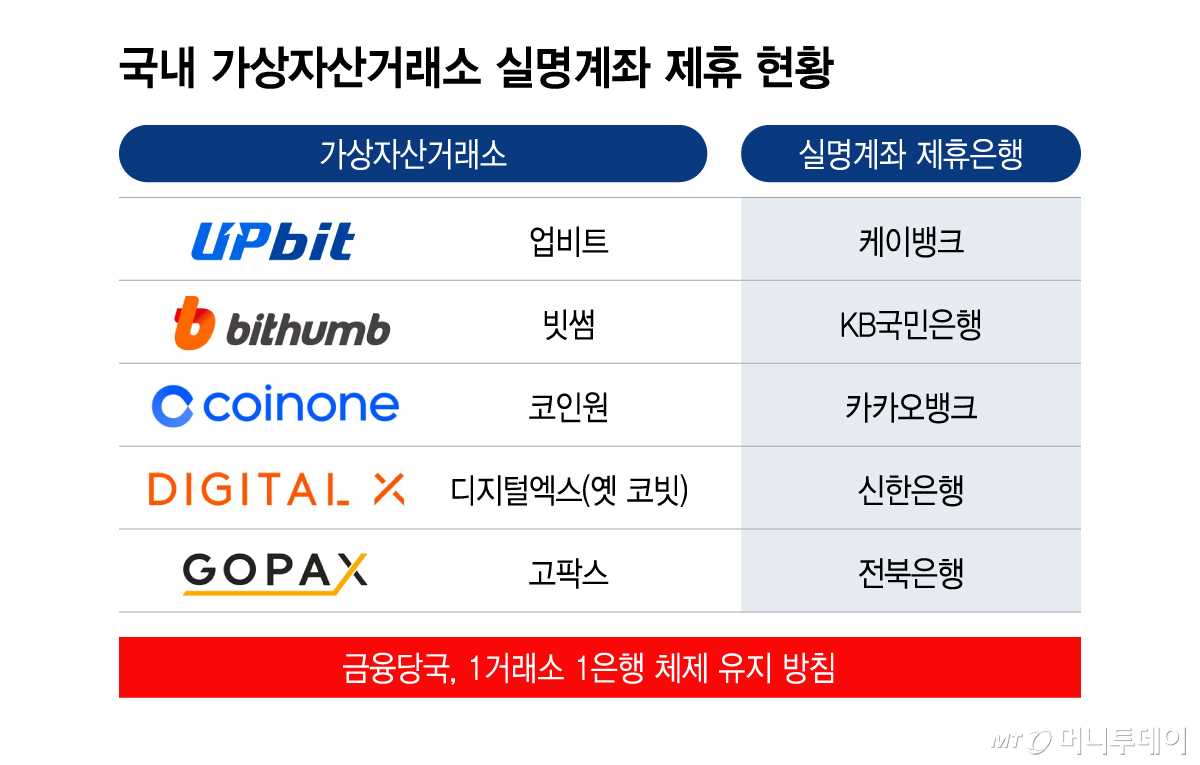
Financial regulators will maintain the "one exchange, one bank" system, under which a virtual asset exchange partners with only one bank for real-name accounts.
This decision stems from the assessment that the industry's internal control capabilities are not yet sufficiently in place, as numerous violations of customer due diligence obligations have been detected even at major virtual asset exchanges.
The plan is to raise the level of anti-money laundering and internal controls within the virtual asset sector under the leadership of banks.
According to financial regulators on Wednesday, the Financial Services Commission has decided not to push for amendments to the Act on the Use of Credit Information for a certain period in order to allow multiple bank partnerships for real-name accounts at virtual asset exchanges.
A senior official from the financial regulators said, "It is important who will lead and drive responsible innovation in the virtual asset market," adding, "Since banks have far more well-established customer due diligence (KYC) and internal control systems than virtual asset operators, it is necessary to maintain the single-bank system for the time being."
Currently, the top five won-market virtual asset exchanges in Korea each have real-name account partnerships with one bank. Upbit has partnered with K Bank, Bithumb with KB Kookmin Bank, Coinone with KakaoBank, DigitalX (formerly Coinbit) with Shinhan Bank, and GOPAX with Jeonbuk Bank. Users of an exchange must open an account at the bank partnered with that specific exchange to make won deposits and withdrawals.
Financial regulators believe that allowing multiple bank partnerships could increase money laundering risks as trading funds are dispersed across several banks.
This is because it becomes difficult for individual banks to grasp the overall flow of funds, and responsibility for anti-money laundering measures may shift to exchanges, which have relatively weaker internal controls.
The official said, "If multiple real-name accounts are recognized, primary responsibility will shift to virtual asset operators, making it difficult for banks to play a leading role," adding, "Allowing real-name accounts with a single bank means assigning responsibility to that bank, thereby raising the level of internal controls in the virtual asset sector."
Financial regulators assess that they have raised the level of internal controls in the virtual asset sector through the single-bank partnership system.
However, they judge that it is still too early to rely on the exchanges' own capabilities, as numerous customer due diligence violations continue to be detected even at major exchanges.
In the long term, it appears that multiple bank partnerships could be allowed once virtual asset operators have sufficiently secured their own internal control capabilities.
However, at present, there is a calculation that prioritizes the effectiveness of anti-money laundering and internal controls at exchanges over the convenience enjoyed by exchange users.
Previously, Yoo Young-jun, Digital Financial Policy Officer at theFSC, explained in a briefing on the Basic Act on Digital Assets the previous day, "Issues related to real-name accounts will be separately reviewed by the Financial Intelligence Unit (FIU) once the Basic Act on Digital Assets is proposed."

 in FINANCE
