

[More diverse corporate information on the startups mentioned in this article can be viewed on the Unicorn Factory big data platform 'Data Lab'.]
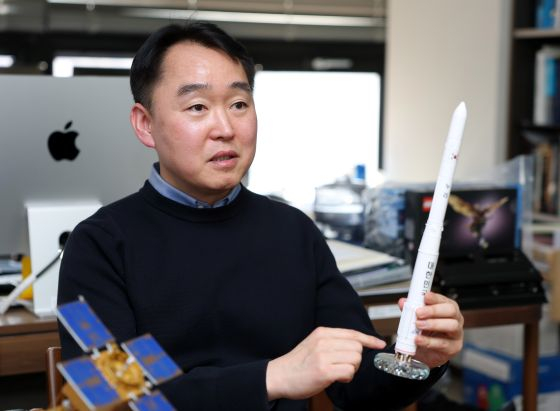
"We live in an era where news of rocket launches is reported every other day. Space is no longer a distant future realm but is rapidly establishing itself as a real-world industrial infrastructure."
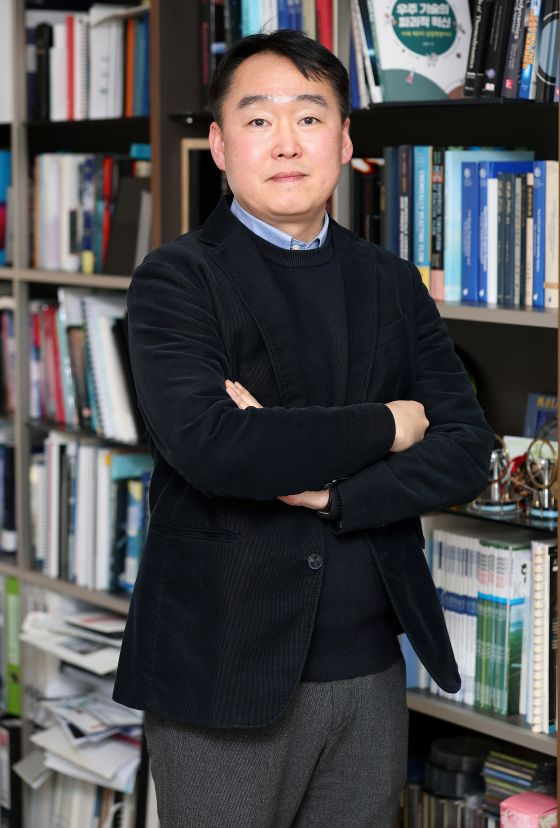
Last year, approximately 300 rockets were launched worldwide. We have now reached a level where rockets are launched somewhere on Earth almost every day. Lee Bok-jik, K-Woo Ju-po-reom (Chairman)(Seoul National University Aerospace Joo Gong-hak-gwa (Prof.)), emphasized that "in the space industry, launch vehicles are like delivery trucks, and what is loaded onto them determines the value of the industry."
The K-Space Forum, launched on the 11th, is a collaborative network involving academia, industry, research, and government to revitalize Korea's space industry. Ten experts in the space industry and investment, including Chairman Lee, serve as operating committee members, while MoneyToday startup media platform 'Unicorn Factory' and the Global Digital Innovation Network (GDIN) co-operate the joint secretariat.
The space industry is larger than semiconductors; it is time to broaden our vision
Chairman Lee pointed out that Korean society tends to view space with a focus solely on launch vehicles. This means it is now time for Korea's domestic space industry to expand beyond launch vehicles into a broader ecosystem. While he stated that the Nuri (Korea-type launch vehicle) launch was a symbolic achievement of Korean space technology and a core foundation that must be sustained, he added, "Now is the time to broaden our vision not just to launch success itself, but to what industries we can grow together based on it."
The background for Elon Musk to embark on rocket development through SpaceX was also to pursue the satellite internet 'Starlink' business. Since relying on external launch services could lead to limitations in controlling costs and schedules, they sought to secure their own launch capabilities to perform this directly.
Chairman Lee stated, "Korea has already reached a significant level in individual technical capabilities such as satellites, launch vehicles, and components, but there is still a lack of stable structures and agreed-upon directions to bundle these into a single industry and grow them continuously." He added, "Only when launch vehicle development and the satellite, data, and service industries grow in balance will space establish itself not just as a national event, but as a sustainable industry."
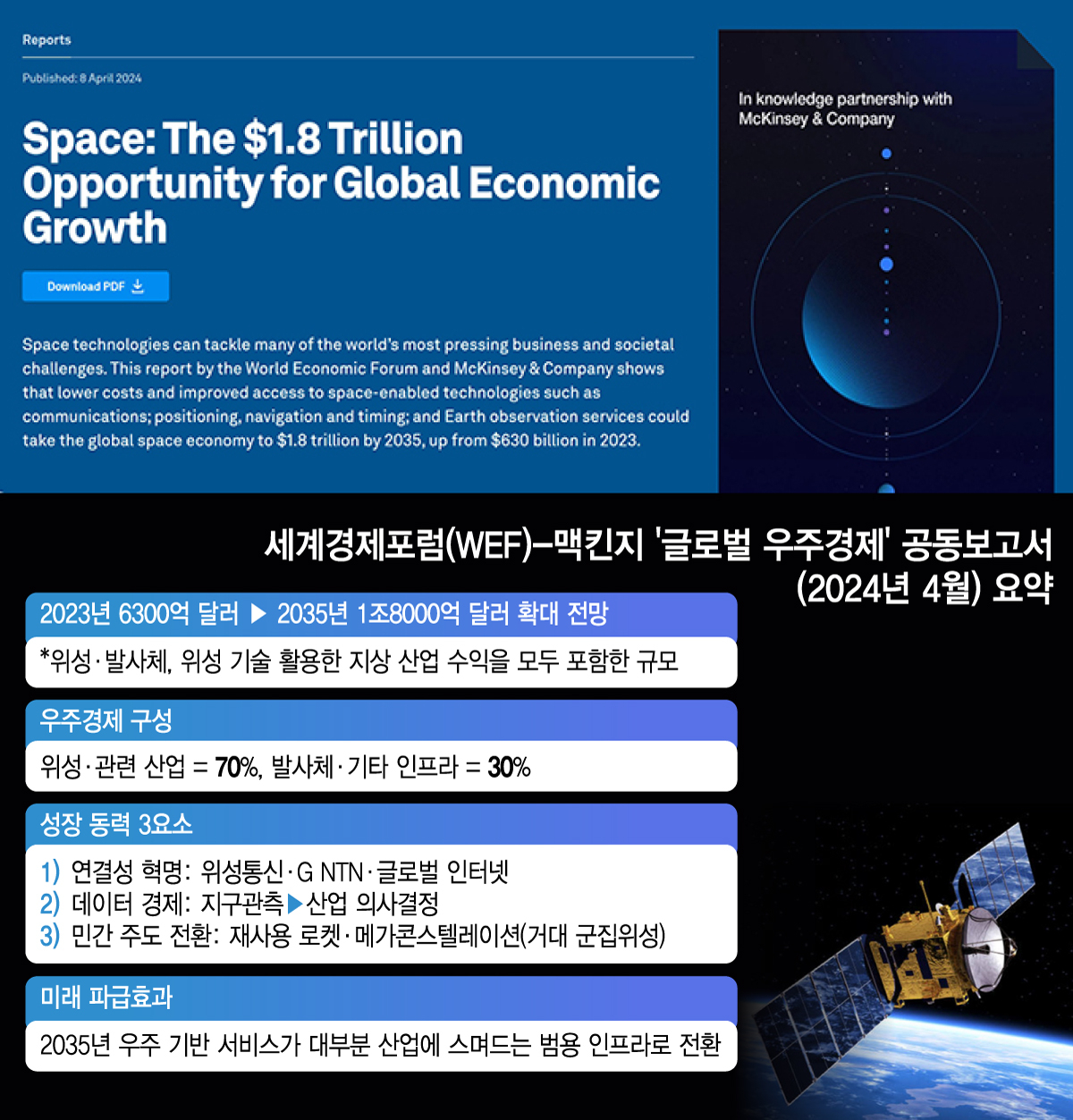
According to McKinsey and the World Economic Forum, the global space industry size is projected to grow at an annual average of about 9%, from $630 billion (approximately 925 trillion won) in 2023 to 1.8 trillion won (2,643 trillion won) by 2035. Even looking at the current scale alone, the space industry has already surpassed the smartphone industry (589 trillion won in 2024), not to mention the semiconductor industry (911 trillion won).
Chairman Lee said, "The total amount of objects launched into space last year is estimated to be around 3,000 tons." He added, "When converted to market value, this amounts to approximately 200 billion to 300 billion won per ton. Satellites or equipment sent to space have a value almost equivalent to gold bars just by weight alone." This indicates that the space industry is a representative high-value-added industry where even a single small object creates enormous economic value.
Companies must build platforms to accumulate 'heritage'
He advised, "For Korea to secure competitiveness in the space industry, it is most important to establish structures that allow related startups to gain practical experience."
Chairman Lee identified 'heritage' as the most necessary element for domestic space startups to grow. This refers to a track record verified at least once in space; in other words, there must be experience of actually operating in the real space environment for the market and investors to move.
Professor Lee said, "When a startup says it is entering the space business, clients ask first, 'Have you been verified in space?' The lack of experience itself to answer that question is the biggest barrier for K-space startups."
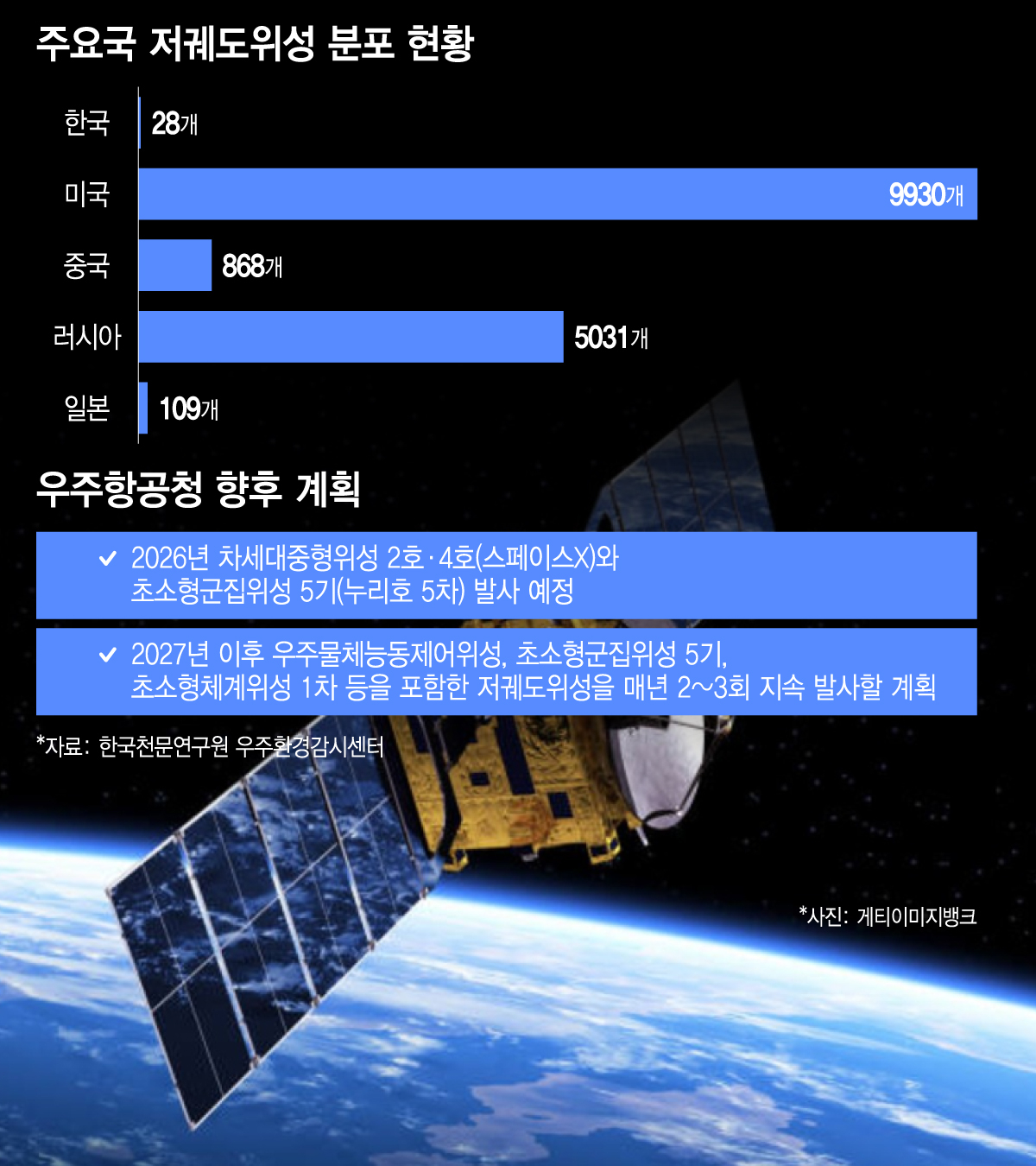
The problem is that Korea lacks such experimental opportunities significantly. If the opportunity to launch Nuri is missed, one must wait a long time for the next launch, and using overseas launch sites requires bearing enormous costs. The structure does not allow for daily experimental opportunities. The reality that advanced technologies secured by the government with massive budget investment are not smoothly transferred to actual industrial sites is also pointed out as a major barrier.
Chairman Lee diagnosed that "design blueprints or technology ownership are complexly entangled with regulatory and liability issues, making rapid iterative experimentation and improvement like SpaceX difficult for private companies." He added, "Launch permits are also tailored only to specific designs; even minor changes follow liability issues, creating a structure where agile movement is difficult." He further noted, "Even support policies aimed at building corporate capabilities have been interpreted as 'subsidies' or 'favoring specific companies,' leading to actual cases where they were interrupted or reduced midway. In such an environment, it is difficult for companies to formulate long-term strategies, and trust in the space industry as a whole will inevitably be shaken."
The solution lies in 'grassroots test beds' and the normalization of launches
Chairman Lee proposed building 'grassroots test beds' and normalizing launch services as solutions to overcome these limitations. He emphasized, "Just as local soccer is needed to produce national team players, space also needs basic experimental fields for industries to grow." The explanation is that platforms must be established where attempts such as sounding rocket (research rockets that briefly visit space) production, rocket re-entry experiments, and mounting small payloads can be carried out daily, allowing startups to accumulate heritage and the industry to grow.
He said, "The government should not demand only one perfect success but should support private companies in accumulating verification through repeated small failures." He added, "Since the space industry is an early-stage market requiring a long time for growth and involves large capital investment scales, the government's role is more important than anything else."
Chairman Lee pointed out that the essence of the space industry lies in electronics, communications, optics, and software industries, evaluating that Korea, as an IT powerhouse, possesses sufficient potential. He stated, "We must connect our manufacturing competitiveness to space and establish foundational industries such as data centers." He emphasized, "We must create a turning point where space moves from a national event to corporate revenue, and from one-off successes to repeatable service industries."
He further added, "The starting point for moving in this direction is ultimately finding the 'missing links' in our industry and filling them," stating that the K-Space Forum will take on that role.
[MoneyToday startup media platform Unicorn Factory]

 in FUTURE


