

[For more diverse company information on the startup mentioned in this article, visit Unicorn Factory's Big Data Platform Data Lab.]
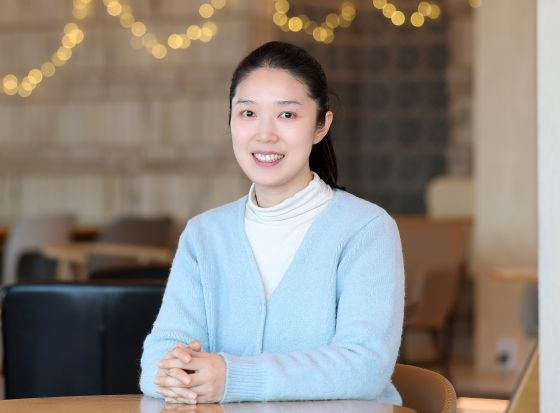
"Sustainability must be proven with numbers."
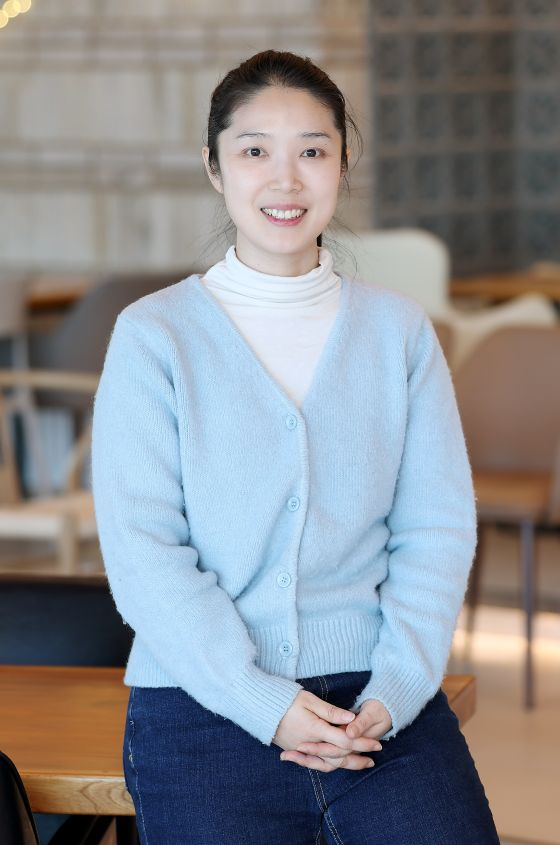
This is the words of Seo Sun-mi, CEO of Sustainable Lab Lee Neo-beul-raep (CEO), who transformed from a travel startup founder into a bio-material technology entrepreneur. Sustainable Lab Lee Neo-beul-raep (CEO) is a climate tech startup developing materials and products that replace plastics by utilizing biomass from wildfire-damaged trees and agricultural/food waste in Busan.
,Global annual plastic waste reaches approximately 350 million tons, with 66% generated from consumer goods discarded within five years of use. In Korea, annual plastic waste ranges between 7 million to 12 million tons, and the government aims to reduce this by over 30% by 2030.
,Sustainable Lab Seo (CEO) began in the beauty industry. Seo explained that "the beauty and personal care sector accounts for about 66% of total plastic usage, and it is a market where environmental regulations are first applied, centered on Europe." The company launched experiments with eco-friendly cosmetics using agricultural/food waste biomass and solid cosmetics without plastic containers but determined they could not provide fundamental solutions due to limitations in usability.
,Seo identified the root of the problem not in products but in materials. Moving beyond the limitation that existing bio-plastics contained only 15-20% biomass, the company attempted to design materials where biomass is central. After numerous experiments, they increased the biomass content to 70-80% and minimized refining processes to create a structure that fixes carbon within the material itself.
,What emerged from this process is 'Terrafin'. Terrafin is a bio-CCUS (carbon capture, utilization, and storage) material designed to convert discarded biomass such as rice husks, wildfire-damaged wood, coffee grounds, and oyster shells into plastic-replacement materials for long-term carbon storage. Official testing confirmed an average carbon storage capacity of 0.949 kg per kilogram of material. Terrafin has completed registration with the government procurement agency, and environmental certification and ISO certification are currently in progress. Seo emphasized, "Unlike existing ESG products, Terrafin is significant because it proves carbon reduction effects with numerical data."
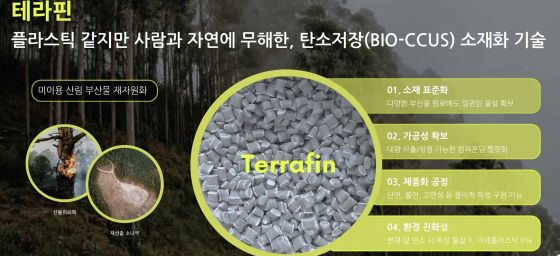
,Development of bio-CCUS material 'Terrafin' utilizing biomass
,The technology development process was not smooth. The biggest barrier was insufficient infrastructure. Plastic injection molding equipment cost billions of won, and there were almost no factories in Korea where startups could entrust initial experiments. Ultimately, the first material tests were conducted in Vietnam, and technical foundations were built by verifying physical properties and processing feasibility through overseas experiments. This experience became a turning point for Sustainable Lab __NAME_0__ to establish itself not merely as an eco-friendly brand but as a deep tech materials company.
,Recently, Sustainable Lab Seo (CEO) diversified its raw materials using forest resources. Seo was selected for the 'Youth Forest Entrepreneurship Catalyst Support Project' promoted by the Korea Forest Service and the Korea Forestry Promotion Institute, establishing a foundation to stably collect and utilize wood damaged by wildfires and pine wilt disease. Research and development (R&D) budgets for product development were also supported.
,He stated, "By expanding the raw material scope from agricultural/food waste biomass to forest resources such as wildfire-damaged trees, the possibilities for material development have greatly expanded." He added, "Converting forest biomass that was previously discarded or incinerated into materials with carbon storage functions marks an important turning point in building a more diverse portfolio of carbon storage materials." He further noted, "Utilizing forest resources goes beyond simple raw material diversification; it simultaneously connects environmental values such as wildfire recovery, resource circulation, and carbon reduction."
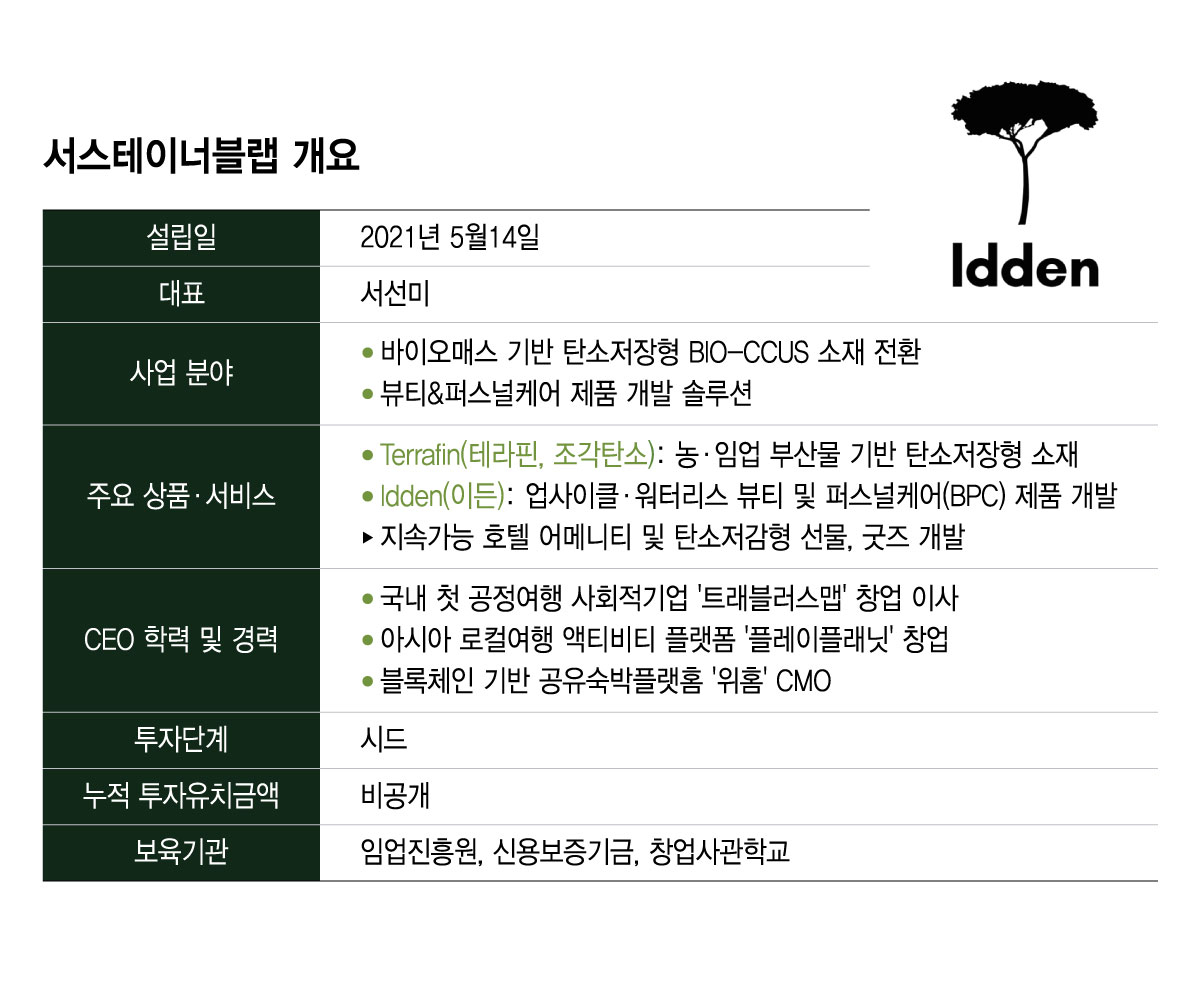
,From 'rapid decomposition' to 'carbon storage'
,Seo pointed out that "existing eco-friendly materials in the market remain focused on the criterion of 'how quickly they decompose'." He noted, "During the biodegradation process, carbon can be re-emitted, and significant energy is consumed during extraction and refining processes." He emphasized, "In the future, the standard for eco-friendly materials should not be 'rapid decomposition' but rather how long they can store carbon."
,Sustainable Lab __NAME_0__ is expanding industrial applications alongside technology commercialization. Through a Proof of Concept (PoC) collaboration with Hyundai E&C, the company is developing urban greening solutions for residential complexes including amenities and landscaping facilities. It continues to expand into various fields such as supplying amenities to Glad Hotels and developing goods for POSCO APEC.
,Alongside this, the company launched the life amenity brand 'Idden' utilizing Terrafin. Products include solid toothpaste 'Earth Tab', replaceable toothbrushes 'Earth Brush', and upcycled beauty products 'Blender Earth Bar', combining portability with eco-friendliness. Seo stated, "For eco-friendly products to lead to repeat purchases, they must be selected based on both function and design." He added, "Idden is a brand that extends the enjoyable experiences of travel into daily life, achieving a 96% design satisfaction rate in consumer surveys."
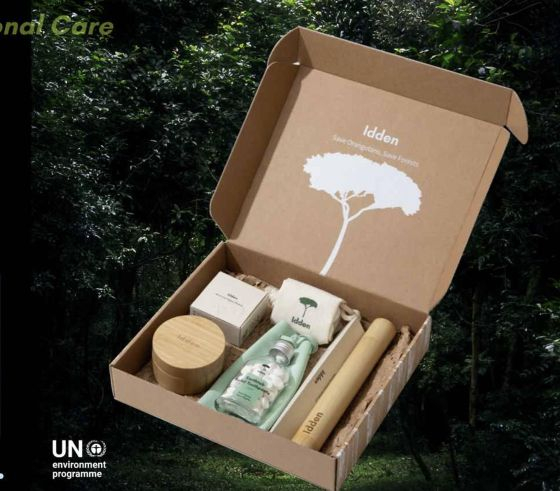
,Making sustainability 'the standard of daily life'
,Sustainable Lab Seo (CEO) aims not only to supply materials but to establish the standard for eco-friendly products used in daily life. Seo explained, "We want to create a standard for eco-friendly products that anyone uses in their daily lives," adding, "We are working on connecting the origin and narrative of discarded resources into a single material brand."
,The plastic-replacement material 'Terrafin' currently commands a price 20-30% higher than existing plastics due to additional processes required for biomass collection and processing. However, the company expects unit costs to be reduced to existing levels once mass production systems are established. Unlike the plastics industry with over a century of history, the alternative materials industry has just entered its initial stage. Seo explained that securing economies of scale and process innovation are key challenges.
,Sustainable Lab __NAME_0__ plans to build a 'Terrafin OS' system to track material origins and carbon storage data, and later integrate artificial intelligence (AI) to create a platform where consumers can verify their own carbon reduction contributions simply by using products.
,[MoneyToday startup media platform Unicorn Factory]

 in FUTURE


