

[For more diverse company information on startups, visit Unicorn Factory's Big Data Platform 'Data Lab'.]
Space has evolved from an era of exploring unknown frontiers to becoming a core pillar of industry reshaping the global economic board. In particular, low-orbit (Low Earth Orbit·hereinafter LEO), located 160–2,000 kilometers above Earth, is emerging as a forward base for a new industry integrating communications, manufacturing, observation, and logistics.
According to major investment banks (IBs) such as NovaSpace, the world’s largest space defense consulting firm, and Bank of America, the global space industry is projected to grow from 570 billion dollars (approximately 836 trillion won) in 2023 to 1.5 trillion dollars (approximately 2,200 trillion won) by 2040. Major institutional investors have analyzed that the key driver of space industry growth will emerge from low-orbit sectors linked with terrestrial industries.
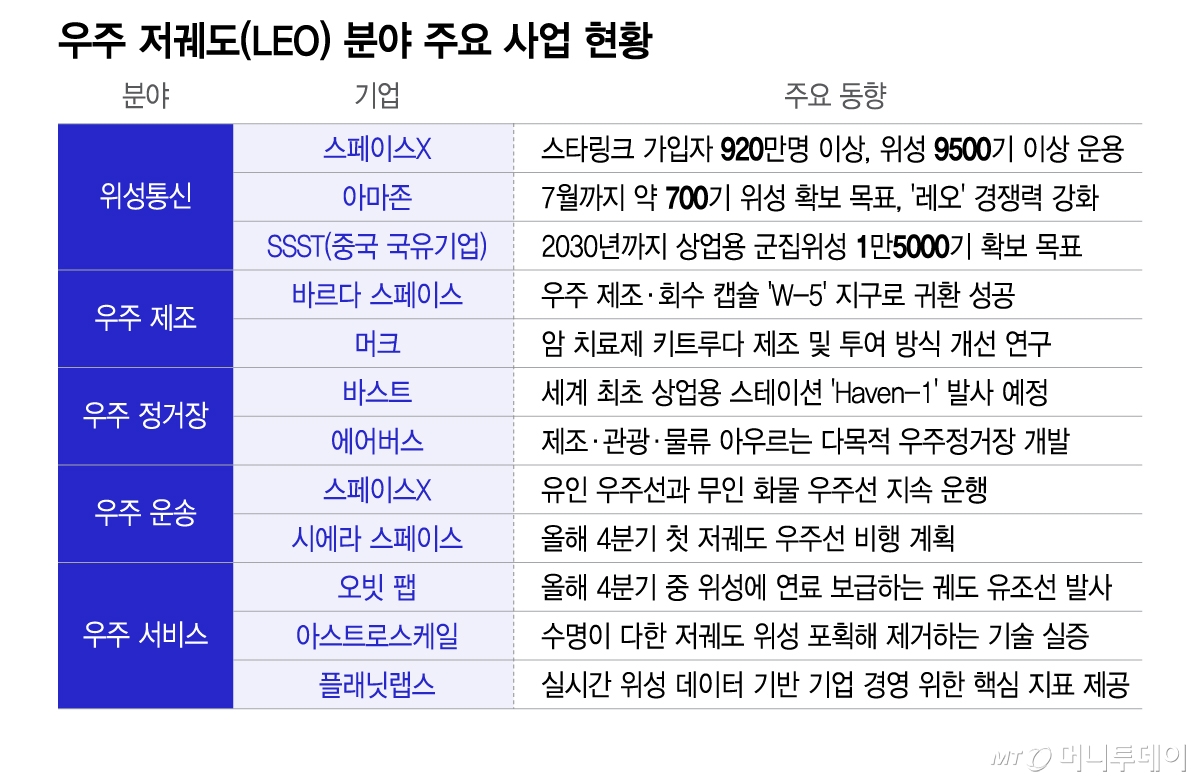
Among low-orbit industries, satellite communications is the most commercially active sector. According to global market research firm Research Nester, the global satellite communications market size is expected to grow at an annual average rate of 14.3%, rising from 12.4 billion dollars (approximately 18.18 trillion won) last year to 47.4 billion dollars (approximately 69.51 trillion won) by 2035.
Currently, the U.S.-based SpaceX effectively monopolizes this sector. As of early this year, SpaceX’s Starlink operates over 9,500 satellites and has secured more than 9.2 million subscribers.
In response, Amazon is aggressively pursuing a catch-up strategy by rebranding its satellite communications service, Project Kuiper, as Leo (LEO). The company aims to launch approximately 700 satellites into orbit by July to establish the world’s second-largest constellation of satellites.
Notably, Amazon plans to integrate its cloud service infrastructure, AWS (Amazon Web Services), with its satellite network to secure differentiated competitiveness in the enterprise market against Starlink.
China aims to expand its foothold by breaking through the Western-dominated satellite communications market through its national-level "Space Silk Road" strategy. It is currently advancing two low-orbit satellite internet projects: GuoWang (National Network, targeting 13,000 satellites) and Qianfan (Commercial Constellation, targeting 15,000 satellites).
Another tipping point for the satellite communications sector is Direct-to-Device (D2D) technology, which enables direct connection between smartphones and satellites. Previously, a separate antenna was required to receive satellite signals; now, an era is dawning where communication is possible anywhere in the world using only a smartphone.
According to global technology advisory firm ABI Research, D2D users are projected to surge from 585 million in 2024 to 2.6 billion by 2035. SpaceX has already launched a text messaging service with T-Mobile, while AST SpaceMobile is preparing communication services in partnership with AT&T and Verizon.
The Era of "Made in Space" Draws Near
The low-orbit industry is expanding beyond communications into the realms of biotechnology and manufacturing. The microgravity environment of space, where convection and sedimentation caused by gravity are nearly absent, offers optimal conditions for producing high-quality materials and pharmaceuticals that are impossible to manufacture on Earth.
According to global market research firm Research and Markets, the space manufacturing sector is expected to grow at a steep annual compound growth rate (CAGR) of 22.88%, rising from 1.48 billion dollars (approximately 2.17 trillion won) last year to 6.26 billion dollars (approximately 9.18 trillion won) by 2032.
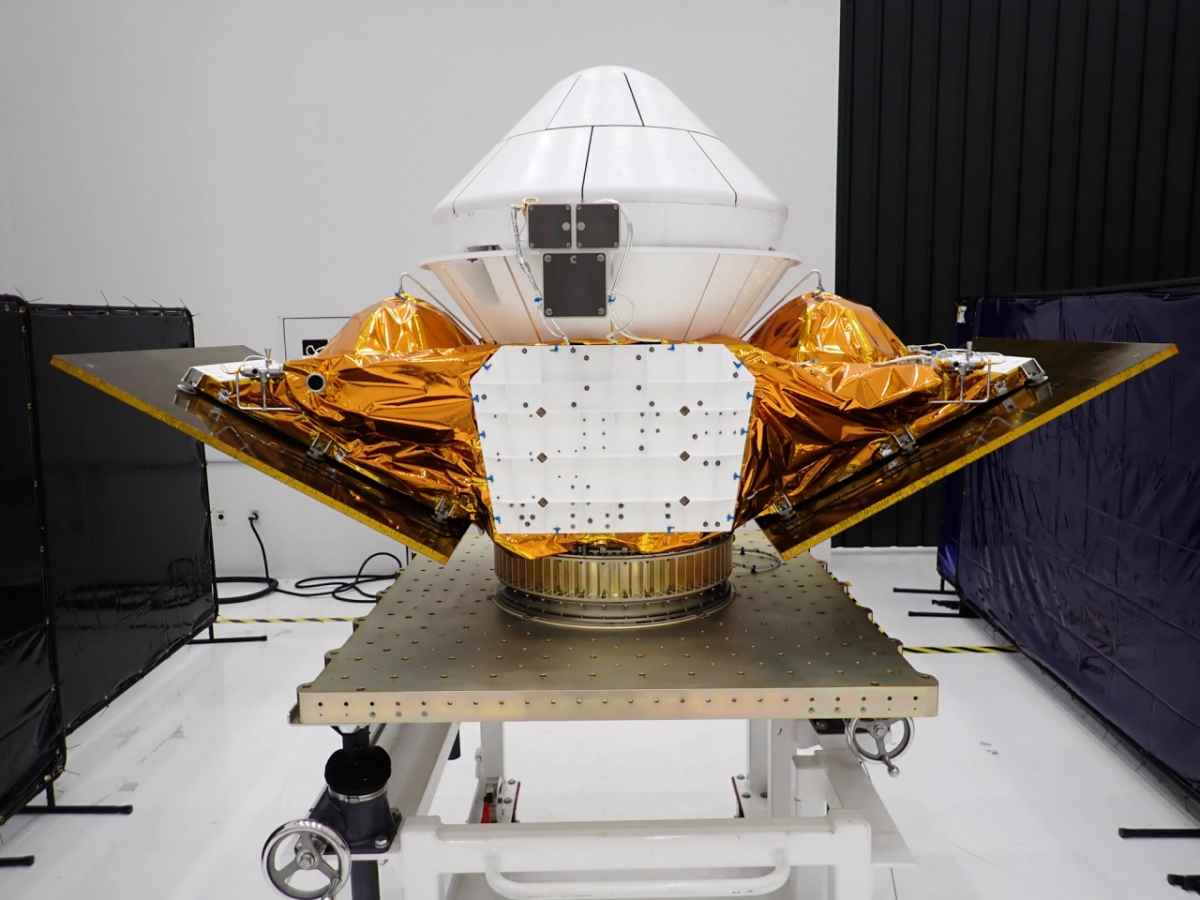
In the case of U.S. space biotech startup Varda Space, it has secured the title of "a pharmaceutical company that manufactures drugs in space and brings them back to Earth." This was achieved by returning its space manufacturing and recovery capsule 'W-5' to Earth earlier this year, proving the commercial viability of space manufacturing.
"Safe return to Earth" is considered the most challenging stage in space manufacturing. To successfully recover internal drugs or materials without deformation or degradation during re-entry into the atmosphere at temperatures exceeding 1,500 degrees Celsius, advanced technology and design are required.
Global pharmaceutical company Merck is conducting research to improve administration methods by manufacturing the cancer drug Keytruda in space. The value of this related market is estimated to reach 30 billion euros (approximately 51 trillion won).
Efforts to produce defect-free semiconductors and ultra-high-quality optical fibers are also ongoing. Materials produced in space are expected to possess significantly superior performance, enabling their integration into advanced terrestrial industries such as artificial intelligence (AI) and quantum computing, thereby creating new value.
Furthermore, with NASA planning to retire the International Space Station (ISS) by 2030, competition is intensifying among private entities to build a "space business park" led by the private sector.
Among those targeting the "post-ISS market," U.S. space startup Vast is a representative example. It plans to launch the world’s first commercial station, 'Haven-1,' this year. Airbus and Blue Origin are developing commercial space stations aimed at multi-purpose orbital platforms encompassing manufacturing, tourism, and logistics.
From Gas Stations to Janitors: The Rise of "Space Service Industry"
The "orbital services" sector, which enables efficient operation of space assets including satellite refueling and repairs, also holds high market potential. Fortune Business Insights projects that the overall orbital services market will grow from 2.81 billion dollars (approximately 4.12 trillion won) last year to 6.87 billion dollars (approximately 10.8 trillion won) by 2034.
In the "orbital transport" sector, Sierra Space’s Dream Chaser spacecraft aims to conduct its first low-orbit flight in the fourth quarter of this year. This spacecraft will perform the role of transporting cargo to space stations.
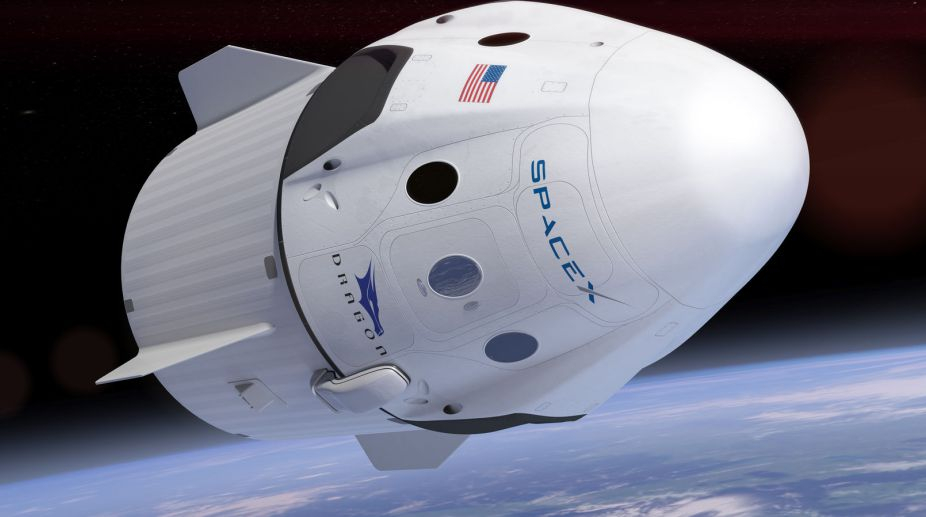
SpaceX is enhancing its capabilities for personnel and material transport in space through commercial flights of its crewed spacecraft 'Crew Dragon' and unmanned cargo spacecraft 'Cargo Dragon.'
U.S.-based Orbital Fab, aiming to become a "space gas station," plans to launch an orbital tanker to refuel satellites by the fourth quarter of this year. Meanwhile, Astroscale and ClearSpace plan to demonstrate technologies from this year to capture and remove defunct satellites amid increasing collision risks due to congestion in low-orbit regions.
Additionally, Planet Labs and BlackSky have established DaaS (Data-as-a-Service) models based on AI analysis platforms. These provide core indicators for corporate management by analyzing satellite data in real time, including crop yield forecasting, carbon emission monitoring, and supply chain risk management.
In South Korea’s case, priority is being placed on the satellite communications sector. To secure leadership in network control during the 6G era, a 320 billion won low-orbit satellite communications R&D (research and development) project has been finalized, with the goal of launching 6G-based satellites and establishing pilot networks by early 2030.
An industry insider stated, "While the U.S. is led by the private sector, China is mobilizing national resources to catch up, leading to a perception that the low-orbit industry is becoming core infrastructure reshaping the global economic landscape." He added, "Especially this year will be a critical turning point as numerous projects move out of laboratories and enter the commercialization phase."
[MoneyToday startup media platform 'Unicorn Factory']

 in FUTURE


