

[For more diverse corporate information on the startups mentioned in this article, visit Unicorn Factory's big data platform Data Lab.]
Domestic fintech startups are knocking on the door of the initial public offering (IPO) market, leveraging their achievements and profitability in global markets such as India and the United States. With K bank finally poised to enter KOSPI after three attempts, a favorable wind is expected to blow through the domestic fintech IPO market as well.
According to the venture and startup industry on the 3rd, K bank's listing on KOSPI scheduled for the 5th is expected to serve as a catalyst for reevaluating valuations in the internet banking and fintech sectors, which have been delayed by controversies over offering prices and profitability. The fintech IPO market, which had been sluggish for some time, is also expected to gain momentum.
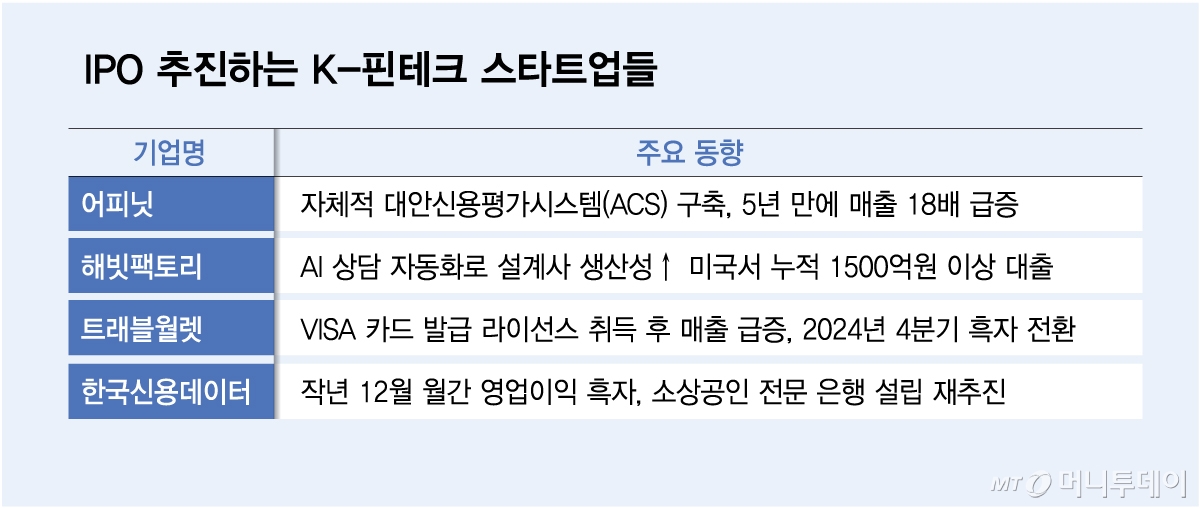
Candidates for 'post-K bank' include firms with proven growth potential such as →Upinnet→, which has built a track record in India; →Habit Factory→, which broke into the U.S. mortgage market; →Travel Wallet→, a cross-border payment fintech; and →Korea Credit Data→, which has established a strong value chain in the domestic small business sector.
Having entered India in 2014, Upinnet operates 'TrueBalance,' an AI-based financial product brokerage platform, based on its non-bank financial company (NBFC) license approved by the Reserve Bank of India (RBI).
It has built a proprietary 'Alternative Credit Scoring System (ACS)' that analyzes over 90,000 non-financial smartphone data points using AI to serve India's 1 billion strong middle class who struggle to access bank loans or credit cards. The system completes credit assessments in just 5–10 minutes and brokers financial products accordingly.
Performance growth has been steep as well. Revenue surged approximately 18-fold over five years, from 9.1 billion won in 2020 to an estimated 165 billion won last year. Operating profit was preliminarily recorded at around 30 billion won last year. Cumulative financial product brokerage volume exceeded 2.6 trillion won, with monthly average brokerage reaching approximately 80 billion won.
Upinnet has selected Mirae Asset Securities as its lead underwriter and is set to begin its KOSDAQ listing process in the second half of this year. Recently, it secured a Series E investment of 32 billion won, completing final preparations for its IPO.
Habit Factory has also captured both international expansion and profitability. Established in 2016, Habit Factory operates 'Signal Planner,' an insurance comparison and recommendation app that automates the entire process of insurance consultation, planning, and recommendation using AI. Through automated AI consultations, it increased productivity per designer by more than ten times compared to the industry average.
In 2023, it obtained a license to operate as a mortgage-specialized bank in the United States and launched its mortgage service 'Loaning.ai.' Applying an exchange rate of 1,450 won per dollar, it executed loans totaling 116.5 billion won last year. Cumulative loan volume exceeds 256.1 billion won.
Profitability has also entered a stable trajectory. In the first quarter of last year, revenue reached 9.4 billion won, an 86.8% increase year-on-year, and operating profit turned positive at 700 million won. On an annual basis, it recorded revenue of 39 billion won and an operating loss of 2.6 trillion won, significantly reducing the previous year's deficit of 13 billion won.
This year's sales target is 67 billion won, with operating profit projected at 12 billion won. Regarding the IPO, it has selected Samsung Securities and KB Securities as joint lead underwriters. Jung Yun-ho, co-CEO of Habit Factory, stated, "We can generate meaningful revenue and operating profit this year, so the planned IPO should be feasible."
Travel Wallet, which promotes 'zero foreign transaction fees,' saw its performance surge rapidly following the acquisition of Asia's first VISA card issuance license in 2020, coinciding with increased demand for overseas travel.
Revenue grew from 338 million won in 2021 to 2.671 billion won in 2022, 23.058 billion won in 2023, and 59.236 billion won in 2024. The fourth quarter of 2024 marked a successful turnaround to profitability. While the specific listing date has not been disclosed, it is reported that preliminary discussions with multiple securities firms regarding lead underwriter selection are underway.
Korea Credit Data, which provides bookkeeping management, sales analysis, payment, and financial services to 1.7 million businesses nationwide through its small business management service 'Cash Note,' is also approaching its IPO timing.
Korea Credit Data recorded a monthly operating profit surplus in December last year, dispelling concerns about profitability, and is accelerating plans to establish a specialized bank for small businesses. Considering that the 100 billion won convertible bonds (CB) raised in 2023 mature in 2028, it is expected to complete its entry into the stock market before then.
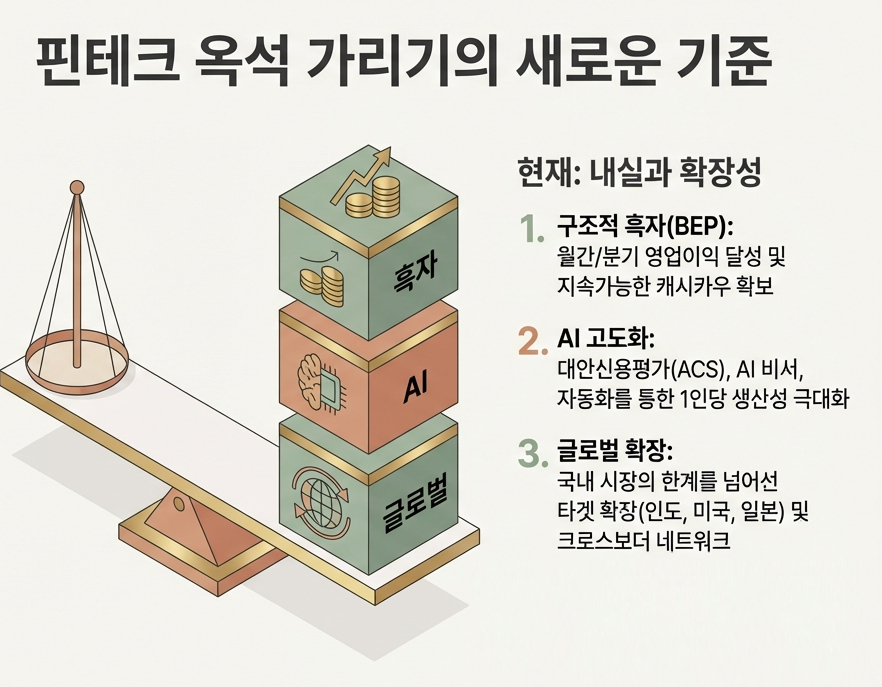
A fintech industry official stated, "Recently, the fintech IPO market has shown a trend of placing importance on profitability and the ability to apply AI technology." He added, "Starting with K bank's listing, we expect a relay of listings by companies equipped with both strong performance and technological capabilities will inject vitality into the domestic fintech ecosystem."
→[MoneyToday startup media platform →'Unicorn Factory'→]→

 in FUTURE

