

[More diverse corporate information on startups can be viewed at Unicorn Factory's Big Data platform, Data Lab.]
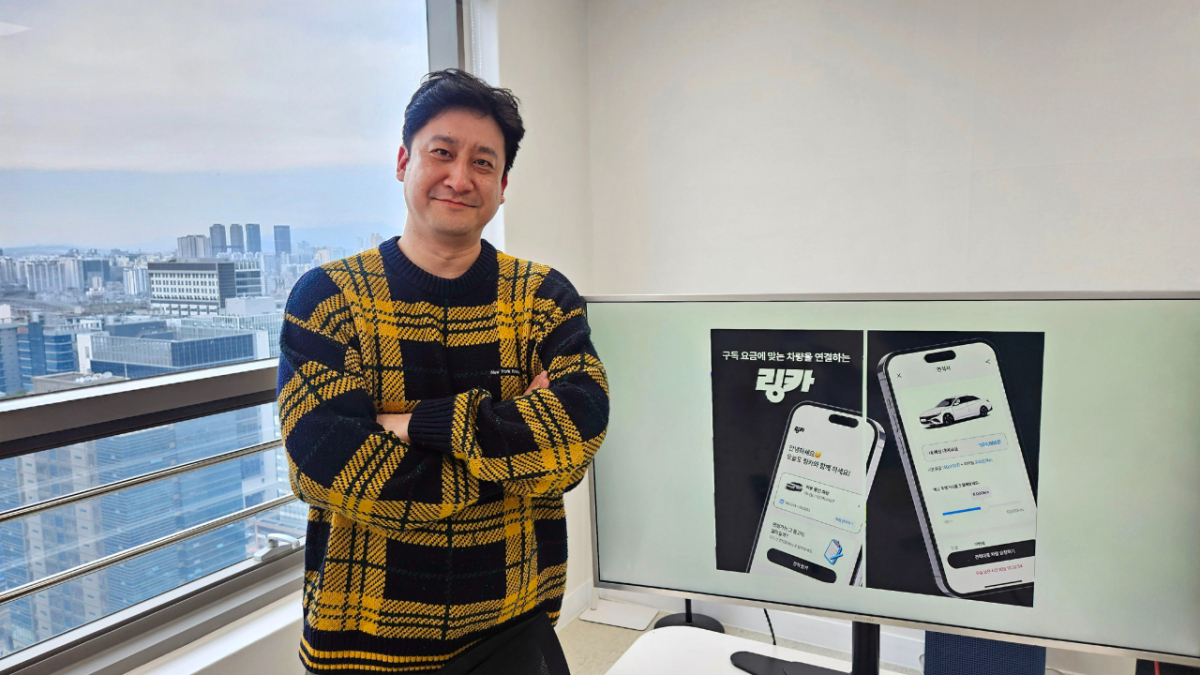
Even when purchasing used cars, strict application of the DSR (Debt Service Ratio) regulation means that many consumers either downgrade their vehicle class or abandon purchases entirely if they have existing housing collateral loans or personal credit loans. As an alternative, many are turning to rental-type products such as rent-to-own and leasing. However, existing rent-to-own and leasing services limit choices to a pre-acquired inventory held by the provider, resulting in a narrow selection range. Consumers face difficulties finding vehicles that match their desired model year, specific model, options, or color.
The more granular the search filters become, the number of available vehicles drops sharply, and in some cases, no vehicle may exist that meets the desired conditions. As a result, consumers are left with no choice but to compromise on their preferences or make a suboptimal selection. A startup has emerged to address this issue through a "subscription" model. Solvers Fincap operates Linkcar (링카), a service in which consumers directly select a used vehicle from general listings, and the company purchases that vehicle to offer it to them via subscription.
The name Solvers Finance embodies the meaning of "a gathering of problem solvers." The first area they focused on was mobility, and within that sector, they launched the Ringka service to address the issue of financial exclusion in the used car market.
The "subscription" model transcends the limits of rent and lease.
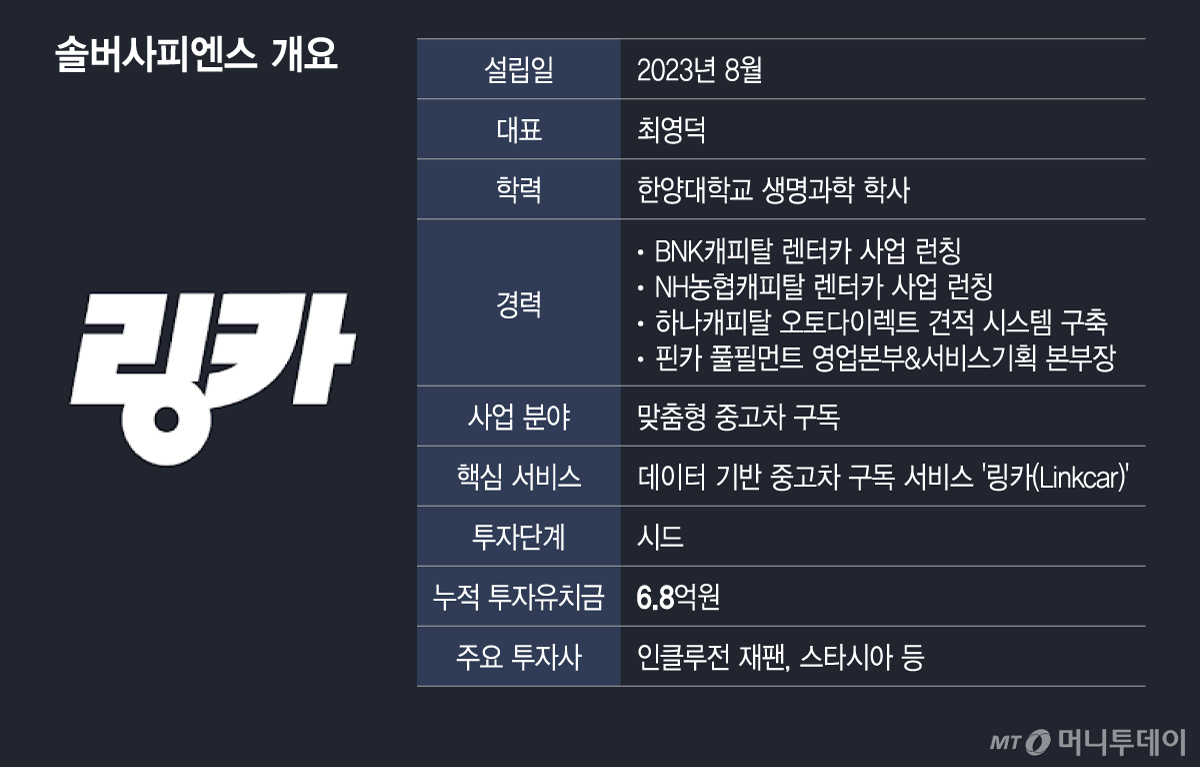
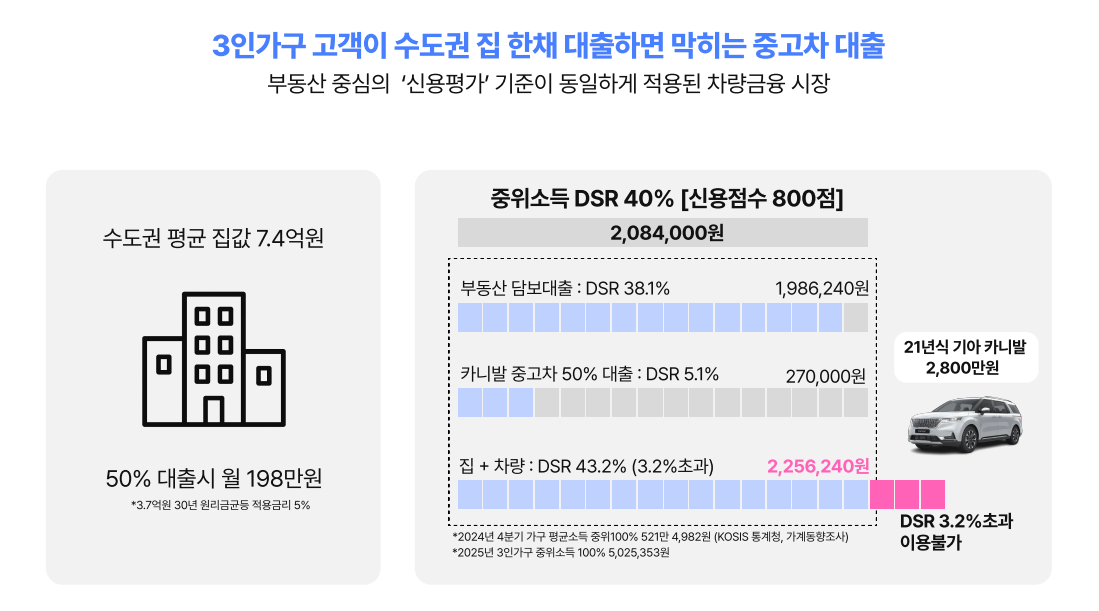
Choi Young-deok, CEO of Solver S&P, pointed out that "despite vehicles being essential goods as indispensable as food, clothing, and shelter, the same real estate collateral loan evaluation method is applied when purchasing a vehicle, binding them to DSR regulations centered on real estate." He added, "For example, even if a three-person household owning a home at the median price in the Seoul metropolitan area borrows only a portion of the home's value, their DSR can reach nearly 40%," and noted that "it is not uncommon for individuals with an excellent credit score of 800 points to be unable to secure even an additional car installment loan of just 10 million won."
He added that the current approach, which restricts loans based solely on whether real estate leverage is used regardless of income levels or actual repayment ability, is outdated. He diagnosed that due to such regulations, approximately 150,000 customers with strong creditworthiness are being excluded from the financial market annually.
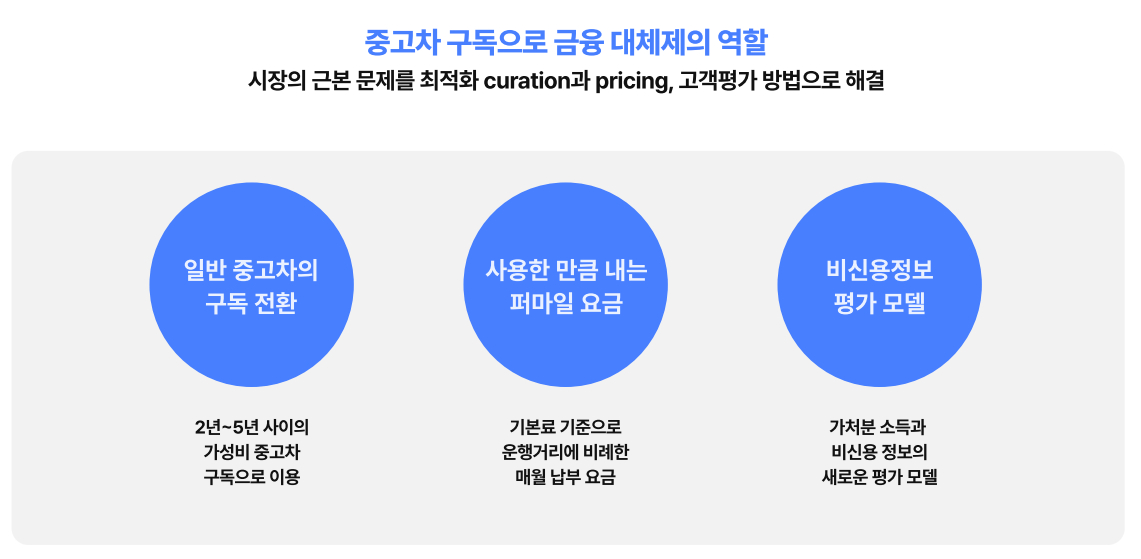
Solvers F&P reported that the DSR safety device is actually hindering access to automotive finance and proposed a new evaluation model based on disposable income (income available for free consumption after deducting expenses such as consumption and savings) as an alternative.
According to the explanation, based on annual income and health insurance payment records confirmed through National Tax Service data, estimated income is determined, and spending patterns such as the monthly average credit card usage amount included in National Tax Service deduction details are cross-referenced to calculate the consumer's actual 'monthly disposable income' available each month. If the calculated monthly disposable income falls within Ringa's monthly average subscription fee range of 300,000 to 900,000 won, approval is granted even for low-credit individuals with a credit score of 350 points, allowing them to use the service. After a customer selects a vehicle, all processes are completed within an average of seven days from application to usage.
Choi (CEO) stated, "While the existing financial sector relies solely on NICE or KCB credit scores, Ringka analyzes disposable income and actual spending records." He added, "Even for those with low credit scores, we evaluate their actual monthly capacity to spend, solving the problem of financially excluded individuals who cannot purchase vehicles due to DSR regulations." Over a period of one year and four months, testing was conducted using 23 vehicles under the MVP (Minimum Viable Product) concept. The results showed that customers selected based on disposable income maintained service at a rate of 95.2%. There was only one case of vehicle repossession due to delinquency.
Choi (CEO) stated that the cause was not moral hazard on an individual level, but rather business deterioration and bankruptcy resulting from a sluggish economy. They added that the fact that only one recovery case occurred alongside a high service retention rate proves that Linka's disposable income assessment model accurately identifies actual payment capacity.
"Per-mile fee plan"... up to 35% monthly savings
Solvers Fincap's revenue consists of monthly subscription fees and recovery costs from vehicle sales. The company equips all vehicles with OBD (On-Board Diagnostics) devices to manage risk. If payments are overdue by three to five days after the due date, the engine is remotely disabled; if the delay extends to five to seven days, the vehicle is immediately recovered to minimize sunk costs. By identifying early signs of abnormalities through OBD and predicting and managing maintenance timing, the company preserves the asset value of its vehicles.
An OBD-based 'Per-mile' pricing plan is also scheduled for launch. This plan calculates the depreciation of a vehicle's future value based on how much the customer uses it, converting that amount into a fee per kilometer driven. Choi (CEO) stated, "Existing rental and lease products typically pre-agree on an annual mileage of 15,000 to 30,000 kilometers at the time of signing the contract, and the calculated vehicle depreciation is divided equally and paid monthly." He added, "The average usage for users is around 9,000 kilometers, meaning they end up paying for and effectively wasting the cost associated with the remaining mileage they do not use."
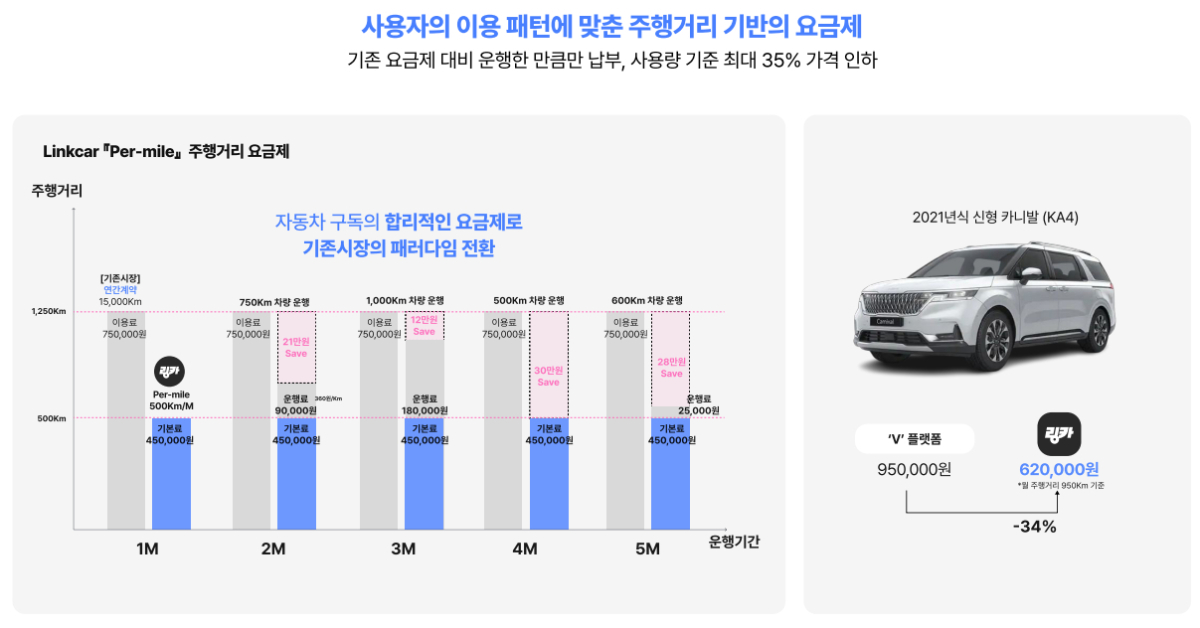
Ringgo provides a 'benefit' to customers who drive less by preserving the vehicle's value, thereby lowering their usage fees. This is based on the principle of calculating expected profits from future vehicle sales and reflecting them in current usage fees. Choi (CEO) stated, "Using the per-mile fee plan can reduce monthly charges by up to 35% compared to the existing method," adding that "the company is currently collecting and verifying data to establish an accurate fee model, with actual implementation planned for new customers in the second half of this year."
Solverspace aims to expand its vehicle fleet to 300 units this year. Alongside this goal, the company plans to further enhance machine learning-based customized vehicle curation, real-time data evaluation models, and residual value prediction for vehicles based on operational data accumulated over time.
Choi (CEO) stated, "When consumers search for Carnival at a rental car company, they typically find options for people in their 10s and 20s, but Ringka utilizes a general vehicle database to offer more than 100 times the selection." They added, "National Tax Service data reflects the previous year's figures, creating a time lag; therefore, we will link income and expenditure data in real time through future credit card company verification and other means." The speaker further emphasized, "It brings great satisfaction when consumers who were rejected by the existing credit evaluation system are able to use their desired vehicles through Ringka," and concluded, "We aim to expand our subscription model beyond vehicles into various sectors, creating a new economic ecosystem based on actual value rather than credit scores."
[Money Today startup media platform 'Unicorn Factory']

 in FUTURE


