

[For more diverse information on startups mentioned in this article, you can view it on the Unicorn Factory Big Data Platform Data Lab.]
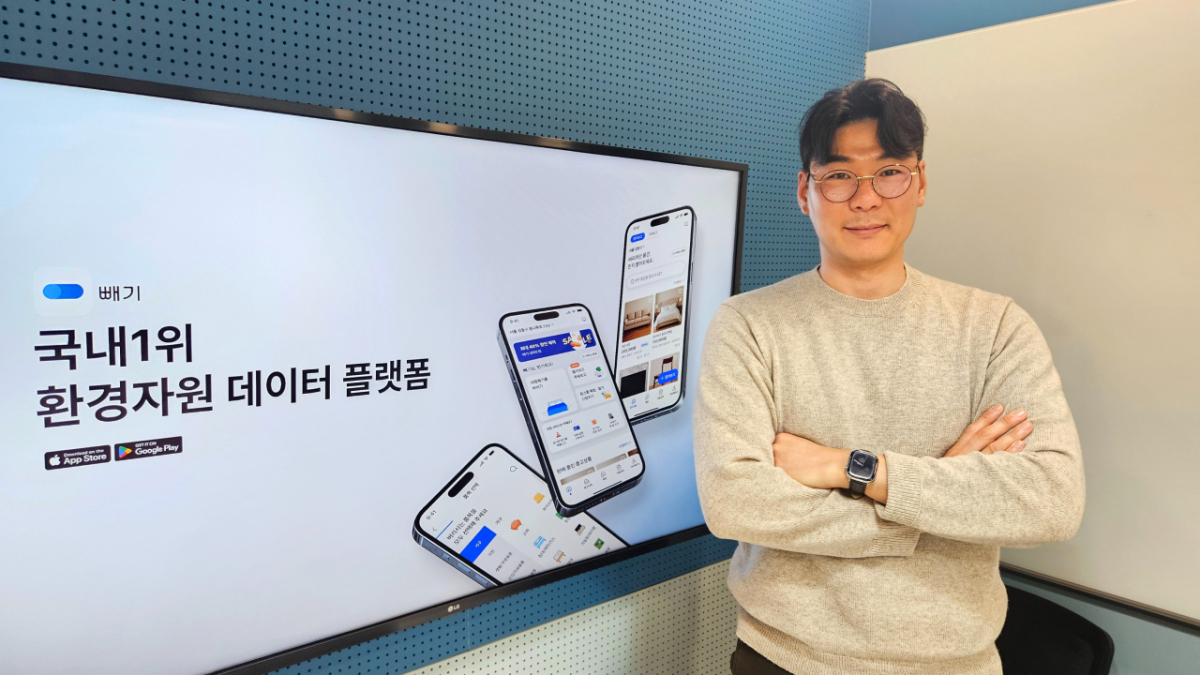
"The process of buying things takes only a few seconds online, but disposing of them remains stuck in an analog method from 30 years ago. Bridging this gap was the beginning of innovation."
Ko Jae-seong (CEO), CEO of Gata, which operates the AI-based resource circulation platform 'Ppae-gi' (Subtraction), found the starting point of the business in everyday inconveniences. The experience of visiting a local office to dispose of large waste when moving, and having to drag heavy appliances out even on rainy days, became the clue for the business.
Ppae-gi, Gata's flagship service, integrates fragmented waste disposal and processing processes with data, maximizing administrative efficiency for local governments while enhancing individual convenience. It possesses the technical capability to automatically map various waste items to administrative standards through AI.
Challenging the analog waste disposal market
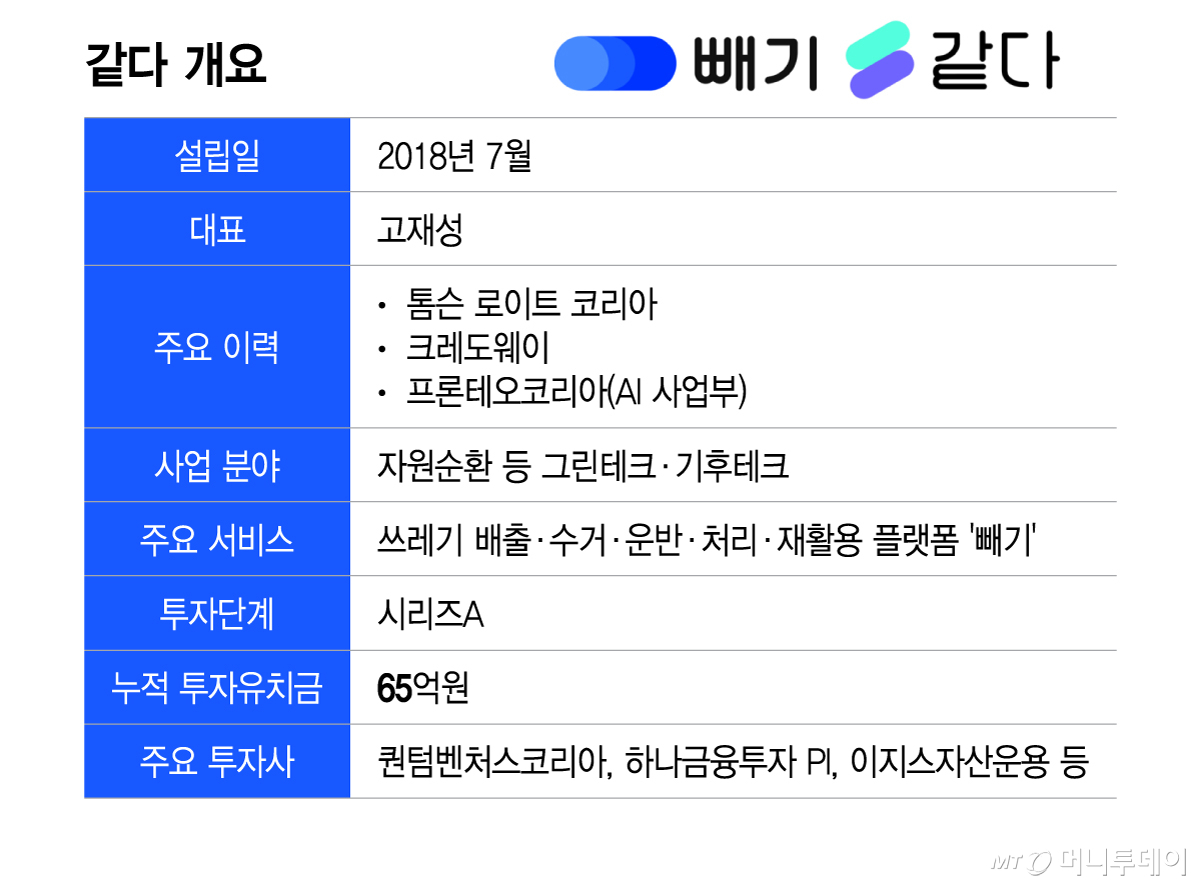
The unique company name 'Gata' (Same) reflects his business philosophy. Ko (CEO) said, "In the early stages of the business, we experienced the conservative and exclusive atmosphere typical of the waste disposal market," and added, "We incorporated the concept of 'same heart' into our mission to resolve this market environment through technology and benefit society."
The initial service expansion plan was also reflected in the company name. Starting with the waste disposal service 'Ppae-gi' (Subtraction), they planned △'Deo-gi(+)' (Addition) for second-hand trading, △'Na-nu-gi(÷)' (Division) for sharing and donations, and △'Go-pu-ha(X)' (Multiplication) for cloud-based collaboration.
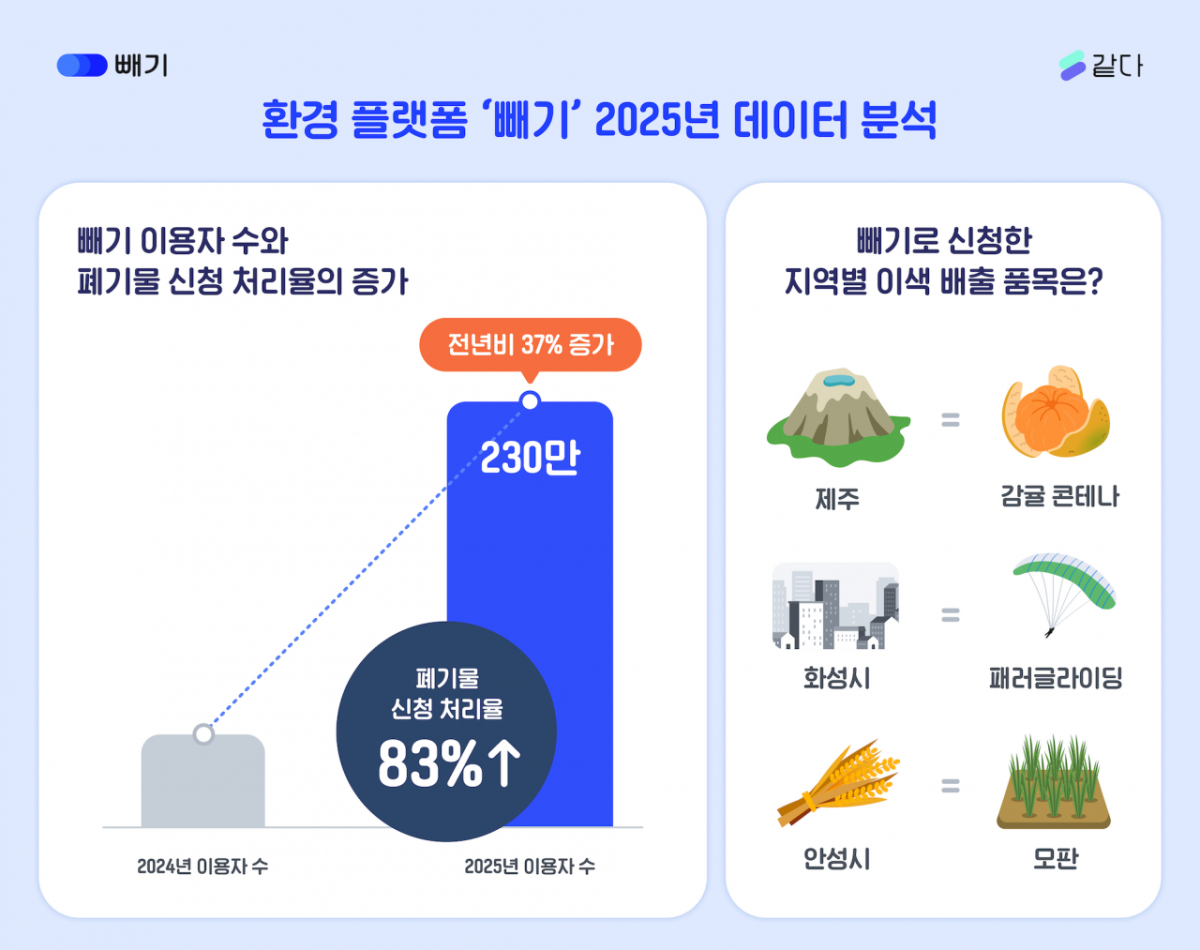
Currently, the focus is entirely on the Ppae-gi service. At present, Ppae-gi has grown into Korea's number one waste disposal service, having signed agreements with over 80 local governments and secured a cumulative 2.3 million registered users. The business model operates on two pillars: a subscription-based software-as-a-service (SaaS) solution for local governments and an intermediary platform connecting large-scale and construction waste transportation. Approximately 300,000 disposal applications are received monthly.
AI translating various waste items into 'administrative language'

Technologically, differentiation has also been achieved. Through CNN (Convolutional Neural Network) technology, an AI deep learning model used for visual image analysis, the system automatically recognizes the item and specifications of waste in photos and standardizes varying item names across local governments using Natural Language Processing (NLP) technology. A comprehensive survey of ordinances from all local governments nationwide created an integrated database (DB) containing up to 3,500 items.
Ko (CEO) stated, "In some local government ordinances, 'massage chairs' were not listed as an item, so people often left them on the roadside." He continued, "Now, when a user selects a massage chair in the app and uploads a photo, Ppae-gi's AI maps it to the most similar item according to that local government's ordinance. This means residents can legally pay fees and dispose of waste properly, while local governments can reduce the burden of illegal dumping and public complaints."
Thanks to these efforts, Ppae-gi has enabled real-time sharing of disposal data, reducing average collection vehicle operating costs by 20%, and digitized all paper documents related to waste for local governments. It is estimated that cumulative carbon dioxide emissions have been reduced by 17,000 tons and waste incineration by 4,500 tons. In particular, about 12% of disposal applications made through the Ppae-gi app are converted into second-hand transactions, creating a virtuous cycle for resource circulation.
The difference from existing garbage disposal platforms lies in the strong partnership with local governments. Ko (CEO) said, "Other platforms attract users through advertising and marketing, but we have local governments announce the service to residents as an official channel." He added, "A model that encompasses public SaaS, private transportation intermediation, and second-hand trading is unique to Ppae-gi in Korea."
Transforming old junk shops into modern 'resource stations'
Gata is also promoting a project to digitally transform (DX) aging junk shops and remodel them into modern hubs for resource circulation. Ko (CEO) defined junk shops as "the last logistics warehouse where inventory exists only in the owner's mind, with no systemization whatsoever."
He emphasized, "By leveraging the strategic location of junk shops in prime areas of old downtowns, we will install an ERP (Enterprise Resource Planning) system to digitize receipts and inventory management that were previously handled manually, and link this with our platform to create synergy."
The goal is to collaborate with local governments to convert the interior of junk shops into showroom-style spaces, shed their messy image, remodel them into safe and clean 'resource stations,' and franchise them, turning them into modern facilities that citizens can visit without resistance.
Ko (CEO) said, "We will utilize these as multi-purpose spaces to raise awareness of the importance of resource circulation by conducting educational programs related to waste disposal," and added, "The first store applying digital transformation is scheduled to launch in September or October."
This model will also be a core strategy when expanding into overseas markets such as Vietnam or Indonesia in the future. He stated, "We plan to target Vietnam and Indonesia, where waste disposal laws have just been introduced, as our first targets to export Korea's advanced systems."
He further emphasized, "We aim to break the prejudice that the environmental industry has low profitability and leave a record of how Korean companies completely changed perceptions about waste disposal and established a resource circulation system in the future."
[MoneyToday startup media platform 'Unicorn Factory']

 in FUTURE


