

[Exclusive] Despite 49 rounds of consultations, virtual asset taxation infrastructure remains "stagnant"... Exchanges say "nine more months needed after finalizing detailed plan"

Although the government has announced the implementation of taxation on virtual asset transactions in January next year, it was confirmed that not a single one of the five major virtual asset exchanges has prepared the relevant systems. System development has been delayed because detailed taxation criteria have not been finalized. In addition, given the limitations in verifying income information from overseas exchanges, forecasts are emerging that virtual asset taxation may be deferred once again.
According to documents obtained by the office of People Power Party lawmaker Park Soo-young, a member of the National Assembly's Committee on Finance and Economy, between 2022 and October this year, the government and exchanges conducted 49 rounds of consultations regarding taxation, but no exchange has yet established a taxation system.
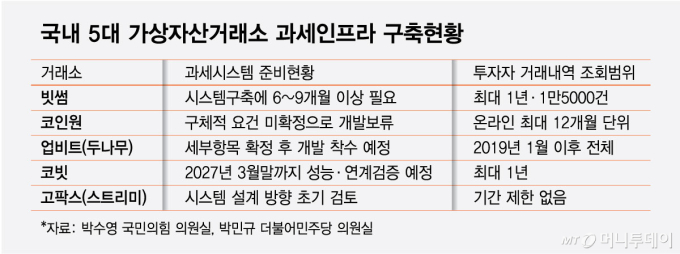
Since reporting to the National Tax Service in November last year that it had not begun developing its virtual asset taxation system, Bithum has maintained the same status through this month. At the time, Bithum stated that while it examined the necessity and structure of the taxation system, it could not begin development because detailed criteria such as laws and forms had not been finalized.
Bithum takes the position that a minimum period of six to nine months or more is required for system development, even if phased preparation periods are conducted in parallel. Specifically, it explained that starting from when the tax authority's test environment is established, the following are needed: two months for reviewing and finalizing detailed requirements; four months for system design and development; two months for data consistency verification and migration of past records; two months for linkage tests with the tax authority and integrated testing; and one month for user verification, disaster response training, and stabilization.
Since the National Tax Service has stated that it will verify income from transactions in 2027 starting from filings in May 2028, taxation itself is not impossible, but a period extending beyond the planned implementation date of January next year is required.
Coinone also stated, "We have conducted internal discussions on system construction, but we are holding off on commencing work." Upbit (Dunamu) is preparing to begin development after finalizing items for transaction statements and aggregation tables. Coinbit plans to conduct performance tests and interface verification by March 31 next year. Koinex (Streamy) is at the stage of initially reviewing the direction of system design.
In addition, exchanges verbally conveyed to the Park Su-yeong (Rep.) office that "it is difficult to ensure sufficient security, performance, and disaster recovery verification if a large-scale taxation system is built in a short period." They also expressed concerns that approximately two years of preparation time are needed for verification and stabilization, and that insufficient preparation could lead to omissions in transaction data or errors in withholding tax and the application of tax treaties for non-residents and foreign corporations.
A time lag is also emerging in securing income information from overseas exchanges. According to documents from the Park (Rep.) office, 46 countries, including South Korea, Japan, and the United Kingdom, will participate in information exchange under the Crypto-Asset Reporting Framework (CARF) in 2027. It was analyzed that if taxation is implemented next year, information exchange via CARF will be difficult with approximately 43% of the target countries.
As the issue of insufficient taxation infrastructure has surfaced, movements to postpone implementation are appearing not only from the opposition but also from the ruling party. Democratic Party of Korea lawmaker Park Min-gyu, a member of the National Assembly's Committee on Political Affairs, has filed as the representative sponsor a bill to amend the Income Tax Act with the intent of effectively delaying the implementation date for taxation on virtual asset income from next year to 2029. However, political controversy is expected to continue over whether insufficient preparation for taxation constitutes sufficient grounds for a fourth deferral since legalization in 2020.
Virtual Asset Taxation at the Crossroads of a "Fourth Deferral"... Intensifying Political Debate
Since preparation for virtual asset taxation is not yet complete, voices demanding another deferral are growing within the political sphere. However, counterarguments also emerge that taxation should proceed as scheduled in accordance with the tax principle that "where there is income, there is tax," given that it has already been deferred three times.
According to political circles on the 21st, virtual asset taxation is a system that imposes an income tax of 20% (22% including local income tax) on the amount exceeding 2.5 million won after deducting 2.5 million won from annual income generated by the transfer or lending of virtual assets such as Bitcoin. Introduced through an amendment to the Income Tax Act at the end of 2020, it was originally scheduled for implementation in 2022 but was postponed three times due to reasons including deficiencies in the taxation system and investor protection mechanisms.
Despite three postponements, preparations remain incomplete. According to documents submitted by the five major virtual asset exchanges to the office of People Power Party lawmaker Park Soo-young, not a single exchange has completed the construction of a taxation system. Upbit (Dunamu), South Korea's largest virtual asset exchange, is preparing to begin development after finalizing items for transaction statements and aggregation tables. Coinbit plans to conduct performance tests and interface verification by March 31 next year. Koinex (Streamy) is at the initial stage of reviewing system design directions. Coinone also stated, "We have conducted internal discussions on system construction, but we are holding off on commencing work."
According to the office of Democratic Party of Korea lawmaker Park Min-gyu, a member of the Committee on Political Affairs, differences were confirmed in the scope of transaction history inquiries provided to investors by each exchange. Upbit allows inquiry into all transaction history from January 2019, while Bithum allows inquiries within a maximum of one year and up to 15,000 entries. Coinone allows inquiries into transaction history since 2021 in units of up to 12 months on its online platform. Coinbit allows inquiries within a maximum range of one year, and Koinex has no limit on the inquiry period.
Currently, the People Power Party has decided to make the deferral of virtual asset taxation its party stance. The Song Eon-seok (Rep.) has filed a bill to abolish virtual asset taxation, while Kim Sang-hoon and Jeong Seong-guk (Rep.) have each filed as representative sponsors bills to amend the Income Tax Act to defer the implementation of taxation by two to three years. Within the ruling camp, Park Min-gyu (Rep.) has filed a bill with the intent of effectively delaying the implementation of taxation from next year to 2029.
Ruling party lawmakers on the Committee on Finance and Economy, which is responsible for reviewing tax laws, are also showing a cautious stance on deferring taxation. Oh Gi-hyeong (Rep.), the ruling party spokesperson on the committee, stated during the National Tax Service national audit on the 13th last month, "We can discuss how to change the basic deduction amount or whether to expand loss deductions," indicating room for institutional improvement.
There are also points noting that political judgments considering public sentiment opposing taxation among youth and retail investors have played a larger role in the political moves toward deferral than the policy burden associated with inadequate taxation infrastructure.
On the other hand, Jeong Chaek-yeon-gu (Director), an innovation official of the Rebuilding Korea Party, stated on this day, "The grand principle of taxation that 'where there is income, there is tax' cannot be a subject of compromise. What the government and the ruling party should do is not 'abandoning taxation' but 'rational design,'" adding, "We hope the Democratic Party will abandon political engineering vote calculations and return to the path of a livelihood reform party." This argues that virtual asset taxation should proceed as scheduled.
The review report on the "Petition Regarding the Abolition of Virtual Asset Taxation" by the National Assembly's Committee on Finance and Economy also pointed out that "reversing the decision on whether to tax virtual asset income, which has already been determined through discussions in the Tax Subcommittee, etc., could undermine trust in tax policy."
Meanwhile, the issue of deferring virtual asset taxation is expected to be discussed during the National Assembly's review of the tax law amendment bill in November.
Two Months Before Virtual Asset Taxation... Desperate Situation in Establishing Taxation Criteria, Deferral Theory Gains Weight
With two months remaining until the implementation of virtual asset taxation, deferral theories are emerging. The difficulty for tax authorities in establishing taxation criteria, as well as the lack of relevant infrastructure at exchanges, are reasons adding weight to the deferral theory.
According to the government and industry on the 21st, the Ministry of Economy and Finance held a closed-door meeting with industry representatives and related experts the previous day, launching an inspection of virtual asset taxation. The purpose was to hear industry opinions ahead of the two-month mark before implementation.
First Vice Minister of Economy and Finance Kwon Dae-young stated, "The principle that 'where there is income, there is taxation' must be respected," explaining, "For that principle to take proper root in the market, taxation infrastructure and market discipline systems must be established together." He added, "We will comprehensively inspect preparation status, including conditions for international information exchange, taxation criteria by transaction type, and filing convenience," and "We will carefully consider the opinions raised and consult closely with relevant ministries." This is interpreted as meaning that decisions will be made after comprehensively assessing infrastructure and other factors, rather than finalizing taxation immediately.
To tax virtual assets, it is necessary to establish taxation criteria for each transaction type, including calculating acquisition costs and verifying transaction records from overseas exchanges and personal wallets, as well as staking (a method of depositing cryptocurrency in a blockchain network for a certain period to receive rewards) and airdrops (the unauthorized distribution of cryptocurrency tokens or coins to numerous wallet addresses for free).
Securing overseas transaction information is also required, but this is not an easy situation. Unlike domestic exchanges, there are limitations in securing taxation data for transactions using overseas exchanges or personal wallets. Consequently, concerns are emerging that taxation may be concentrated on users of domestic exchanges. This suggests that issues of tax fairness between users of domestic and overseas exchanges could arise.
The international virtual asset information exchange system is also still inadequate. South Korea will apply the OECD Crypto-Asset Reporting Framework (CARF) starting next year, but the United States will not participate until 2029. Taxation issues that may arise if international information exchange is not smooth are also significant.
It is pointed out that establishing rational taxation criteria that taxpayers can empathize with is important, and there are many hurdles to overcome from establishing taxation criteria to amending laws. In effect, it can be seen as a situation where implementation in January next year is practically impossible for the government.
An industry official stated, "As the virtual asset market develops, transaction methods are becoming diversified and complex, so there is a need to establish clear taxation criteria to resolve uncertainty," adding, "Business operators need time to build and verify taxation data submission systems, and the issue of tax fairness with overseas exchange users must also be considered." It is pointed out that at this point, deferral of taxation is unavoidable in order to establish specific systems.
However, a government official stated, "Ahead of the implementation of virtual asset taxation on January 1, 2027, the National Tax Service will announce a plan containing taxation criteria in November as scheduled," explaining, "Since virtual assets involve technical areas, separate guides will be issued for each case so that citizens can easily view and understand them."
He continued, "The announcement content will include calculation methods based on technical taxation criteria within the limits delegated by law," while adding, "Determining whether to tax staking (a method of depositing cryptocurrency in a blockchain network for a certain period to receive rewards) and other items that become taxable under virtual asset taxation requires legal interpretation and is an area where the Ministry of Economy and Finance and the National Tax Service must consult." This can also be seen as acknowledging that many issues remain to be consulted on.
Meanwhile, virtual asset taxation was introduced through an amendment to the Income Tax Act in 2020 and has been deferred three times. Although multiple deferral bills have been filed, if no additional legal amendments are made, taxes on virtual assets must be paid starting from January next year. A tax rate of 22%, including local income tax, is applied to the amount exceeding 2.5 million won in annual

 in STOCK

