

[For more diverse corporate information on the startup featured in this article, please visit the Unicorn Factory big data platform 'Data Lab'.]
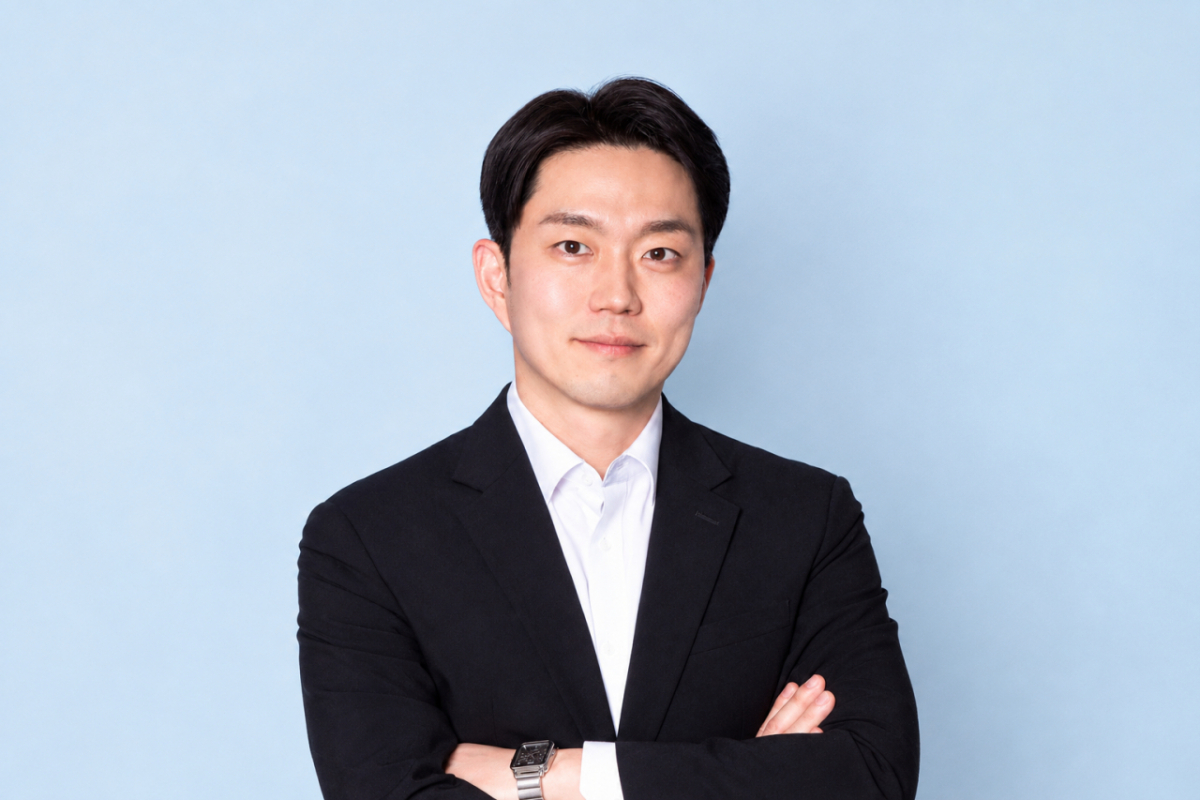
"We started with the goal of becoming Korea's Circle, but now our aim is to become the digital asset financial institution that best responds to financial regulations. Ultimately, we aspire to be a trusted partner that all financial institutional investors seeking to conduct digital asset businesses turn to first."
Kim Gyeong-eup, CEO of Open Asset, recently met with Money Today's startup-specialized media platform 'Unicorn Factory' and defined the company as "a place that possesses blockchain technology and Web3 experience while properly understanding financial regulations," stating the above.
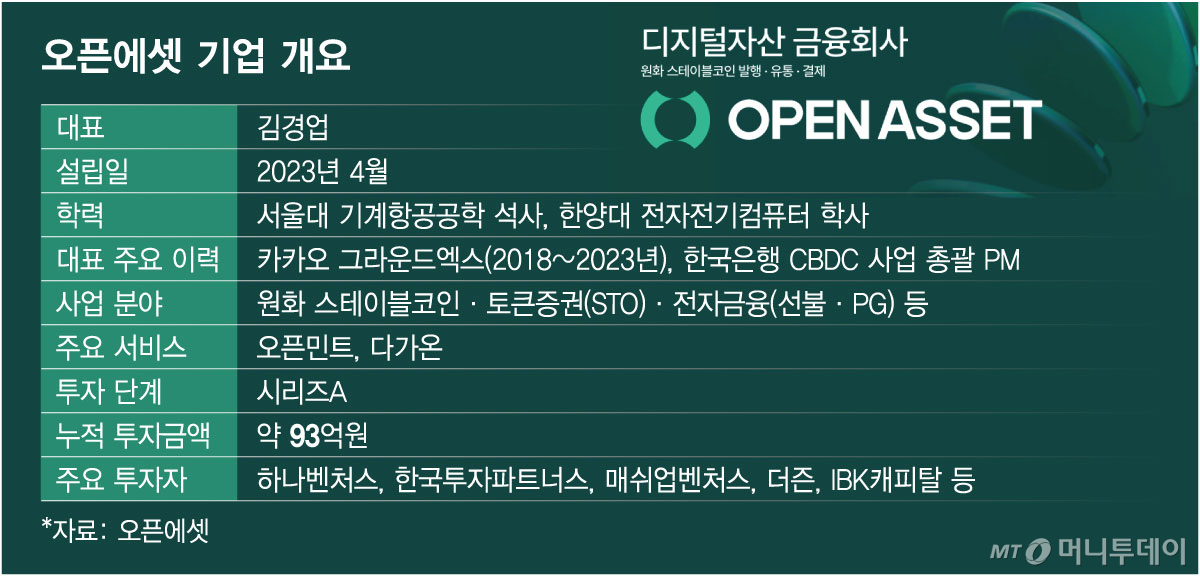
Founded in 2023, Open Asset is a startup providing the infrastructure necessary for financial institutional investors to issue, store, transfer, and exchange digital assets, including stablecoins. Rather than simply supplying blockchain technology, it focuses on designing systems that allow financial institutional investors to conduct digital asset businesses while complying with existing regulations.
Behind this confidence lies the experience Kim (CEO) has accumulated by moving between the blockchain and financial sectors. Kim (CEO) began his career as a software developer at Samsung Electronics before joining Kakao's blockchain subsidiary Ground X, where he played a key role in the development and launch of the mainnet for the public blockchain platform 'Clayton.' He subsequently oversaw Bank of Korea's central bank digital currency (CBDC) project, gaining experience in integrating blockchain technology into financial infrastructure.
From Clayton to Bank of Korea CBDC
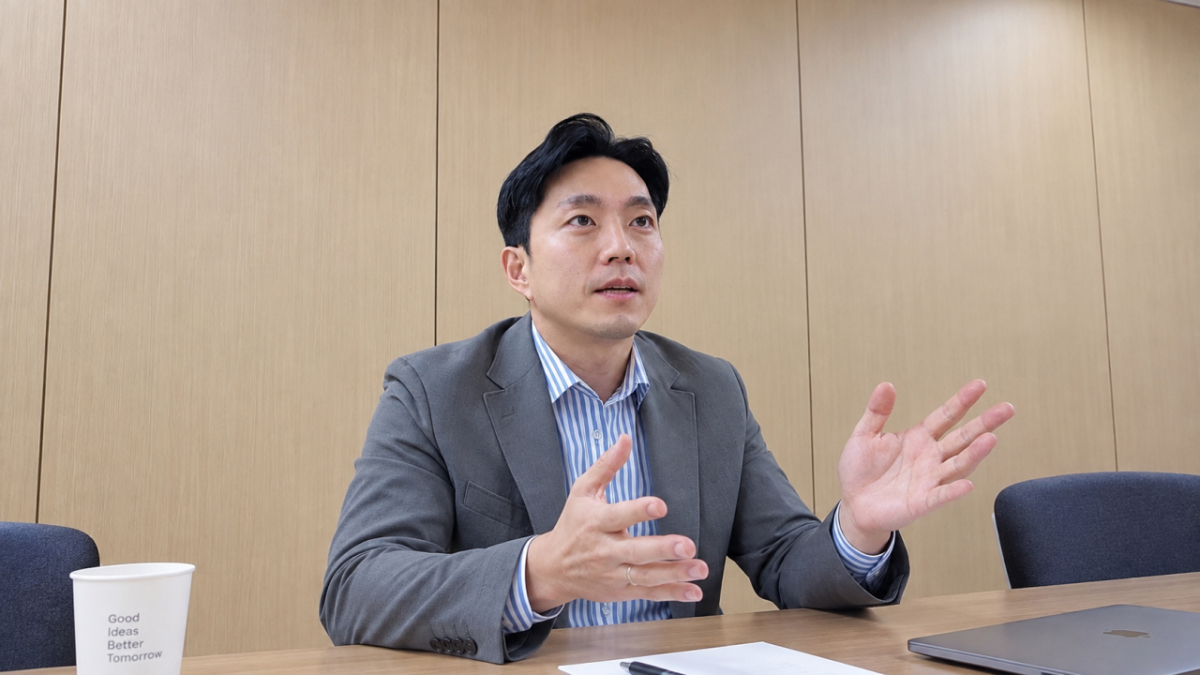
The seed for the startup was planted during the Bank of Korea CBDC project. Kim (CEO) foresaw that the private stablecoin market would also grow while developing the CBDC. Kim (CEO) said, "At the time, seeing the growth of Circle's and Tether's dollar stablecoins overseas, I thought we needed to prepare a won-denominated stablecoin as well."
Coincidentally, in 2023, the Financial Services Commission announced its 'Plan for Improving the Regulatory Framework for Issuance and Distribution of Security Tokens,' formally kicking off discussions on institutionalizing security tokens (STOs). Kim (CEO) judged that he could leverage his experience in mainnet, wallet, and CBDC development, and founded Open Asset in April of that year. Subsequently, the company signed a business cooperation agreement with Korea Investment & Securities and took charge of developing the distributed ledger system for issuance by 'Korea Investment ST Friends,' a security token consortium. Securing its first reference immediately upon founding, the company used this as an opportunity to formulate a strategy to pursue both stablecoin and security token businesses together.
The initial goal was to become "Korea's Circle" by directly issuing a won-denominated stablecoin. However, as institutionalization discussions shifted toward bank-led consortiums last year, the strategy changed to supplying stablecoin issuance and distribution infrastructure to financial institutional investors. Kim (CEO) stated, "We judged that it would be difficult for us to become an issuer on our own if the direction was bank-centric," adding, "Instead, we pivoted to supplying the issuance system to a bank-led consortium and building the market together."
No Issuance Without Deposits… 'OpenMint' with Regulations Embedded
The service that best exemplifies this strategy is Open Asset's flagship stablecoin issuance and management solution, 'OpenMint.' It is a system designed to allow banks and issuers to jointly perform everything from stablecoin issuance to deposit management. To date, the company has conducted Proof of Concept (PoC) and other initiatives with a total of eight financial institutional investors.
The core feature is "bank dual signing." Even if an issuer attempts to issue stablecoins, they cannot be issued unless the bank verifies and approves the deposits. This blocks issuance without deposits at the system level. The system also features the ability to manage deposits distributed across multiple banks. Kim (CEO) noted, "The key is that even issuers cannot issue coins arbitrarily," explaining, "By ensuring issuance only occurs with bank approval, we have technically fundamentally prevented issues where deposits and issuance volumes do not match."
If OpenMint is the infrastructure for "creating" stablecoins, the company's other core service, 'Dagawon,' is a service for financial institutional investors and corporations to actually "handle" digital assets. It provides functions such as storage, transfer, exchange, and wallet services. To launch Dagawon, Open Asset has completed its registration as a Virtual Asset Service Provider (VASP) and is undergoing review by financial authorities.
Kim (CEO) said, "Banks face a heavy burden in directly operating new digital asset systems while complying with existing regulations," adding, "We are dividing the areas that banks should handle from those Open Asset will take on, and reflecting financial institutional investors' requirements into our services."
Expanding Touchpoints with Financial Sector… "Leap to a Digital Comprehensive Financial Company"
The company is also broadening its touchpoints with the financial sector. To date, Open Asset has secured investments from Hana Ventures, Korea Investment Partners, Mashup Ventures, The Zen, and IBK Capital. In particular, bank-affiliated and finance-affiliated investors, as well as infrastructure companies, are participating as key investors.
Recently, it was selected as a collaboration partner for NH NongHyup Bank's 'NH Open Business Hub,' the only blockchain startup chosen, and is promoting collaborations such as PoCs in the digital asset field. Kim (CEO) stated, "Nonghyup is an important cooperation partner in the digital asset business," noting, "It is highly significant that we were selected as the only blockchain startup."
The company is also preparing for potential delays in the institutionalization of won-denominated stablecoins. Once its VASP registration is approved, it plans to launch a dollar stablecoin service first. It is conceptualizing services such as storing and managing export proceeds received in dollar stablecoins by export companies overseas, and converting them into won in coordination with financial institutional investors.
In the medium to long term, Kim (CEO) foresaw that the domestic financial ecosystem would evolve into a 'HYBE-lead' structure where existing financial networks and digital asset-based financial networks are used together as needed. This includes utilizing more efficient methods for overseas remittances and payments.
Kim (CEO) said, "Customers do not necessarily need to know whether their overseas remittance or card payment was processed via bank transfer or through stablecoins or deposit tokens," adding, "What matters is using digital assets to enhance the overall efficiency of financial infrastructure."
He continued, "Stablecoins are just the starting point of the business Open Asset is envisioning," concluding, "We will expand our business areas and ultimately establish ourselves as a comprehensive financial company based on digital assets."
[Money Today Startup Media Platform Unicorn Factory]

 in FUTURE


