

[For more diverse company information on the startup mentioned in this article, please visit Unicorn Factory's big data platform 'Data Lab'.]
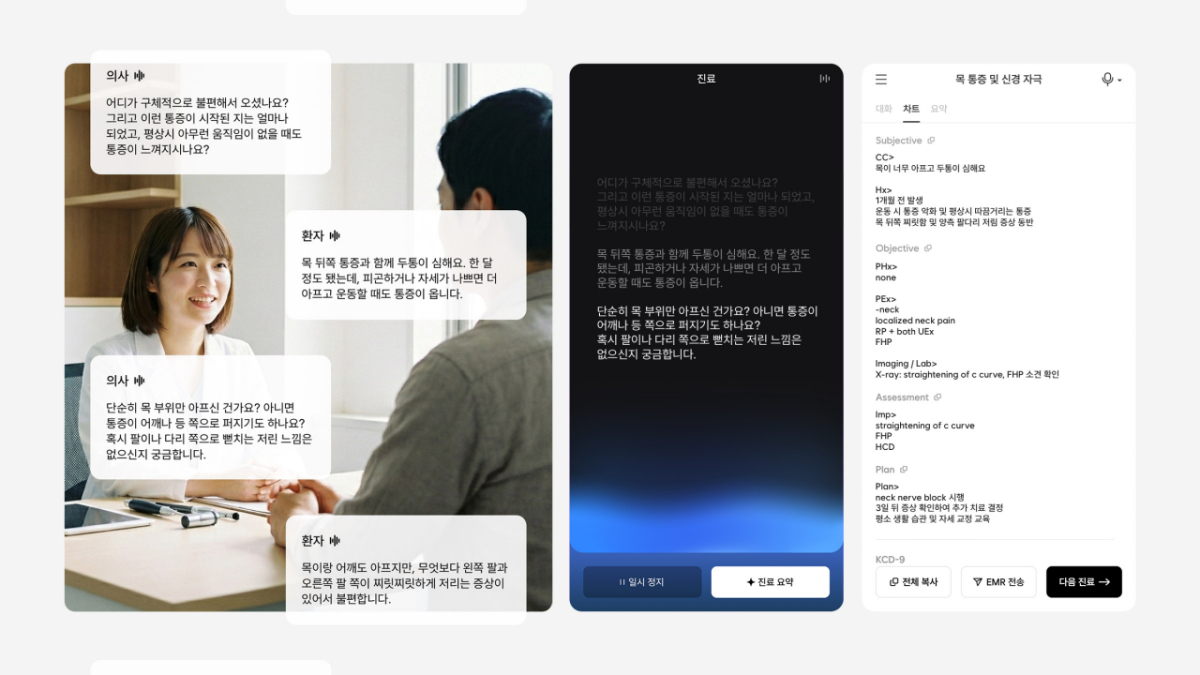
Doctors' work continues even after consultations end. To properly claim health insurance reimbursement fees, they must create SOAP (Subjective symptoms · Objective findings · Assessment · Plan) charts in the format required by the Health Insurance Review & Assessment Service. It frequently happens that doctors fail to fill out charts due to being overwhelmed with patients, resulting in unclaimed or reduced medical fees.
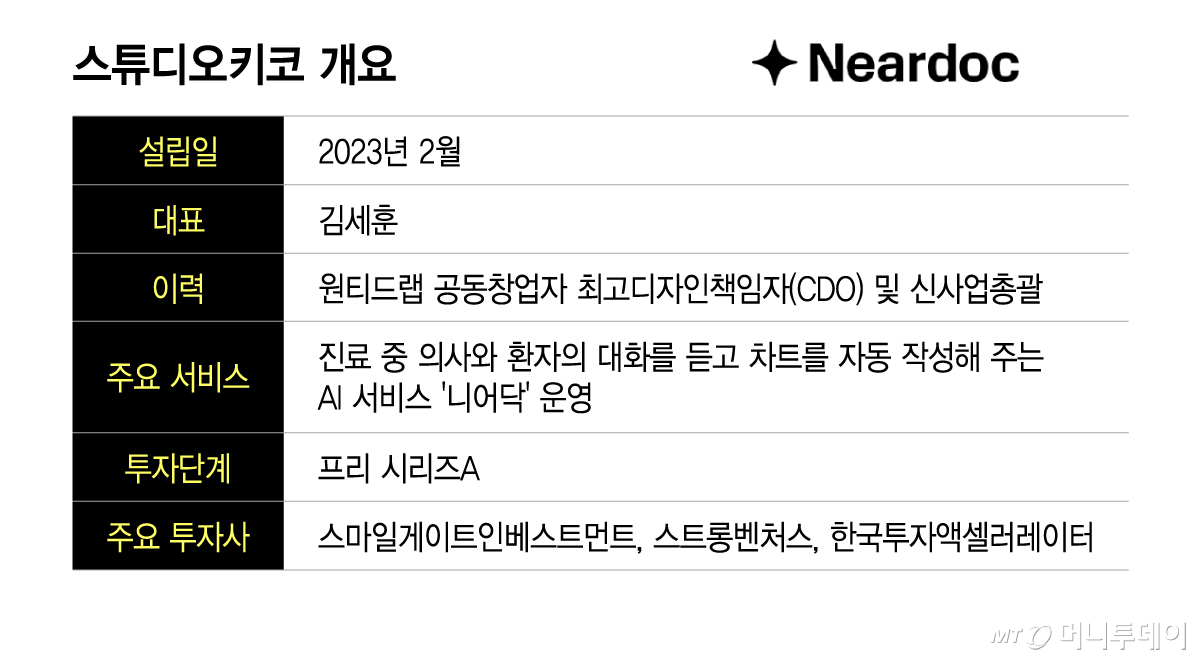
Startup Studio Kiko has targeted this gap in the medical field. 'Neardoc,' introduced by Studio Kiko, is an AI service that listens in real time to conversations between doctors and patients in consultation rooms, automatically generates completed SOAP charts without any separate input, and directly enters them into electronic medical records (EMR). Charts are completed in just five seconds after consultations end.
Recently, Studio Kiko secured Pre-Series A funding from SmileGate Investment, Strong Ventures, Korea Investment Accelerator, and others. Notably, Strong Ventures, which participated as an early investor alongside X-Squared when the company was operating its pre-pivot (monetary policy shift) item, also conducted follow-up investment in this round after the business model was transformed. This is interpreted as a high evaluation of growth potential following the business transformation.
Adoption at 300 hospitals through word of mouth
Studio Kiko has advanced Neardoc based on its self-developed medical AI engine 'Xynar.' It controls hallucination phenomena that general-purpose large language models (LLMs) can cause during medical Q&A processes and is designed to output only information based on clinical evidence by applying multi-layered Retrieval-Augmented Generation (RAG). The system has learned over 17,000 medical terms across more than 20 medical specialties to automatically generate charts tailored to the context of each specialty and accurately understands medical terms and abbreviations that appear during conversations.
As a result, the rate at which doctors modify AI-generated charts is only about 2% on average. The system also includes a feature that learns individual doctors' chart input habits, so after just a few uses, it automatically generates personalized style charts. Another major strength is compatibility with major domestic EMR systems, eliminating the need to replace existing infrastructure.
Additionally, audio recorded in consultation rooms is immediately converted to text and then deleted, a design that blocks issues related to the Medical Act and Personal Information Protection Law from the outset. A 360-degree microphone is used to ensure consistent voice capture regardless of where speech occurs within the consultation room. The system also supports insurance billing tasks directly tied to hospital revenue, automatically mapping over 40,000 Korea Standard Classification of Diseases (KCD) codes, significantly reducing risks of omissions or reductions during the Health Insurance Review & Assessment Service billing process.
'Clinical-Specialized Ambient AI Scribe,' such as Neardoc, is the fastest-growing category in the global medical AI field. In the United States, 70% of doctors already use AI charting tools, and the related market size is projected to grow more than fivefold from $6 billion in 2025 to $30 billion in 2033.
Aligning with this trend, Neardoc was adopted by over 300 hospitals and clinics within two months of launch without any advertising. According to a survey conducted by Studio Kiko on adopting facilities, chart creation time decreased by an average of 70%, and the number of patients seen in the same amount of time increased by approximately 1.5 times. As doctors could focus entirely on patients instead of monitors, patient satisfaction and re-visit rates also rose significantly.
Kim Se-hoon, CEO of Studio Kiko, stated, "We aim to create consultation rooms where doctors can fully focus on patients and build future medical infrastructure that enables top-tier care anywhere."
The 'Execution Power' VC Investment Behind Wanted Lab's Listing

Another factor attracting investor attention is the outstanding team composition. Studio Kiko is led by Kim Se-hun (CEO), a co-founder of Wanted Lab who spent nine years managing the company's IPO and overseas market expansion. Additionally, Ryu Kyung-mook, former head of service development at Wanted Lab and now Chief Technology Officer (CTO), and Lee Chang-min, an orthopedic specialist and now Chief Medical Officer (CMO), have joined to create synergy.
Jo Yu-jin, team leader at SmileGate Investment, said, "We invested because we believe the achievements and references accumulated since the Wanted Lab days, including global expansion, can support the team's execution power. With a proven founding team, its own AI engine, and the achievement of securing initial 300 hospitals without advertising, we judged that growth potential is high."
Studio Kiko plans to further advance its services by learning accumulated data after chart automation to develop an 'Auxiliary Clinical Decision Support System (CDSS)' that assists in determining diagnoses and prescriptions. Ultimately, it aims to build a 'Medical Operating System (Medical OS)' covering all aspects of consultation room operations and use this as a stepping stone to challenge the global market.
Kim Se-hoon, CEO of Studio Kiko, expressed his ambition: "We aim to create consultation rooms where doctors can fully focus on patients and build future medical infrastructure that enables top-tier care anywhere."
[MoneyToday startup media platform Unicorn Factory]

 in FUTURE


