

From joint and several liability guarantees to RCPS... 'Adventure' disappears from K-adventure capital
Betting on 'safety' rather than 'adventure'…The bare face of K-risk capital①
More diverse corporate information on the startups mentioned in this article can be viewed at Unicorn Factory's big data platform 'Data Lab'.
Venture capital is designed on the premise of failure. The structure requires that even if nine out of ten investments fail, a single major success is sufficient; hence it is called "risk capital." However, domestic venture investment practices are far removed from risk. Overly designed investor safety mechanisms directly link company failures to the personal bankruptcy of founders.
This is attributed to the domestic investment ecosystem's tendency to make it difficult to easily forgive venture investment failures. While the government has recognized such issues and made efforts, including revising standard contracts, criticism also arises that policy finance institutional investors' policy direction fails to keep pace with these changes.
Investor protection clause that ties up founders in a "labyrinth of mountains"
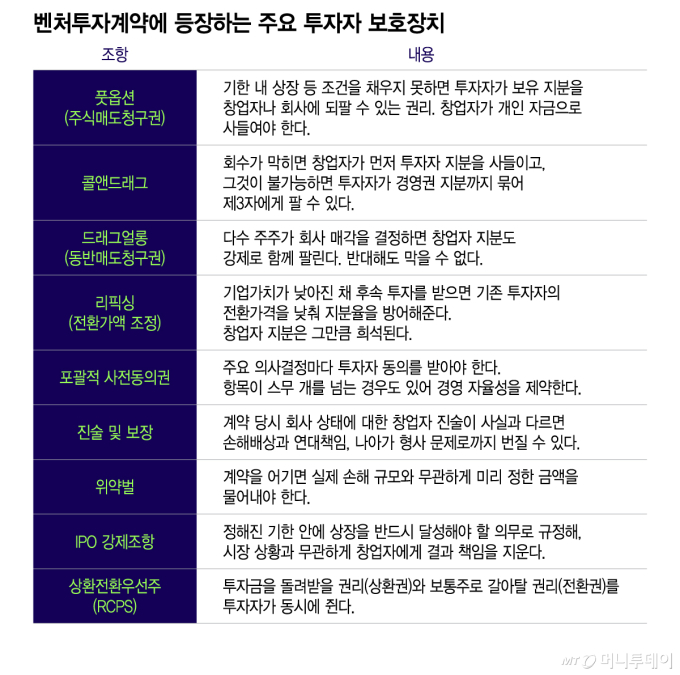
In venture capital contracts, joint and several guarantees by founders were once a standard provision. Although this practice is gradually disappearing from the regulatory framework, a workaround remains in which major shareholders or management personnel effectively assume the same obligations under the guise of "interested parties." Other mechanisms designed to protect investors also impose burdens on founders, such as put options (the right to demand stock repurchase), which allow investors to force founders to sell their shares, and drag-along rights (co-sale rights), which require founders to sell their stakes if a majority of shareholders decide to sell the company.
In addition, practices such as repricing (adjusting the conversion price to protect existing investors' shareholding ratios by lowering the conversion price when receiving follow-on investments despite a drop in corporate valuation) and penalty clauses that demand a pre-determined amount from founders regardless of the actual scale of damages are also cited as vicious habits that pressure entrepreneurs.
The same applies to redeemable convertible preferred shares (RCPS), the most commonly used venture investment vehicle in Korea. Investors hold both the right to recover their investment if conditions are not met (redemption right) and the right to convert into common stock at a favorable time (conversion right).
Kim Sung-hoon, a lawyer at Mission Law Firm, stated, "Redemption rights are only possible within the scope of distributable profits, but startups do not have such profits; therefore, in practice, destructive clauses involve conversion rights and repricing." He added, "When raising follow-on investment through a down round (subsequent investment conducted at a lower corporate valuation), if repricing is triggered, the governance structure can be overturned. Consequently, requests for existing investors to waive or exempt repricing may go unanswered, leading to the collapse of the follow-on investment itself."
Lack of consensus on "Yongin Failure" manifests as investor protection measures
Unlike in Korea, there is a shared understanding in overseas venture investment circles such as Silicon Valley that most startup investments fail. This is why contracts that attribute individual failures solely to the entrepreneur's personal responsibility are difficult to establish. According to local investors, the U.S. venture capital (VC) industry has never had joint guarantee clauses in the first place.
South Korea is in a different situation. The spectrum of investors ranges from pure private venture capital firms to funds mixed with policy capital and investment companies affiliated with financial holding groups, each capable of absorbing different levels of loss. There is no uniform consensus across the entire ecosystem on what constitutes "failure."
A VC investment screening officer stated, "There have even been cases where individual contributors in a private investment fund, unable to distinguish between investment and lending, grabbed the screening officer by the collar demanding, 'Give me back my money.'" The officer further pointed out, "It is not just individual investors; institutional investor staff also sometimes act like creditors rather than investors."
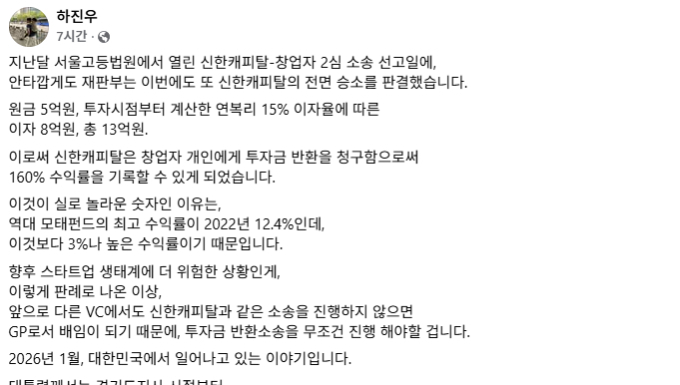
Cases where founders personally assume liability due to joint guarantee or related-party clauses in investment contracts continue to emerge. Urban Base, a proptech startup, faced conflicts with investor Shinhan Capital over joint guarantee issues. OhjiQ, a content startup, found itself in a situation where founder Shin Cheol-ho had to repay the invested amount of 90 billion won and accrued late fees from his personal funds after being listed as a "related party" during the process of signing a conditional investment contract.
"Cultures of Investment Failure in Yongin Must Lead with 'Policy Finance'"
The government also recognizes the need to ease such investor protection measures. On the 30th, the Ministry of SMEs and Startups released a revised standard contract for venture investment that recommends using CPS (convertible preferred shares) instead of RCPS. Rather than defining an IPO as a mandatory result obligation, it has been changed to an obligation to make diligent efforts, thereby protecting entrepreneurs from penalty clauses triggered by external factors such as market stagnation.
However, the startup industry says that problems not included in contracts more often pressure actual founders. How put options and penalty clauses are actually exercised remain in a management blind spot. The reality of fund of funds (Korea venture fund) sub-funds exercising put options or penalty clauses against founders is also not being monitored.
Criticism arises that the policy direction of policy finance, including funds of funds (Korea Venture Fund), has also encouraged investors' "self-preservationism." When a company in which they have invested faces insolvency, they pressure fund managers by raising issues regarding post-investment management. If the corporate valuation falls below the acquisition price, they record impairment losses and reduce management fees. Fund managers, citing demands from contributors for stricter oversight, impose stronger safety mechanisms on entrepreneurs, which ultimately returns as restrictive clauses that tightly constrain the entrepreneurs.
Lawyer Kim Sung-hoon stated, "While it is true that VCs are not acting as venture capitalists but rather like creditors, this is not necessarily due to malicious intent on the part of the VCs." He added, "If policy LPs do not grant fund managers appropriate discretion and autonomy to make and execute judgments, fund managers will inevitably feel pressured and take excessive safety measures, leading to a vicious cycle that ultimately damages the startup ecosystem."
25-year-old RCPS investment practices... Can the 'R' be removed?
Betting on 'safety' rather than 'adventure'…The bare face of K-Venture Capital②
The Ministry of SMEs and Startups has revised the standard venture investment contract and is now recommending the use of convertible preferred shares (CPS) without redemption rights (R). This move aims to break with the long-standing practice in Korea's domestic venture investment market, where redeemable convertible preferred shares (RCPS) have been the default investment method for over 25 years, and to improve the investment environment by aligning it with global standards. The measure is seen as an effort to resolve longstanding concerns about its practical effectiveness raised on the ground and to alleviate the burden on startup founders.
RCPS is a form of stock that combines the right to redeem investment funds when the company generates profits, the conversion right into common shares, and priority dividend rights. The problem lies in the fact that under the Commercial Act, the exercise of redemption rights is permitted only when there are "distributable profits." Most early-stage or technology startups in sectors such as biotechnology and IT (information and communications) operate at a loss, meaning distributable profits do not exist in the first place.
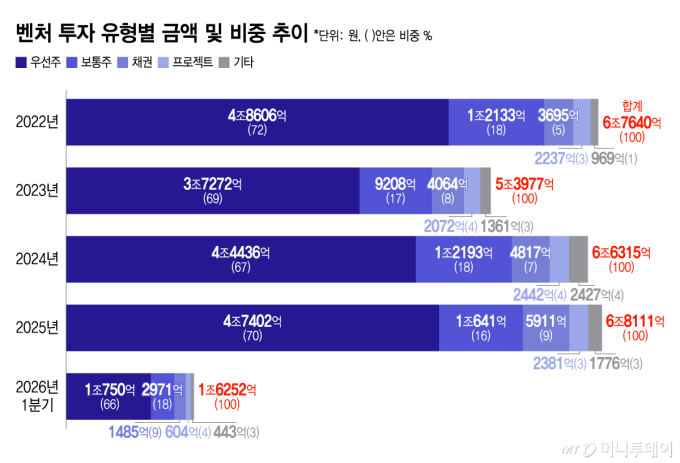
It is a paradoxical structure where, although the right exists on paper, it cannot be exercised when the company faces difficulties, and there is no reason to demand repayment of investment funds when the company has grown sufficiently profitable. Moreover, under accounting standards, these instruments can be recognized as liabilities, leading to persistent concerns that they distort the financial structure of startups; yet, the majority of venture capital contracts still consist of RCPS. According to the Venture Investment Comprehensive Portal, approximately 70% of all annual venture investments are executed in the form of preferred shares. An industry source stated, "It is safe to assume that most of these preferred share transactions are RCPS."
According to industry sources, RCPS were fully introduced into the investment field around 2001. Following the collapse of the venture bubble at the end of 1999, which caused massive losses for venture capital firms at the time, these firms began widely adopting redemption clauses as a safety mechanism for principal recovery. At that time, the primary investment targets of venture capital firms were often large corporate affiliates, supplier companies, and subsidiaries that already generated a certain level of return on investment; however, RCPS were adopted as a common investment tool in anticipation of scenarios where recovery through an initial public offering (IPO) might become unlikely.
A VC reviewer stated, "In the case of bio companies, there are many instances where distributable profits do not arise even after an IPO, making investment via RCPS virtually meaningless." They added, "While this practice has been maintained as a long-standing convention, there is now a growing trend to gradually explore alternative forms such as CPS investments."
Industry observers estimate it will take at least two to three years for CPS to replace RCPS and become the standard in investment markets. The biggest obstacle is the structural 'Lock-in' effect caused by prior rounds. When existing shareholders participate in follow-on investments while holding RCPS, limited partners (LPs) often express reluctance toward investing under CPS, questioning why they alone would face unfavorable terms. Even foreign venture capital firms that typically prefer common shares or CPS find it difficult to unilaterally alter investment conditions when they are not the lead investor in domestic deals, forcing them to follow the existing RCPS format.
The fact that the bill revised by the Ministry of SMEs and Startups remains at the level of non-binding "recommendations" is also pointed out as a limitation. Unless specific guidelines are issued to the management departments or investment teams of each asset management company, there is a high likelihood that they will stick to familiar RCPS contracts due to on-the-ground inertia. Furthermore, New Technology Business Finance Companies (Shingisa), which fall under the jurisdiction of the Financial Services Commission, are outside the authority of the Ministry of SMEs and Startups, meaning there is little incentive for them to waive repayment rights.
An Hee-cheol, managing partner of DLG Law Firm, stated that "it is difficult for VCs to persuade conservative LPs with only standard contracts that lack legal enforceability," and added that "policy incentives, such as granting points for CPS investment deals in Korea Venture Investment's capital contribution projects, must accompany the transition so that both LPs and VCs actively move toward CPS conversion."
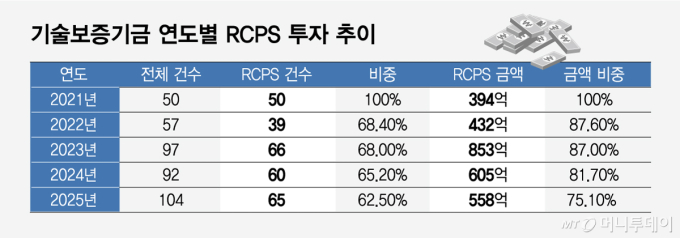
Policy finance institutional investors and conservative financial sector LPs are factors that maintain existing practices. Due to the burden of audits that investigate liability when losses occur, on-site personnel keep redemption rights in contracts as a "psychological safety net," even though they know there is no distributable profit and actual exercise is unlikely.
This preference for RCPS is clearly confirmed through data. An examination of the Technology Finance Corporation's investment records over the past five years shows that a significant portion of all direct investments was executed in the form of RCPS.
A VC official said, "If contracts are concluded by removing repayment clauses with little practical effect, it will be much more efficient for VCs as well, reducing the burden of contract review and management," and added, "To accelerate changes on the ground, major LPs must simultaneously improve regulations by revising investment guidelines or offering incentives."
Why Silicon Valley VCs Were Flustered by the Question of Joint Guarantees: "Then Who Will Start a Business?"
Betting on 'safety' rather than 'adventure'…The bare face of K-Venture Capital③
In Silicon Valley, the home of venture capital, it is rare to find a practice where investors recover their funds by holding individual founders personally liable for startup failures. The notorious clause in venture investment contracts known as "joint and several guarantee" was never even established there. This culture exists because all parties — from limited partners to fund managers to founders — share the premise that most startups are destined to fail.
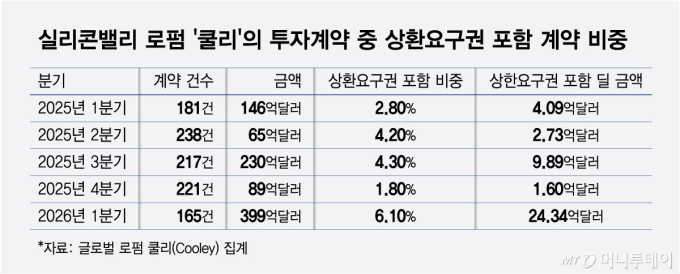
According to Cooley, one of the law firms that handles the most startup deals in Silicon Valley, its quarterly venture investment report shows that contracts with "redemption rights" clauses account for only 2% to 6% per quarter. This stands in sharp contrast to the fact that most domestic venture investment contracts are structured as redeemable convertible preferred shares (RCPS). A representative from a major domestic venture capital firm stated, "Although contracts written as CPS have increased slightly recently, RCPS contracts still account for 85% to 90%."
According to Kauli, Silicon Valley investment practices generally favor entrepreneurs, unlike in Korea where investor protection is prioritized. As of the fourth quarter last year, 98% of contracts stipulated that investors would recover only 100% of their invested capital first. Furthermore, 96% of all contracts were "non-participating preferred shares," which allowed investors to choose either principal recovery or equity distribution, but not both.
Repurchasing shows an even wider gap. According to Q3 2024 Coolly data, the weighted average method was applied to all investment contracts during that period. Not a single contract in Korea used the lowest-price method (pull rate), which is widely employed in the country. The weighted average method recently recommended by the Ministry of SMEs and Startups through revisions to standard contracts has already become the established standard in the United States.
It is a widely accepted view that this founder-centric contract practice emerged on the foundation of Silicon Valley venture investment culture, which tolerates failure. Kim Sung-hoon, an attorney at Mission Law Firm, said, "When I asked a Silicon Valley VC representative why there are no joint and several liability clauses or put options in the United States, he replied, 'It's awkward to be asked why something that never existed doesn't exist.' He added, '99% of venture startups fail while taking on risky endeavors; if we were to impose joint and several liability every time they fail, who would ever become an entrepreneur?'"
Market structures that prevent investors from setting conditions at will also play a role. The more promising the startup, the more choice it has in selecting investors; investment firms that impose unfavorable terms on founders cannot secure good deals.
A VC investment reviewer emphasized, "The fact that there are fewer investor safety mechanisms in Silicon Valley than in Korea is by no means because investors are more lenient." They added, "It is closer to the result of the entire ecosystem learning that a model which shifts recovery to individuals in a market where failure is the baseline does not work."
[Money Today Startup Media Platform Unicorn Factory]

 in FUTURE


