

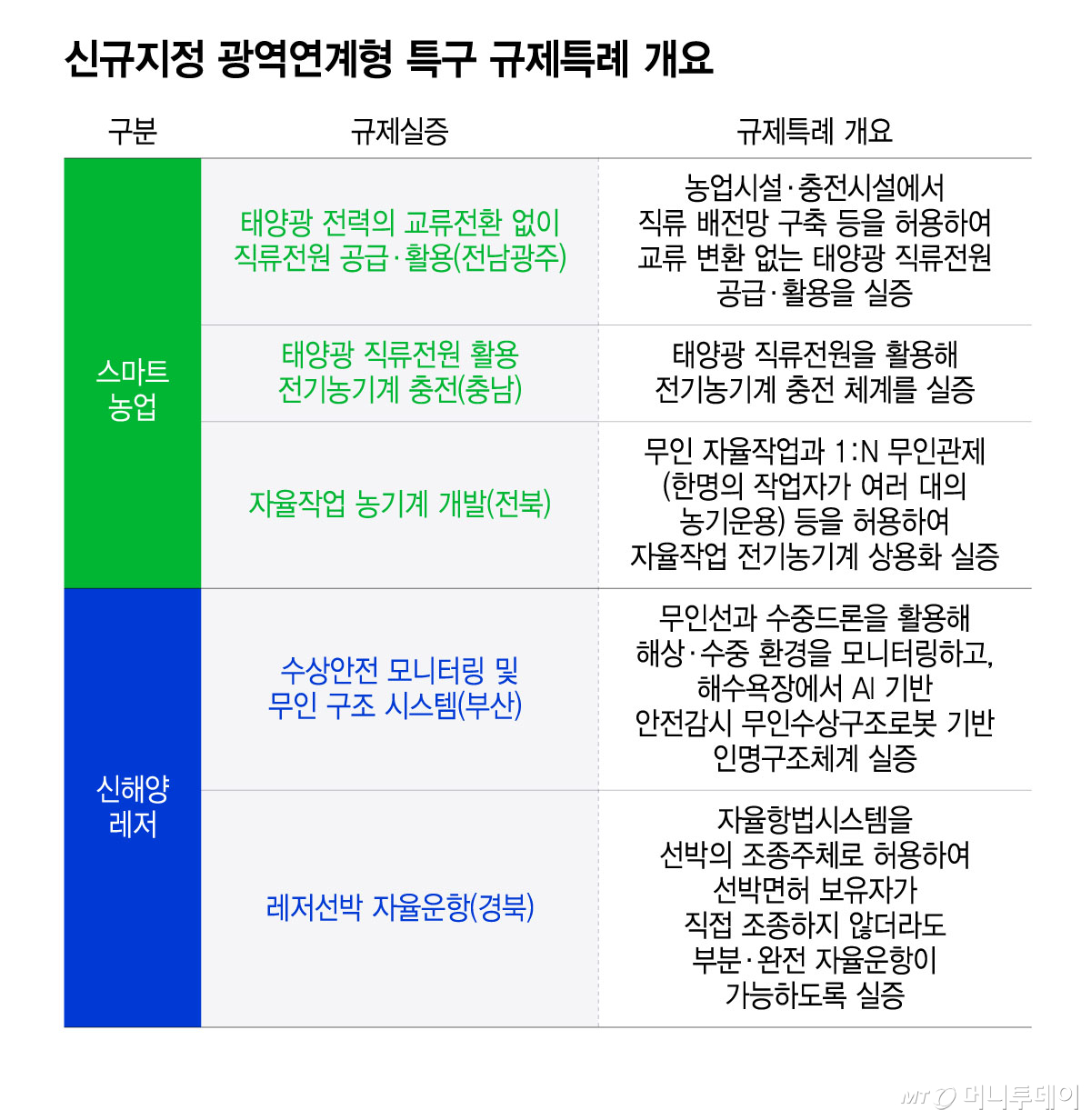
Technology is being developed to use direct current electricity generated from solar power directly as power for agricultural machinery and to enable farming without human operators. Ships at sea will also move autonomously, and unmanned rescue teams will save those in danger. These technologies are expected to be created under the 'Regional-Linked Regulatory Free Zone (Regional-Linked Special Zone),' which is being introduced for the first time this year.
The Ministry of SMEs and Startups announced on the 5th that it convened the '26th Regulatory Free Zone Regulatory Exemption Deliberation Committee' and placed on the agenda a plan to designate new Regional-Linked Special Zones containing such measures, as well as the 'Regulatory Free Zone Innovation Plan' to overhaul the entire Regulatory Free Zone system.
The 'Regional-Linked Regulatory Free Zone,' which was discussed for the first time at this deliberation committee, is a new system launched this year to move away from the existing operation method focused on individual regions and single technologies, enabling two or more local governments to cooperate and integrate related regulations for joint demonstration. The Ministry of SMEs and Startups selected a total of two projects as Regional-Linked Special Zone designation projects after consultations with relevant ministries and careful review by experts, and placed them on the agenda for this deliberation committee.
The 'Smart Agriculture Regional-Linked Special Zone,' centered in Gwangju, Jeollanam-do, and involving Jeollabuk-do and Chungcheongnam-do, will demonstrate electric agricultural machinery charging using solar direct current power and the development of autonomous farming machinery. Naju, Jeollanam-do was designated as the 'DC Industry Global Innovation Regulatory Free Zone' in 2024 and is promoting the world's first commercialization of a DC power grid platform. The core of this initiative is to eliminate double conversion losses that occur when solar power generated via direct current is converted to alternating current for transmission and then back to direct current for battery charging. Centering on this technology, Chungcheongnam-do will demonstrate an electric agricultural machinery charging system, while Jeollabuk-do will demonstrate the commercialization of autonomous electric agricultural machinery through unmanned 'one-to-many' control where one operator manages multiple machines, enabling unmanned autonomous operations.
The 'New Marine Leisure Regional-Linked Special Zone,' a collaboration between Gyeongsangbuk-do and Busan, will test ship autonomous navigation, maritime monitoring, and unmanned rescue technologies in various marine environments ranging from beaches to ports. Gyeongsangbuk-do will focus its demonstration on leisure ship autonomous navigation, allowing autonomous navigation systems to serve as the primary control subject for ships, enabling partial and fully autonomous operation.
Busan will monitor marine and underwater environments using unmanned vessels and underwater drones, and demonstrate a life-saving system based on AI-powered safety surveillance at beaches and unmanned surface rescue robots. Each region plans to establish safety standards that can be utilized nationwide by first verifying core technologies individually and then conducting integrated demonstrations.
Additionally, the deliberation committee discussed the Regulatory Free Zone Innovation Plan, which includes: △promoting regional industries through the introduction of Regional-Linked Regulatory Free Zones; △strengthening communication channels with regulatory ministries to ensure that demonstration results at each stage from zone designation to operation and termination lead to legal revisions; △revising the regulatory exemption system to minimize the burden on companies applying for regulatory demonstrations; and △strengthening support for regional core industry companies in special zones linked to major regional and startup policies such as '5 Poles 3 Special Zones' and 'Startup Cities.'
Noh Yong-seok, First Vice Minister of the Ministry of SMEs and Startups, who chaired the deliberation committee, stated, "It is time to reform the system so that the Regulatory Free Zone, which has rationalized regulations hindering new regional industries and added vitality to the local economy, can achieve even higher results." He added, "We will actively support the smooth implementation of this Regulatory Free Zone Innovation Plan and the Regional-Linked Special Zones to broaden cooperation between regions and help innovative companies grow by overcoming regulatory barriers."
Meanwhile, the Regulatory Free Zone Deliberation Committee is a meeting body that conducts preliminary deliberations on agenda items submitted to the Regulatory Free Zone Committee in accordance with Article 79 of the 'Regulatory Exemption Act on Regulatory Free Zones and Regional Specialization Development Zones.' The agenda items discussed at today's deliberation committee are scheduled to be submitted to the Regulatory Free Zone Committee, chaired by the Prime Minister, at the end of this month for final approval.
[MoneyToday startup media platform 'Unicorn Factory']

 in FUTURE
