

[For more diverse corporate information on the startups mentioned in this article, you can view it at Unicorn Factory's Big Data Platform Data Lab.]
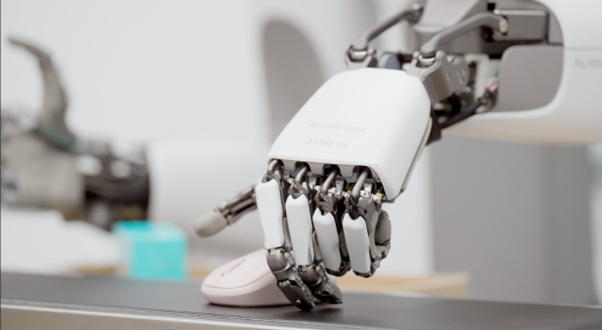
On the 7th, Physical AI (artificial intelligence) company RealWorld announced that it is jointly developing a benchmark to evaluate the hand manipulation capabilities of humanoid robots with three domestic robotics and simulation startups.
Established in July 2024, RealWorld develops foundation models for robots. It has established a data collection system that gathers movements and physical signals from skilled workers at industrial sites across the United States, South Korea, and Japan.
RealWorld has signed memorandums of understanding with Physics Sim Lab, Space AI, and NdotLight. The technologies of these three companies will be utilized to build 'DexBench,' a benchmark currently being developed in collaboration with NVIDIA.
DexBench is a standard for quantitatively evaluating whether robots can perform complex tasks using their hands like humans. It consists of 18 tasks and 80 cases, and is being developed as an open-source project integrated with NVIDIA's robot simulation environment, 'Isaac Lab-Arena.'
Currently, Lotte, SK Telecom, CJ Logistics, Hyosung, HL Mando, Japan's Fuji, All Nippon Airways (ANA), and Mitsui Chemicals are participating as partners in DexBench.
NdotLight creates assets required for simulation environments, such as joint structures, physical properties, and collision meshes, using its proprietary 3D asset generation technology 'TRINIX.' RealWorld verifies the alignment between simulation and reality for these assets through real-world testbeds.
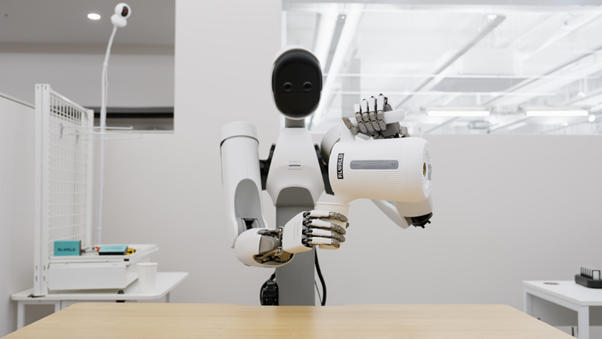
Physics Sim Lab implements industrial sites where robots are deployed, such as convenience stores, logistics warehouses, and manufacturing lines, as digital twins. It is designed to allow space, robots, and tasks to be divided into independent modules and combined, while applying domain randomization that randomly changes working conditions to expand the scope of verification.
Both parties plan to use synthetic data created from Physics Sim Lab's physics simulator for training RealWorld's foundation model 'RLDX-1' and subsequent models.
Space AI is responsible for designing tracks for soft bodies and fragile objects. This involves tasks handling objects that deform or break when subjected to improper force, such as tofu, fruits, and rubber parts, by building a data layer that corrects the physical properties of virtual objects using measured values.
Contact forces are generated using sensor-measured values, while internal stresses are created using simulation labels corrected with measured material properties. These are provided in four layers along with RGB and depth data.
RealWorld previously released RLDX-1 as open source and achieved state-of-the-art (SOTA) performance in eight simulation benchmarks. Last month, it was also selected as a '2026 Technology Pioneer' by the World Economic Forum (WEF).
Ryu Joong-hee, CEO of RealWorld, stated, "For humanoid robots to be useful in actual industrial sites such as manufacturing and logistics, implementing human-level dexterous hand manipulation is key." He added, "This marks a meaningful starting point where Korean startups with expertise in each field collaborate to solve high-difficulty tasks required for global industrial standards."
He further added, "Based on our collaboration with NVIDIA, we will connect the excellent technological capabilities of domestic startups and academia to the global stage and expand a global physical AI ecosystem led by South Korea."
[MoneyToday startup media platform 'Unicorn Factory']

 in FUTURE

