

[For more diverse corporate information on startups, visit Unicorn Factory's Big Data Platform 'Data Lab'.]
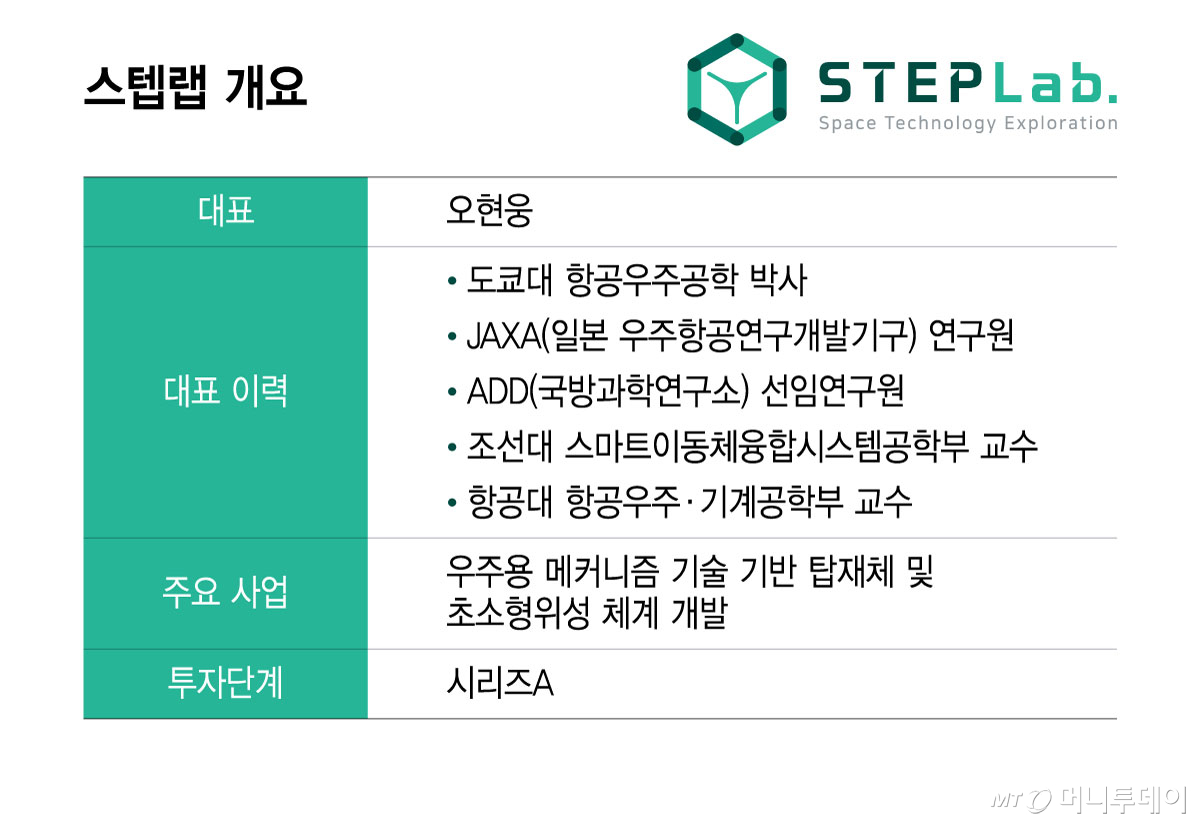
StepLab, a company specializing in ultra-small satellite systems based on space mechanism technology, secured 11 billion won in Series A funding on the 5th. Investors included Company K Partners, Kolon Investment, IBK Venture Capital, Mirae Asset Venture Investment, SL Investment, the Korea Credit Guarantee Fund, and DeCamp (Banking Youth Startup Foundation). Existing investor Company K Partners participated in follow-up funding.
StepLab, established by Professor Oh Hyun-woong of Korea Aerospace University alongside his students, has secured capabilities for payload and ultra-small satellite system development based on space mechanism technology that "grasps, releases, deploys, and moves" payloads.
Company K Partners, which led this investment, first invested in StepLab as an institutional investor in 2024. Kang Sang-soo, Head of Investment at Company K Partners, stated, "We conducted the first round of investment in 2024 because we highly valued Oh Hyeon-ung (CEO)'s experience accumulated at the Japan Aerospace Exploration Agency (JAXA) and the Agency for Defense Development (ADD). Over the past two years, we observed StepLab steadily executing its plans, which gave us confidence in its growth, leading to this second-round investment."
Lee (CEO) explained, "Oh Hyeon-ung (CEO) possesses know-how related to structural analysis design of critical satellite components, thermal analysis required in extreme space environments, and solutions to reduce launch shock and vibrations caused by gravitational acceleration reaching up to 10G during rocket launches. While StepLab refers to its work as 'mechanisms,' from my perspective, its business scope covers the entire spectrum of materials, components and equipment related to satellites, as well as system development."
Although StepLab was established in June 2021, Oh Hyeon-ung (CEO)'s satellite career spans over 20 years. After graduating from the University of Tokyo in 1999, he dedicated himself to satellite technology research at JAXA. Later, after working at ADD, he launched 'STEP CubeLab (Bithgoeul-1)' in India in 2018 while employed at Jo Seon-dae (Prof.). The name 'StepLab' originated from this project.
StepLab's flagship product is the Separation Ring, a launch vibration-dampening separation device that connects and separates satellites from launch vehicles. It is also independently developing the STEP POD, a cube satellite ejection tube that integrates its proprietary vibration-dampening technology (VIS). The STEP POD will be applied to the 16U CubeSat 'DaejeonSAT-1' on Nuri's fifth launch this year. Through this launch, StepLab is approaching space heritage certification for the product.
No Min-sik, an executive at Kolon Investment, stated, "StepLab has secured a competitive advantage over existing overseas mechanisms by integrating shape-memory alloy-based ultra-elastic vibration-dampening technology into space mechanisms, featuring a differentiated design concept that structurally reduces vibration and shock during separation. We judged that as an essential module provider possessing high-difficulty mechanism technology, StepLab has strong potential to leapfrog as a leading domestic company."
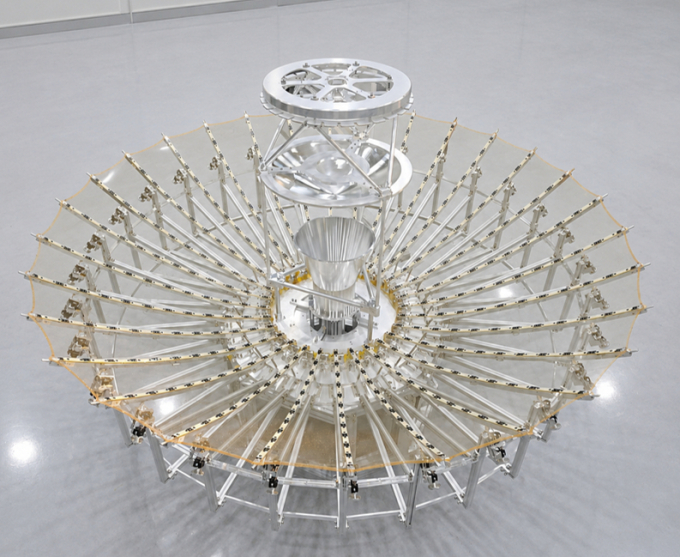
StepLab is also expanding its technological scope in the payload sector. It developed South Korea's first 4-meter-class three-stage deployable Synthetic Aperture Radar (SAR) mesh antenna, securing core technology for SAR satellite payloads. Recently, through ScaleUp Tips (TIPS), it has been developing an AI-based zoom optical module for Space Domain Awareness (SDA). This next-generation optical payload applies AI image processing and high-precision gimbal technology to perform wide-area and narrow-area exploration with a single camera, enhancing detection and tracking capabilities for space objects.
Lee Gang-su (CEO) stated, "As satellite launches increase in the future and numerous SAR satellites are launched into space, demand for deployable structures is expected to rise." He added, "With growing demand for large deployable structures, satellite separation systems, and vibration-dampening systems, the related market will expand." He further noted, "StepLab is virtually the only domestic company handling large deployable structures. The vibration-dampening solution is also unique to StepLab, and there is currently a demand for localizing satellite separation systems that are predominantly foreign-made."
StepLab will invest this funding into global commercialization of space mechanism products that have secured space flight heritage and the establishment of the Yangsan system. Next-generation payload technologies such as SAR mesh antennas and AI-based zoom optical modules will pursue space verification linked to national R&D projects according to each product's technology maturity level, with subsequent commercialization gradually expanded.
Executive No Min-sik remarked, "This year is expected to be a milestone for StepLab in securing multiple space verifications. Having overcome the critical hurdle of 'verification references,' we anticipate that full-scale business expansion will become possible, from components for satellites and launch vehicles to satellite payloads and entire satellite systems."
Oh Hyun-woong, CEO of StepLab, emphasized, "Through this investment, we will fully commence global commercialization of space mechanism products and pursue space verification of next-generation payload technologies. Based on our technological competitiveness covering space mechanisms, payloads, and ultra-small satellite system technologies, we aim to grow into a global space systems company."
[MoneyToday startup media platform 'Unicorn Factory']

 in FUTURE

