

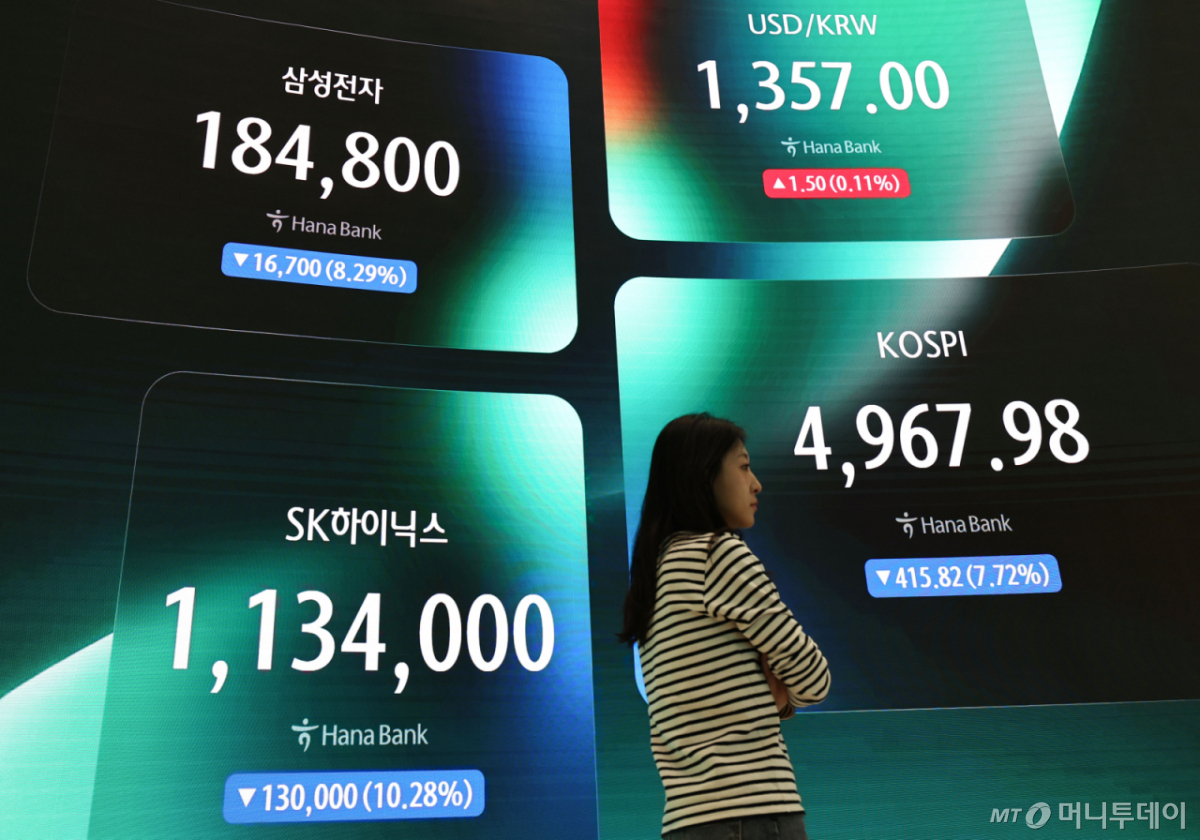
The 'blue wave' sweeping through the U.S. Congress has battered the KOSPI for two consecutive days. Fears that regulations on AI data centers could be tightened have dragged down the market, at one point pushing the index below the 5,000 mark. Analysts say the sell-off has been excessive but expect volatility to persist for the time being.
As of 11:03 a.m. on Friday, the KOSPI stood at 5,094.96, down 288.84 points (5.36%) from the previous trading day. The KOSPI fell as low as 4,911.28 during the session. This marked the first time since February 6 that the KOSPI dropped below the 5,000-point line intraday, a span of 273 days. At 9:03 a.m., the Level 1 sidecar was triggered, and trading was suspended for 20 minutes.
Anxiety grew that the US Democratic Party would strengthen regulations on AI data centers and that construction of AI data centers would be delayed. As a result, the NASDAQ Composite Index fell 5.52% on the 5th (local time). The S&P 500 Index dropped 4.36%, and the Dow Jones Industrial Average declined 3.44%. The Philadelphia Semiconductor Index slid more than 12% on that day.
Analysts judge this sharp drop to be "excessive." They note that since the Democratic Party also supports the AI hegemony competition with China, incentives to fundamentally block data center construction, which is the foundation of AI development, are limited.
Furthermore, the focus of the Democratic Party’s data center regulations is on alleviating resident cost burdens rather than banning construction. Consequently, forecasts suggest there will be no major changes in AI data center construction and memory demand.
Park Yeon-ju, head of the AI Research Center at Mirae Asset Securities, said, “Discussions may arise regarding strengthened data center regulations or a re-examination of tax benefits, but the actual impact on AI investment scale and the US economy will be limited.”
Park added, “Investment speed may slow somewhat, but it is difficult for investments to be canceled outright. The impact on data centers scheduled to come online next year is limited, and while some of the 2028 volume may be delayed, if domestic US investment slows, demand in other regions such as Asia could increase.”
The current KOSPI valuation has also approached historically undervalued territory with a forward PBR (price-to-book ratio) of 0.92 times. However, experts believe the likelihood of continued stock market volatility remains high going forward.
This is because traditional fundamentals logic, such as earnings and valuations, is not being reflected in stock prices due to excessive fear. Additionally, events that could impact AI investment sentiment remain on the horizon, including CoreWeave’s earnings release and Anthropic’s push for an IPO (initial public offering).
Accordingly, advice is emerging that investors should monitor the situation and manage their portfolios rather than immediately selling or buying stocks.
Yoon Seok-mo, head of the Research Center at Samsung Securities, said, “Rather than joining in a panic sell-off immediately, a wait-and-see attitude is needed until market noise subsides. Oil prices have fallen sharply from their peak due to expectations of changes in the Middle East situation, and market interest rates are also showing a downward trend accordingly. This can be a factor that significantly reduces financial burdens related to AI.”
Experts share the common opinion that since the current drop is excessive, selling stocks hastily would yield little benefit. However, aggressive position expansion based solely on undervaluation in a state of deteriorating investment sentiment and poor supply-demand conditions could inadvertently increase losses.
Therefore, while keeping open the possibility of a rebound following the sharp drop, approaches that over-interpret this as a recovery in medium-term trends should be guarded against. Even during a rebound, investors should check the weightings of stocks with high concentration in semiconductors and AI infrastructure and those vulnerable to earnings downgrades.
Experts also suggest looking beyond semiconductors to other sectors. Han Ji-young, a researcher at Kiwoom Securities, said, “It is necessary to reflect in response strategies the possibility of supply-demand diversification into sectors such as banks with valid shareholder return momentum, holding companies where foreign net buying trends are maintained, construction and transportation, and biotech benefiting from eased interest rate burdens.”
Park of Mirae Asset Securities said, “There will be many difficulties due to high volatility, but attention should be paid to fundamentals in the long run. Given that high interest rates and geopolitical risks continue, I recommend diversified and split investments in high-quality core companies with global competitiveness. Considering the volatility, I advise avoiding leveraged investments.”

 in STOCK
