

[For more diverse corporate information on the startups mentioned in this article, please visit the Unicorn Factory big data platform 'Data Lab'.]
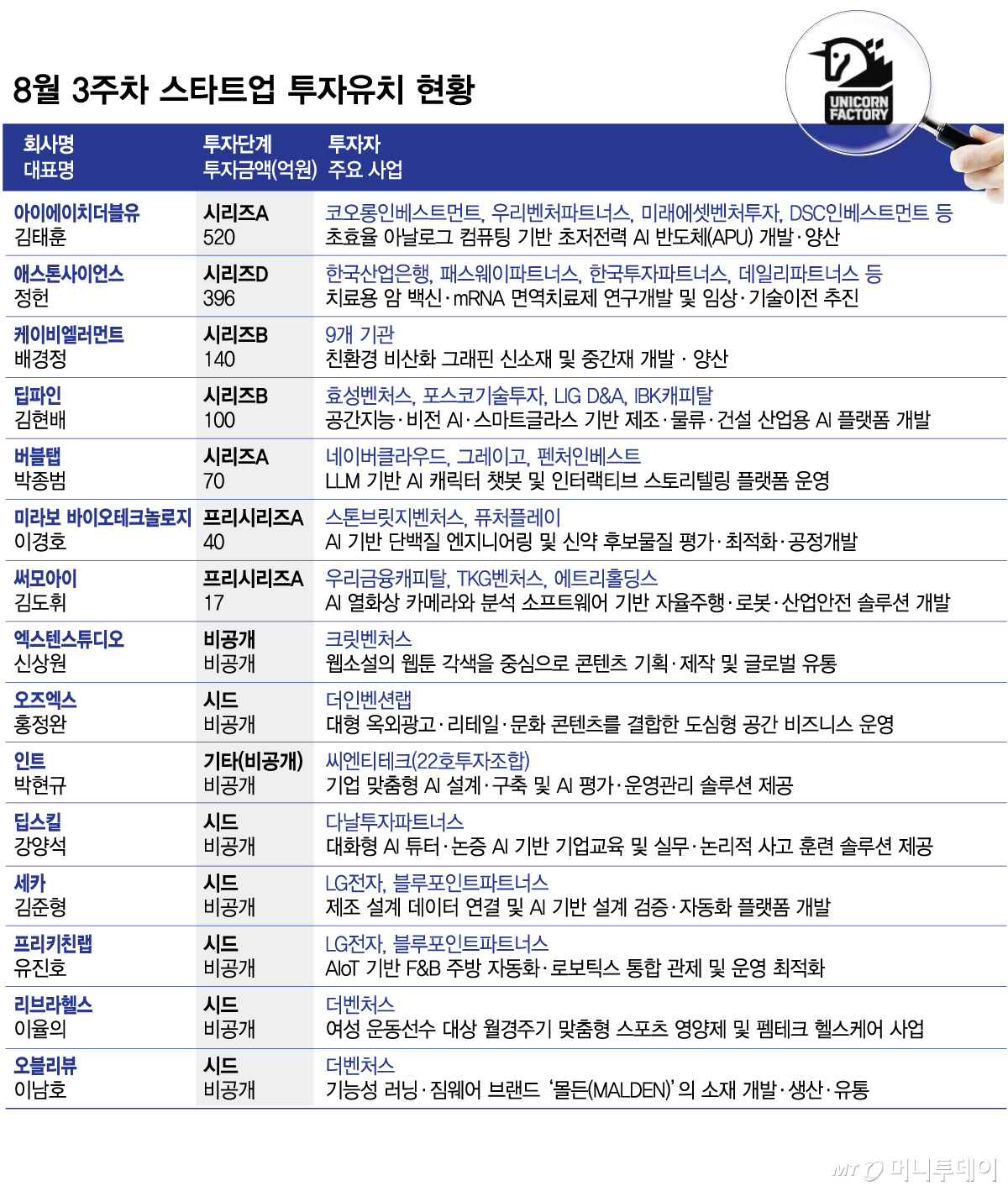
During the third week of August (17th–21st), venture capital shifted its focus to hardware that powers AI (artificial intelligence). There were four deals exceeding 10 billion won, three of which were deep-tech companies rooted in semiconductors, materials, and industrial-site AI.
The startups that secured investment during this period include iHW, Aston Science, KB Element, Deep Pine, Bubble Tap, Mirabo Biotechnology, Thermo AI, X Studio, OzX, Int, Deep Skill, Seca, Free Kitchen Lab, Libra Health, and Oblivious, totaling 15 companies.
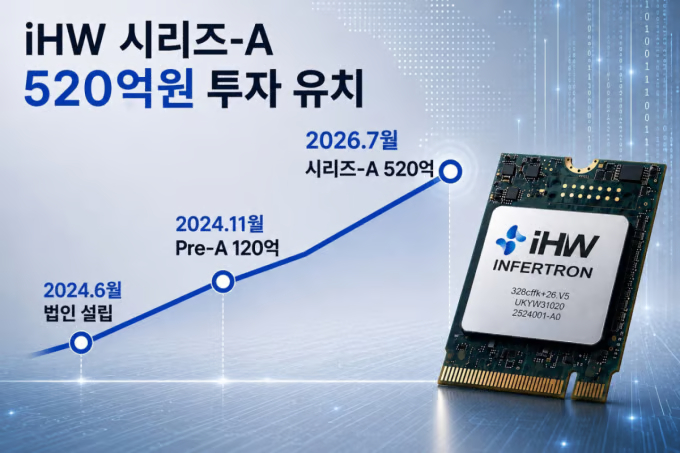
The company that secured the most investment this week is ultra-low-power AI semiconductor fabless firm iHW. In its Series A round, it raised 52 billion won, bringing its cumulative investment to 640 billion won.
All existing shareholders, including lead investor Kolon Investment, Our Venture Partners, Future Asset Venture Investment, DSC Investment, and HB Investment, participated in the follow-on investment. Korea Development Bank joined as a new investor, while LIG Defense & Aerospace invested through a consortium with IBK Capital.
The involvement of policy-financing institutional investors and defense conglomerates at the Series A stage is attributed to iHW's technological competitiveness. The company's developed 'Infertron' is an AI semiconductor using analog in-memory computing (ACiM) that performs calculations directly within memory where weights are stored. Its core advantage lies in reducing data movement, thereby simultaneously lowering power consumption and computational latency.
It can also operate on a single chip without external DRAM and can be produced using mature processes rather than cutting-edge nodes. Another key strength is its low heat generation, which eliminates the need for separate cooling systems.
iHW was established in June 2024 as a legal entity, with executives and engineers from Samsung Electronics, SK Hynix, and Intel forming its core team.
Kim Tae-hoon, CEO of iHW, stated, "There is an increasing number of cases where new data center construction is delayed or faces resident opposition, and there are constraints on the expansion of edge AI that relies on battery capacity. We plan to utilize this investment for the production of edge AI chips (Yangsan) and LLM (large language model) chip prototypes."
Specializing in non-oxidized graphene, KB Element also secured a Series B investment of 14 billion won. With this investment, its cumulative funding increased to 307 billion won.
Nine institutional investors participated in this round. Investors evaluated the company's Yangsan technology for non-oxidized graphene, commercialization references secured across various industries, and the expansion potential of its graphene dispersion and composite material business. Following previous Series A and bridge rounds that raised 7 billion won each, KB Element secured an additional 14 billion won in this round.
Established in 2016, KB Element produces non-oxidized graphene using its proprietary atmospheric pressure plasma process. It has reduced the complex manufacturing process of conventional oxidized and reduced graphene to five steps, securing price competitiveness, and has also established a production method that generates no wastewater. Based on an annual production capacity of up to 21 tons of graphene powder and 2,100 tons of dispersion liquid, the company is expanding its business into high-value-added materials such as graphene dispersions and composites.
The investment will be used for research and development (R&D), expansion of sales personnel, and business growth. In particular, in the second half of this year, it plans to fully launch its graphene masterbatch business, which improves dispersion performance and ease of use. The company aims to expand its supply base to electric vehicles, outdoor gear, and marine industries by offering products that can be applied without additional equipment in existing polymer processing lines.
Venture capital also flowed into startups enhancing work efficiency in factories and logistics centers using spatial AI technology. Deep Pine, an industrial AI platform company based on spatial intelligence, secured a Series B investment of 10 billion won, bringing its cumulative funding to 18 billion won.
Participants in this round included Hyosung Ventures, POSCO Technology Investment, LIG D&A, and IBK Capital. With the Series B investment, cumulative funding reached 18 billion won. Previously, Deep Pine had secured investments from Korea Technology Finance Corporation, IBK Industrial Bank of Korea, Hyundai Motor Group, and LS Group.
Investors reportedly highly evaluated Deep Pine's experience in building solutions at industrial sites and its technology for integration with existing systems. With strategic investors participating who have connections to key customer industries such as logistics, manufacturing, and defense, the pace of technical collaboration and business expansion is expected to accelerate.
Deep Pine is developing an industrial agent platform that digitizes tasks at industrial sites and supports them with AI. Using smart glasses, vision AI, spatial computing, and on-site data analysis, it supports everything from work instructions to verification, recording, and analysis. It supplies solutions primarily to domestic logistics and manufacturing companies and is expanding its application areas to defense and shipbuilding.
Recently, the company has expanded its business into an enterprise-type SaaS (software as a service) platform that integrates with internal corporate systems. This investment will be used for advancing industrial AI agents, expanding SaaS businesses in logistics and MRO sectors, and establishing industry-specific standard models. It will also be deployed to prepare for global expansion and expand R&D personnel.

Accelerator Blue Point Partners invested in two startups this week alongside LG Electronics. Hardware design automation startup Seca and food & beverage (F&B) automation and robotics solution startup Free Kitchen Lab each received seed investments from both companies. The investment amounts are undisclosed.
Free Kitchen Lab is a startup spun off through 'Studio 341 (STUDIO341)', an in-house venture incubation program jointly operated by LG Electronics and Blue Point Partners. It is developing solutions to assist with robotics adoption in F&B stores and optimize kitchen operations.
Noting the lack of data confirming the effects of introducing kitchen automation equipment amid growing labor shortages and rising labor costs in the foodservice industry, the company also identified the problem of fragmented operational data due to differing communication standards among manufacturers for orders, sales, and equipment status as a target for resolution.
Free Kitchen Lab is building an integrated control system that equips kitchen equipment with small AIoT (intelligent Internet of Things) modules, allowing users to check the status of different equipment on a single tablet and remotely control them. It also integrates store operation data such as order intake, sales, and work progress rates to reduce repetitive management tasks. Currently, it is conducting proof-of-concept (PoC) tests with franchise headquarters and foodservice stores, verifying device connection stability and effects such as reduced cooking and operational times.
Seca also launched as an independent legal entity through 'Studio 341'. It is developing an 'AI-based electronic design automation' platform that connects scattered design data in manufacturing sites and automates the hardware design process using AI.
In electronics, automobiles, and semiconductors, increasing product complexity and the growing number of organizations involved in development are leading to greater work burdens due to design changes. This is because whenever requirements or drawings change, it must be verified whether the changes have been properly reflected in related design documents such as circuit diagrams and bills of materials (BOM).
Seca aims to automate change verification, component recommendation, and circuit design and verification by connecting scattered design data including requirements, datasheets, circuit diagrams, BOMs, drawings, register transfer level (RTL), and netlists. It organizes relationships between design elements into an ontology structure to track the scope of impact from changes and analyzes design data by combining rule engines with its own large language models (LLM) and vision-language models (VLM).
Currently, it is conducting demonstration projects with domestic and foreign manufacturing companies including LG Electronics' home appliance and vehicle electronics (VS) business units, DB Global Chip, and Airbus. Based on the results of these demonstrations, it plans to expand subsequent adoption and, in the long term, build a 'hardware-specialized foundation model (HW Foundation Model)' that learns circuit connection relationships, physical constraints, and past design histories to advance its AI-based electronic design automation (EDA) platform.
[MoneyToday startup media platform Unicorn Factory]

 in FUTURE


