

[For more diverse corporate information on startups mentioned in this article, please visit the Unicorn Factory big data platform 'Data Lab'.]
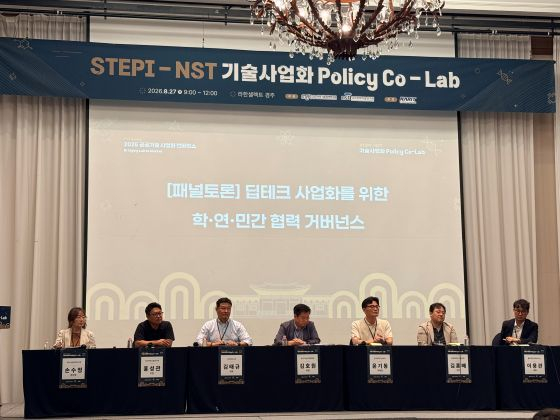
As three technology commercialization comprehensive specialized companies designated by the Ministry of Science and ICT — Korea Science Technology Holding, Yonsei University Technology Holding, and Blue Point Partners — have launched, experts emphasized that to achieve tangible results, it is more critical than the technology itself to establish an execution structure encompassing planning, investment, and decision-making.
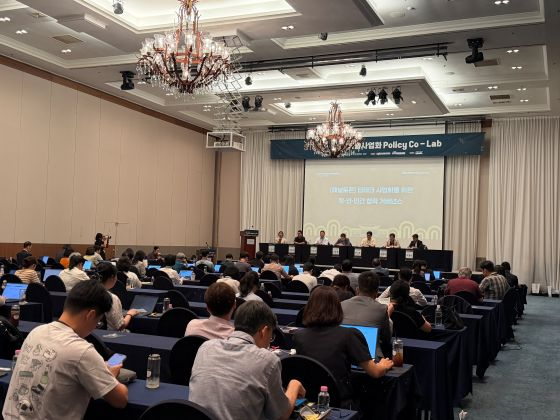
On the 27th, at a special session titled 'STEPI (Korea Institute of Science and Technology Policy)-NST (National Research Council of Science and Technology) Technology Commercialization Policy Co-Lab' held at the Gyeongju LaHan Select Hotel in Gyeongsangbuk-do, discussions continued on the theme of 'Academic-Industry-Private Sector Collaborative Governance for Deep Tech Commercialization.'
The panel was chaired by Kim Ho-won, president of the Korea Technology Commercialization Association. Participants included Kim Tae-gyu, CEO of iPartners; Hong Seong-kwan, head of NST's Technology Commercialization Division; Son Su-jeong, head of STEPI's System Innovation Headquarters; Yoon Ki-dong, deputy representative of Korea Science Technology Holding (KST); Kim Hun-bae, Gi Sul-ji-ju (EVP) of Yonsei University; and Lee Yong-gwan, CEO of Blue Point Partners.
No 'Star' in Technology Commercialization
First, Son Su-jeong (Head) remarked, "There are over 100 officially designated technology holding companies excluding the private sector — but is there any 'star brand' that immediately comes to mind?"
The explanation was that while deep tech (advanced technology) startups are expected to become unicorns (private companies with valuations of 1 trillion won or more), there is a lack of globally successful cases among the specialized technology commercialization companies tasked with nurturing them. Head Son explained, "The system for comprehensive technology commercialization companies was initiated from the awareness that while deep tech startups are urged to become unicorns, the companies cultivating them do not have any unicowns."
He further emphasized, "Technology commercialization is the process of transforming laboratory inventions into market innovations. It requires a subject that goes beyond individual support projects to connect resources and capabilities and design scaling-up pathways."
Highlighting their own assessment that over 1,330 technology commercialization support systems have been identified in budget documents since 2000, he pointed out, "The government has made many efforts, but there are no long-term projects; most are one-off or small-scale initiatives." Accordingly, he stressed that the newly designated comprehensive specialized companies must serve as a 'middle bridge' responsible for everything from initial planning to investment.
Head Son added, "The now-burdened South Korean technology commercialization system actually needs a diet; it is time to build the muscles of entities capable of actual operation." He urged, "I ask that these three institutional investors be allowed to operate without interference for five years and demonstrate convincingly that 'this level of success is achievable.'"
He continued, "We are at a pivotal moment with high expectations for creating substantial economic and social impact commensurate with the 35th trillion won era of government R&D (research and development). I hope this technology commercialization company model becomes a new turning point that lowers market uncertainty through organic collaboration among industry, academia, research, and government, and generates sustainable results."

Not After Results Are Achieved — From R&D Planning Onward… "Align Market and Research Goals"
Panelists diagnosed that the bottleneck in technology commercialization lies at the connection point between the process of generating results and transitioning to commercialization. Hong Seong-kwan, head of NST's Technology Commercialization Division, stated, "Public, university, and private specialized companies are not in a competitive relationship but rather complement the weak links in the value chain." He clarified that NST will also play an 'assist' role by supporting common platform capabilities such as large-scale result planning, high-difficulty technology transfer, and startup/growth support, rather than replacing individual technology transfer organizations (TLOs).
He particularly argued that the starting point for commercialization should be advanced to the research planning stage, not after R&D completion. Head Hong noted, "All three institutional investors begin commercialization from completed results; however, the success rate is low when commercializing fully developed outcomes." He emphasized, "Aligning market demand and research goals from the R&D planning stage significantly improves efficiency."
As evidence, he cited NST's 12-year operation of a convergence research unit project. As a result of placing rights and commercialization experts within the research units from the R&D selection stage to provide close support, 680 billion won in research funding was invested across 18 completed projects, generating 230 billion won in technology transfer revenue.
"Who Gives Up When It Gets Hard?"… The Core of Commercialization Is 'Decision-Making Authority'
As technology commercialization gains momentum, another problem arises: Who decides whether to discontinue a project when its business viability declines, and who bears the responsibility?
Kim Ho-won (Chairman) asked, "If KST needs to withdraw from an invested or supported company whose business viability deteriorates after about a year, does the decision-making authority lie with KST or the researcher?"
Deputy Representative Yoon Ki-dong of KST responded, "Rather than rigidly defining standard rules, we must carefully examine each situation. We should not be consumed by short-term results." He further stated, "Statistically, only one out of 1,000 startups succeeds; therefore, a long-term system that encourages 'honest failure' and draws out potential is necessary."
The issue lies in designing the authority and responsibility that enable such long-term investment. Kim (Chairman) pointed out, "Ultimately, this is a matter linked to KST's performance evaluation. It is crucial to clearly define the decision-making subjects and scope of responsibility among institutional investors."
Universities also face concerns regarding the roles of entrepreneurs and researchers. Kim Hun-bae, Gi Sul-ji-ju (EVP) of Yonsei University, stated, "While entrepreneurship largely depends on the entrepreneur's will and private domain, making university involvement difficult, we are reviewing internal regulations to determine whether faculty members must serve as chief executive officers (CEOs) or can be limited to chief technology officer (CTO) roles."
Regarding a three-year re-approval system for companies with faculty participation, he explained, "We are considering a plan not to approve companies that fail to secure investment and instead guide them toward returning to research or student entrepreneurship. However, for companies that have received private investment, legal review is underway because the university finds it difficult to decide on startup termination due to investment contracts."
"Technology Must Be Translated into Market Language"… Combination of Public and Corporate Technology
How roles should be divided among commercialization entities has also emerged as a key issue. Kim Tae-gyu, CEO of iPartners, diagnosed that the core of public technology commercialization lies not in the technology itself but in a 'responsibility for transition' structure spanning from market validation to investment and global expansion.
He explained the role of comprehensive specialized companies as "jointly considering whether researchers have accurately identified market pain points and coordinating with external experts to create market entry processes." He added, "Private accelerators should act as 'translators' connecting market language with public technology commercialization, while technology holding companies must become 'governance platforms.'" Particularly for deep tech and artificial intelligence (AI) fields, where commercialization targeting only the domestic market is difficult, he suggested that "global linkage from the initial planning stage is essential."
Opinions were also raised that public and corporate technologies should be combined. Lee Yong-gwan, CEO of Blue Point Partners, stated, "Technologies from large corporations have good market fit but lack differentiation, while university and research institute technologies are disconnected from the market; they may have a 'one-shot' advantage but incur high costs to reach the market. These two must be well combined."
He further introduced cases of collaboration with POSCO and RIST (Pohang Institute of Science and Technology) and said, "While continuously monitoring industry issues, there is a need for a structure that allows researchers to pursue large-scale goals over the long term."
[MoneyToday startup media platform Unicorn Factory]

 in FUTURE


