

[For more diverse corporate information on startups, visit 'Data Lab' on the Unicorn Factory Big Data platform .]
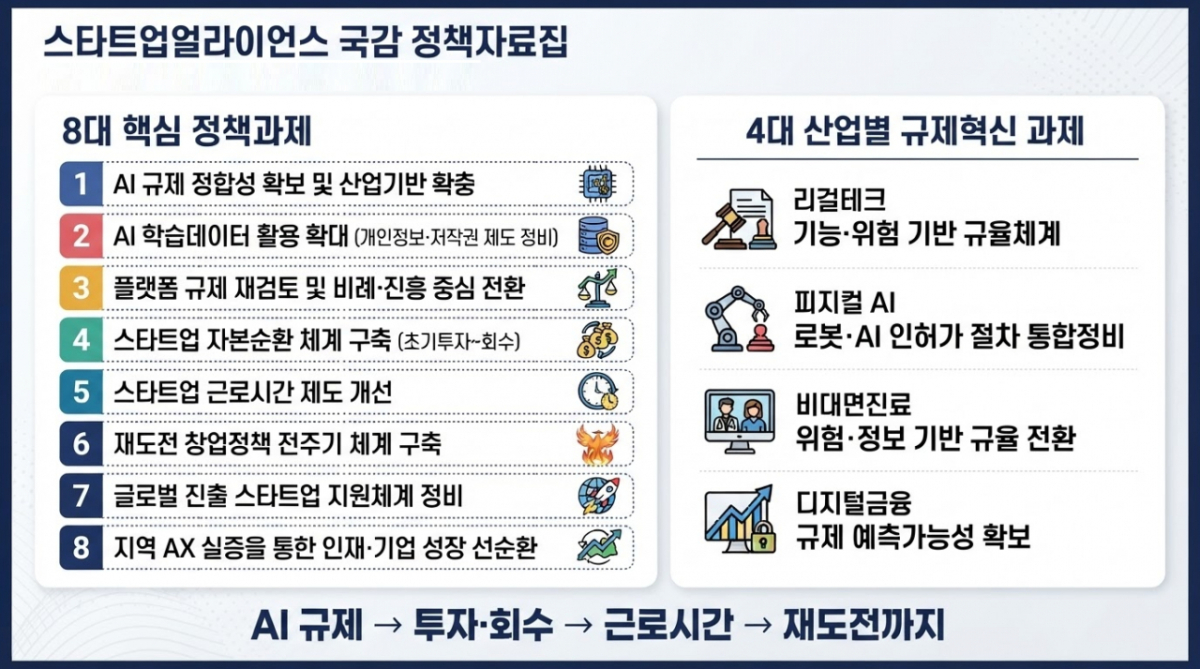
Startup Alliance announced on the 7th that it has published a policy booklet containing a total of 12 startup issues that must be addressed during the National Assembly audit, ranging from AI regulation to investment and exit, working hours, and second chances.
The policy booklet for this National Assembly audit includes eight core policy tasks and four industry-specific regulatory innovation tasks. It focused most heavily on institutional adjustments to connect AI with industrial competitiveness.
The eight key tasks include: securing regulatory coherence and expanding the AI industrial base; revising personal information and copyright systems to expand the use of AI training data; re-examining the foundation of platform regulation legislation and shifting to policies centered on proportionality and promotion; and building a startup capital circulation system from initial investment to exit.
It also proposed: improving working hour systems reflecting startup characteristics; establishing an entrepreneurial policy support system that enables responsible closure and second chances for failed entrepreneurs; setting up a support system connecting global-expanding startups with the domestic ecosystem; and creating a virtuous cycle of talent and corporate growth through AX verification at local industrial sites.
Regarding industry-specific tasks, it was first proposed that a regulatory system is needed for legal tech based on service functions and risk levels. With the spread of agentic AI bringing new legal services, the intent is to define permissible scopes centered on actual provided functions rather than applying uniform regulations across all work areas.
In the physical AI sector, it was proposed that licensing procedures scattered across multiple ministries and institutional investors must be integrated and revised, considering the industrial characteristics of combining robots with AI. For government R&D (research and development) and demonstration projects to lead to commercialization, not only technical development but also institutional procedures hindering on-site application must be improved.
For remote medical consultations, it was proposed that regulation should shift from uniform criteria such as administrative districts to risk- and information-based regulation considering patients' access to medical care, vulnerable time periods for medical services, and usage in adjacent regions. It was also viewed that a system is needed to accumulate actual usage data and research results on safety and effectiveness to reflect them in institutional improvements.
Regarding digital finance, it was proposed that regulatory predictability must be increased during the market entry process of new services. This means clearly defining what conditions a business operator must meet to provide services and establishing criteria to transition existing systems in line with technological changes.
Startup Alliance compiled these tasks along with relevant laws for each standing committee of the National Assembly. From the AI Basic Act to the Capital Markets Act, the Venture Investment Promotion Act, and the SME (small and medium-sized enterprise) Startup Support Act, it presented institutional improvements covering the entire startup process of founding, growth, exit, and second chance as an agenda for the National Assembly audit.
Lee Gi-dae, co-chairman of Startup Alliance, stated, "To leapfrog into one of the top three AI nations, it is important to create an ecosystem where the entire process from founding to demonstration, growth, exit, and second chance flows smoothly, going beyond simply increasing investment scale and the number of startup companies."
He continued, "What is needed now is sophisticated institutional design proportional to company size and actual risk," adding, "I hope this booklet will serve as a useful reference for the National Assembly and the government to examine institutional bottlenecks in the startup ecosystem and design policies and legislation that support innovation and growth."
[MoneyToday startup media platform 'Unicorn Factory']

 in FUTURE
