

The government's startup infrastructure, "maker spaces," established nationwide to lower the barrier for manufacturing startups, is shrinking rapidly, with a decline of about 80% over four years. Critics point out that as the scale and budget for general labs, which supported prototype production by non-manufacturing experts, have been significantly reduced, the original policy intent to "help anyone become a maker and start a business" has become meaningless.
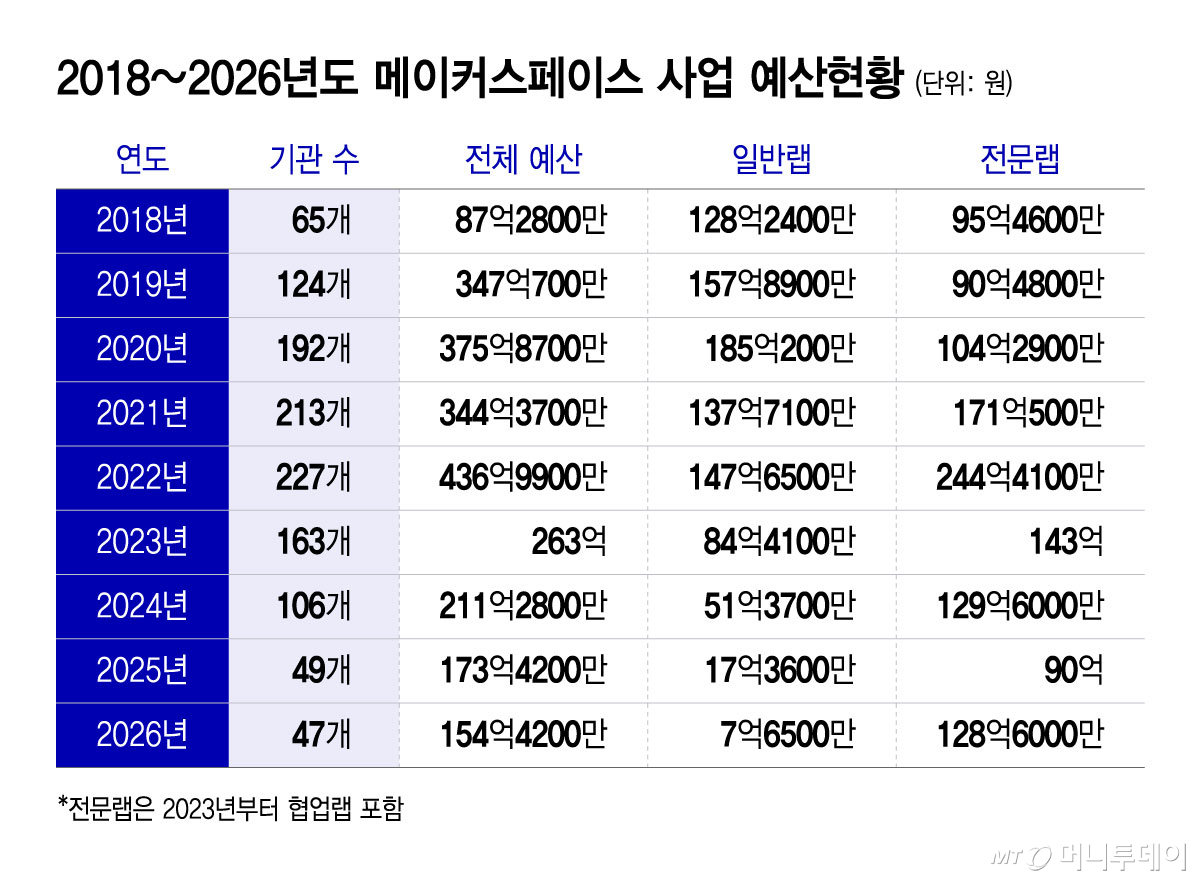
According to data submitted on the 16th to the office of Democratic Party of Korea lawmaker Oh Se-hee of the National Assembly's Industry, Trade and Energy and SMEs Committee by the Ministry of SMEs and Startups, the number of maker spaces started at 65 in 2018, rose to 227 by 2022, but only 47 are currently operating. This means 180 sites (79.3%) have disappeared within four years.
Maker spaces are facilities equipped with production tools such as 3D printers and laser cutters, allowing entrepreneurs and the general public to turn ideas into prototypes. Launched in 2018, the project was operated by dividing it into "general labs" responsible for public creativity and education, and "specialized labs" specialized in prototype production and startup linkage. The budget allocated from 2018 to this year reached 239.4 billion won.
In the early stages of the maker space implementation, more budget was allocated to general labs than to specialized labs, in line with policy direction. Specialized labs are mainly operated by public sector entities such as Creative Economy Innovation Centers and private companies with strengths in manufacturing. In contrast, general labs had a relatively low entry barrier, with high schools and local living cooperatives among the selected operators.
In 2018, budgets of 12.8 billion won for general labs and 9.5 billion won for specialized labs were executed. This trend continued in 2019 (general labs: 15.8 billion won, specialized labs: 9 billion won) and 2020 (general labs: 18.5 billion won, specialized labs: 10.4 billion won). However, after the specialized lab budget (17.1 billion won) surpassed the general lab budget (13.7 billion won) in 2021, the gap widened, and this year's general lab budget (800 million won) falls far short of the specialized lab budget (4.4 billion won) and the manufacturing-specialized collaboration labs introduced from 2023 (8.5 billion won).
Among the 47th currently operating maker spaces, only nine are general labs. These too are far removed from the "general labs" at the early stage of policy implementation when anyone could participate in prototype production, such as Korea University Sejong Industry-Academic Cooperation Group and Busan Technopark.
The reduction of general labs is interpreted as a result of many prospective entrepreneurs facing difficulties in reaching the Yangsan stage after prototype production. The Ministry of SMEs and Startups explained the background of releasing the "manufacturing-specialized maker space" operation plan last January, stating, "Many startups have continuously encountered structural limitations where they hit a wall at the production transition stage, including Yangsan design and product certification, after prototype production."
However, the Ministry of SMEs and Startups maintains that this is not a reduction of the project but a shift in direction. A ministry official said, "The project's basic direction itself has some overlap with the private sector," adding, "We believe the initial goal of 'comprehensive equipment distribution' has been achieved to some extent, so we plan to focus on supporting advanced manufacturing startups going forward."
Critics also point out that the effectiveness of the existing equipment distribution has declined. According to the Ministry of SMEs and Startups, as of September this year, a total of 700 pieces of equipment used in maker spaces nationwide are classified as idle equipment. New equipment construction has not been supported since 2023.
Democratic Party of Korea lawmaker Oh Se-hee stated, "Maker spaces need to be upgraded to support actual manufacturing startups and reach Yangsan, going beyond simple equipment distribution," while adding, "During the policy transition process, we must also examine whether the facilities and equipment built so far are being properly utilized and whether opportunities for the general public and prospective entrepreneurs to take their first steps in manufacturing startups are sufficiently maintained."
He continued, "It is necessary to review the overall operation of the project to increase the utilization rate of existing infrastructure and ensure that support at each stage from prototype production to productization and Yangsan is organically connected."
[MoneyToday startup media platform Unicorn Factory]

 in FUTURE
