

[For more diverse corporate information on the startups mentioned in this article, please visit the Unicorn Factory Big Data Platform 'Data Lab'.]
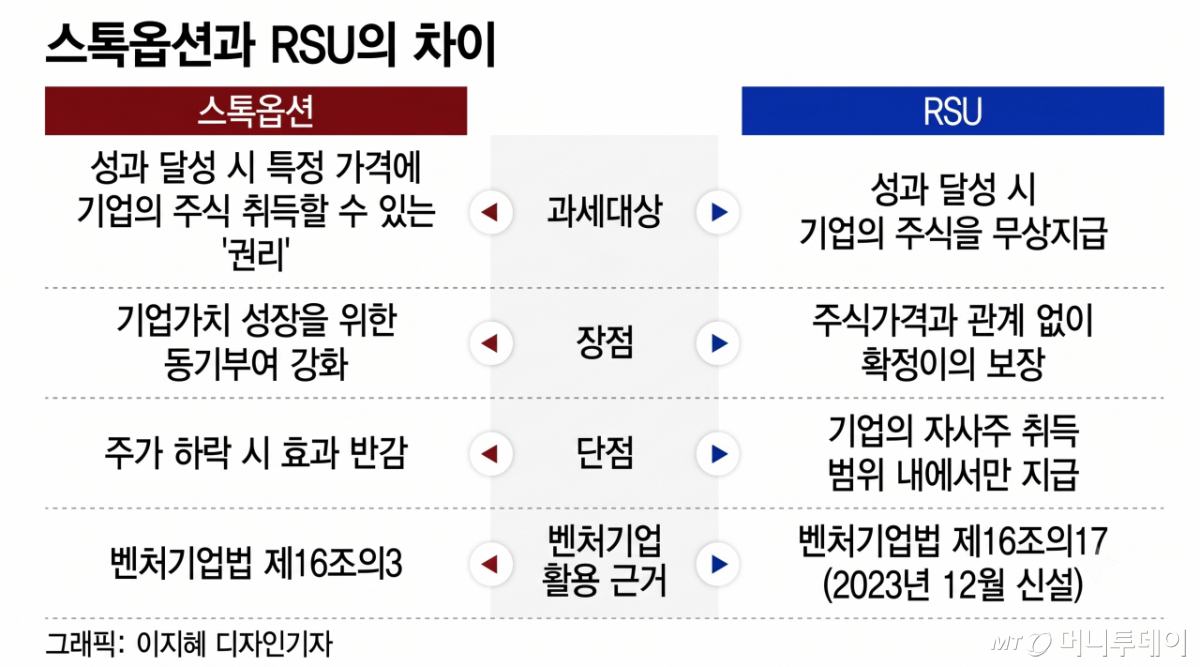
It was argued that to activate the distribution of RSUs, RSA (performance-based shares paid in advance or upfront), etc., to employees and staff at venture companies and startups, institutional reforms are needed to expand compensation sources, eligible recipients, and tax benefits. Under the current system, it is difficult for companies to secure funding, and employees face significant limitations, such as receiving unlisted stocks that are hard to cash out while having to pay labor income taxes in cash.
On the 17th, at the '5th Venture and Startup Growth Forum' held at the National Assembly, Ahn Hee-cheol, managing partner of DLG Law Firm, made these remarks. The forum was co-hosted by the Korea Startup Forum and the Venture Company Association, with support from the Ministry of SMEs and Startups and the Small and Medium Business Research Institute. It was led by Representative Jang Cheol-min of the Democratic Party of Korea.
Attorney Ahn stated, "Venture companies and startups find it difficult to provide cash compensation on the scale of large corporations, making RSUs and RSA essential for attracting innovative talent and encouraging long-term retention." However, he added, "The current system has bottlenecks in five areas—funding, eligibility, employment status, taxation, and procedures—compared to stock options, so they are not being utilized on the ground."
Even for early-stage startups, companies must purchase their own shares with cash (funding), register this in the articles of association for each grant, obtain a special resolution at the shareholders' meeting, and then report to the Ministry of SMEs and Startups (procedure) before distributing them only to employees and staff (eligibility), which has lowered utilization rates. Furthermore, from the perspective of employees, they receive unlisted stocks with no liquidity while having to pay labor income taxes in cash (taxation). If they leave the company inevitably, they cannot protect their rights (employment status), making these instruments less preferred.
In response, Attorney Ahn proposed allowing founders to utilize contributed shares as RSUs or RSAs. Instead of requiring a special resolution for each grant, he suggested that shareholders' meetings approve only the total allocation amount, eligible recipients, and evaluation criteria. He also recommended expanding the scope of eligible recipients to include employees of acquired companies, domestic and foreign affiliated companies, and external experts.
Especially regarding taxation, since most recipients receive unlisted stocks, he emphasized that a full deferral of tax payment until actual sale should be introduced to reduce the burden on workers. He also called for special provisions such as the five-year installment payment option for excess non-taxable amounts, and exemptions from unpaid taxes in cases of return or loss of value. Regarding employment requirements, he argued for greater flexibility, such as recognizing partial entitlement proportional to the period for those who leave involuntarily.
Following this, at the same forum, Lee Min-hyung, head of the Venture Company Association, presented on 'expanding the scope of mid-sized companies subject to venture company verification,' and Noh Min-seon, a research fellow at the Small and Medium Business Research Institute, presented on 'allowing special extended working hours in AI (artificial intelligence) and venture/startup R&D fields.'
Representative Jang Cheol-min (Rep.), who hosted the forum, stated, "To ensure that corporate performance benefits members and becomes a new driving force for further challenges, institutional support tailored to each growth stage is necessary." He added, "As the secretary of the Ministry of Trade, Industry and Energy and Small and Medium Business Committee, I will follow up on the legislation and policies needed based on the opinions presented at this forum."
[MoneyToday Startup Media Platform Unicorn Factory]

 in FUTURE
