

[For more diverse corporate information on the startups mentioned in this article, please visit the Unicorn Factory big data platform 'Data Lab.]
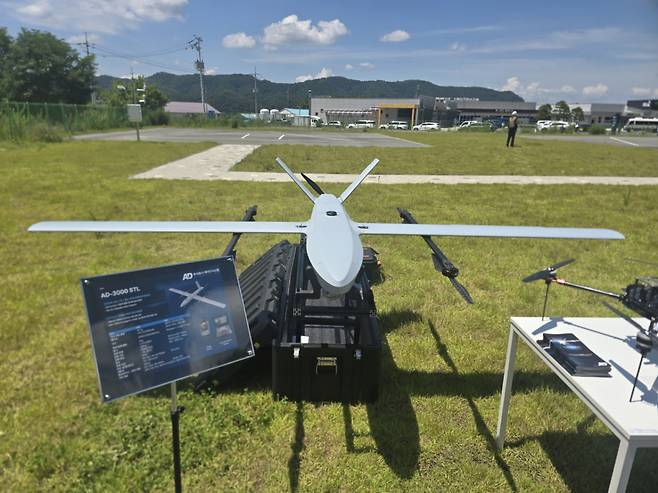
On the 16th, AD System, a defense company specializing in small stealth unmanned aerial vehicles (UAVs), announced that it has secured Series A funding totaling 13 billion won.
This round was led by LB Investment. Institutional investors including Korea Development Bank, SmileGate Investment, Future Asset Venture Capital, Future Asset Capital, Flux Ventures, and InnoPolis Partners also participated in the investment. With this round, the cumulative investment raised reached approximately 18.4 billion won.
Founded in 2019, AD System is a defense company that independently handles the entire UAV development process, from airframe design and composite material manufacturing to flight control and avionics software development, as well as system integration. Based at its headquarters in Cheonan, Chungcheongnam-do, and its factory and corporate research institute in Hwaseong, Gyeonggi-do, the company develops various unmanned system, including vertical takeoff and landing (VTOL) fixed-wing platforms and educational multi-copters.
AD System's core focus is on developing UAVs that enhance battlefield survivability by countering counter-UAV (C-UAS) system. The company has developed technologies such as low-observability (stealth) design and materials, VIO/SLAM-based GPS-denied navigation, anti-jamming data links, and terminal-phase evasion flight. Its goal is to ensure mission capability by improving UAV survivability in battlefields where jamming and detection-interception threats are constantly present. According to the company, its key technologies have been verified through tests conducted by the Agency for Defense Development (ADD).
The company's ability to internalize the entire UAV development process from design to production, along with its track record of supplying defense-related products, influenced this funding round. Recently, AD System secured an 8.7 billion won contract to supply educational drones for training army drone operators. Earlier in July, the company was selected as a supplier alongside PreNew and Aerlux for this project. Under the contract, it will supply a total of 3,792 units of the educational drone 'AD-ME1' to designated army delivery units.
The company plans to use the investment funds to develop cost-effective UAVs that implement battlefield survivability technologies at reasonable prices and establish large-scale production systems. This decision comes amid a shift in the UAV battlefield from high-cost precision platforms to scenarios where multiple units are operated as consumables under jamming and interception threats, increasing the importance of unit price competitiveness and mass supply capabilities.
To achieve this, the company will expand its large-scale production facilities and automated equipment and is scheduled to complete development of its next-generation UAV platform 'AD-4000,' which it is developing independently, by next year.
Kim Jeong-ho, CEO of AD System, stated, "In Daejeon, survivability that allows UAVs to penetrate enemy counter-UAV systems and survive is essential, but expensive UAVs that can only be used in limited numbers are not the solution." He added, "The goal of this investment is to secure low-observability and anti-jamming technologies while achieving unit prices and production capabilities that allow for sufficient supply volumes."
[MoneyToday Startup Media Platform Unicorn Factory]

 in FUTURE
