

[For more diverse corporate information on the startups mentioned in this article, please visit Unicorn Factory's Big Data Platform Data Lab.]

"Our initial hypothesis was completely wrong. People weren't conversing with characters; they were 'experiencing' stories generated in real time by AI (artificial intelligence)."
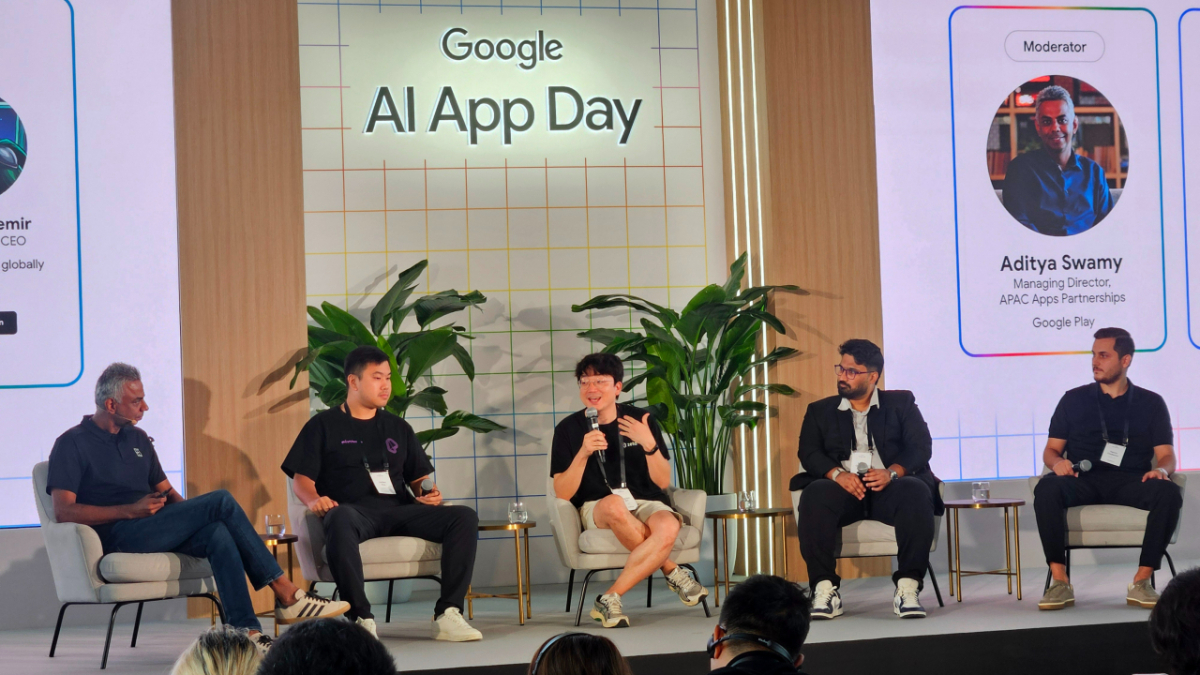
Kim Jong-yoon, CEO of ScatterLab, stated at a founder dialogue during Google's "AI App Day" held on the 17th (local time) in Singapore: "Our AI storytelling platform 'Zeta' has ranked number one in Korea and also achieved the top spot in Japan."
The AI App Day was organized for founders and executive-level decision-makers leading AI-native app businesses. The event focused on helping developers discover new growth opportunities and accelerate their businesses amid the rapidly evolving AI market, with approximately 150 companies attending this year.
Panelists at the dialogue included Kim (CEO), along with Jaden Shek of PixVerse (co-founder), Rallis Gudipati of Dashverse (co-founder), and Yalcin Ozdemir of AppNation (co-founder). They shared insights on AI app model strategies, monetization, and user acquisition techniques.
Kim (CEO) remarked, "As a 15-year entrepreneur, I am the oldest in age and have the longest company history here." He added, "I have been directly developing early deep learning models such as BERT and RoBERTa since the Transformer paper emerged around 2017–2018, before 'AI' became a trending term."
ScatterLab's first product was the social AI chatbot 'Luda'. When starting Zeta, the company's hypothesis was that "users would directly train characters to create engaging conversations on the platform." However, early data overturned this assumption.
Kim (CEO) explained, "Daily usage time for previous companion (chatbot-style) apps was 15–20 minutes—a figure that makes sense if you imagine having just one friend on a messenger app. Yet, even from the early days when our model performance was poor, Zeta recorded daily usage of 1 to 1.5 hours."
He continued, "The key insight was 'excellent storytelling created on the spot.' Until now, all stories were crafted by human creators, but now machine learning, AI, and users themselves playing the lead roles combine to create immersive, dynamic narratives."
From an AI service provider's perspective, high user dwell time translates directly into increased inference costs. Kim (CEO) explained that they addressed this challenge through a "two-stage strategy."
He stated, "80% of our users are free-tier users. Since the revenue from ads is fixed, both the budget available for inference and the model size we can use are also constrained. Ultimately, the question became 'how much fun can we create within these limits?' We focused on this for the past two years."
The result of this focus has become ScatterLab's competitive advantage. Kim (CEO) confidently asserted, "Our models are extremely cost-effective and efficient, yet their performance rivals that of models 10 or even 100 times larger."
The most emphasized advice from Kim (CEO) was to abandon fears regarding monetization. He stressed, "If you have a product, do not hesitate to monetize it through ads or in-app purchases."
Kim (CEO) shared, "Initially, I was terrified of inserting full-screen ads during gameplay. So we started with 15-second ads every 30 minutes, but retention rates showed no change. The same held true even when we reduced intervals to 25 minutes, 10 minutes, and finally 7 minutes."
He further added, "If you are providing sufficient value to users, you can be more aggressive. It is better to channel that energy into improving model performance and product quality. You should experiment with far more models—closed models, long-tail models, proprietary models, and others."
Other panelists' assessments aligned with Kim (CEO)'s perspective. Gudipati, founder of Dashverse, stated, "We plan to shift our billing model from a credit-based system to a flat-rate subscription. Usage-based billing causes users to calculate 'should I click this?' which hinders experimentation."
Ozdemir, founder of AppNation, remarked, "Just because complex models can do everything doesn't mean we need to create an all-in-one app. It is crucial to build an app portfolio by identifying specific use cases that ordinary people will use daily."
[MoneyToday startup media platform 'Unicorn Factory']

 in FUTURE

