


The second round of "Everyone's Startup," which closed on the 17th, saw a 47.5% increase in participants compared to the first recruitment in the first half of the year. Although the recruitment period was only 29 days—much shorter than the first round's 51 days—the number of final applicants was higher. Mentors institutional investor who have begun reviewing application materials are reporting that there are more ideas with solid content than in the first round. Both quantity and quality appear to have improved over the first half of the year.
However, since the number of mentors institutional investor and mentors has not increased accordingly, the burden per mentor for document review is expected to rise significantly. Additionally, while finalists for the first round must be selected by mid-October, the schedule is tight due to the Chuseok holiday period. It is also noted that practical difficulties have been compounded by enhanced security measures implemented to prevent the information leak incident that occurred during the first round of "Everyone's Startup."
92,838 applicants... 10,000 to be selected in October
According to the Ministry of SMEs and Startups on the 22nd, a total of 92,838 people applied for the second round of the public startup audition program "Everyone's Startup," which opened recruitment on the 20th of last month and closed on the 17th of this month. This represents a 47.5% (29,894) increase compared to the final applicant count of the first round in the first half of the year (62,944). The Ministry of SMEs and Startups commented that it reflects "even hotter startup enthusiasm."
Mentors institutional investor must select 10,000 first-round finalists through idea review by October. The number of mentors institutional investor for the second round of "Everyone's Startup" increased to 172 organizations, up from 131 in the first round. In total, 6,380 individuals are involved in actual reviews and mentoring, including 518 senior entrepreneur mentors.
A mentor institutional investor official stated, "Although the number of submitted documents has increased, the second round of Everyone's Startup coincides with the Chuseok holiday during the document review period, making it difficult to urge responsible mentors to meet deadlines." The official added, "To align as closely as possible with other institutional investors and the Ministry of SMEs and Startups, we are providing various conveniences for mentors."
Second round of "Everyone's Startup" shows improved standards and security compared to the first round
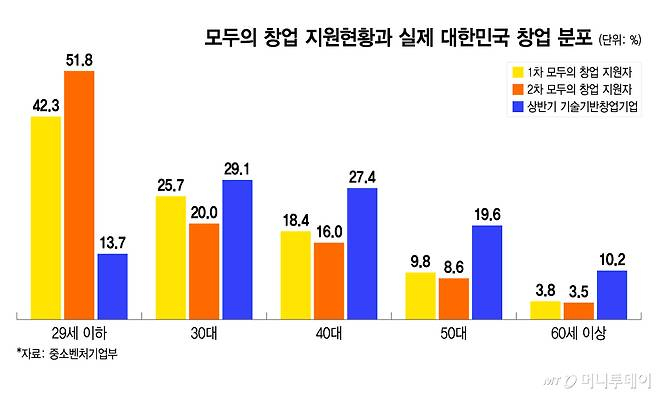
Mentors institutional investor evaluated that the overall quality of submitted startup ideas has advanced compared to the first round. A representative from an accelerator (AC) who serves as a mentor said, "In the first round of 'Everyone's Startup,' many applicants submitted ideas with only a single line, resulting in numerous 'dummy' entries that made it difficult to write review comments. In contrast, the documents received this time (second round) contain significantly deeper thinking and more innovative ideas, so we expect the review process will take more time."
Strengthened review procedures, criteria, and security compared to the first round also pose a burden for mentors. While in the first round of "Everyone's Startup," one mentor often conducted reviews alone, the second round requires three responsible mentors to conduct joint reviews. Additionally, reviewers must write at least 200 characters of feedback per applicant. To prevent information leaks, the 'copy and paste' function for submitted startup idea content has been disabled. Mentors must manually type out the content before providing their evaluations.
After selecting first-round finalists through idea review, mentors institutional investor must also conduct a "requirement verification" to determine whether selected applicants actually meet the eligibility criteria as prospective entrepreneurs for "Everyone's Startup." The tight schedule, increased number of applicants, improved quality of startup ideas, and enhanced security are all weighing heavily on the shoulders of mentors.
"We take responsibility for reviewing and mentoring based on a single 'fresh idea'"

Many mentors are currently working in venture capital firms (VC), accelerators (AC), universities, and public institutional investors. Although they receive fixed compensation from the Korea Startup & Venture Fund budget for participating as "Everyone's Startup" mentors, it is said that their pay is meager compared to the actual time and effort invested. There is also a burden associated with all mentors operating under their real names and providing review comments to both successful and unsuccessful applicants.
However, reports indicate that the reason these individuals volunteer for mentorship despite low compensation and tight review deadlines is the strong "professional joy" derived from encountering new startup ideas and developing them into commercial ventures. This goes beyond simple enjoyment; it sometimes leads to actual investment. CNTech, which mentored first-round finalists in the first round of "Everyone's Startup," invested 200 million won in an AI operations management item. The Gwangju Creative Economy Innovation Center is also planning to link with TIPS after investing 100 million won in a motor technology project.
One mentor said, "Unlike the standardized ideas we usually encounter in the field, occasionally innovative technologies and business approaches stand out. I believe this may be one of the most positive effects of 'Everyone's Startup'."
[MoneyToday startup media platform 'Unicorn Factory']

 in FUTURE


