

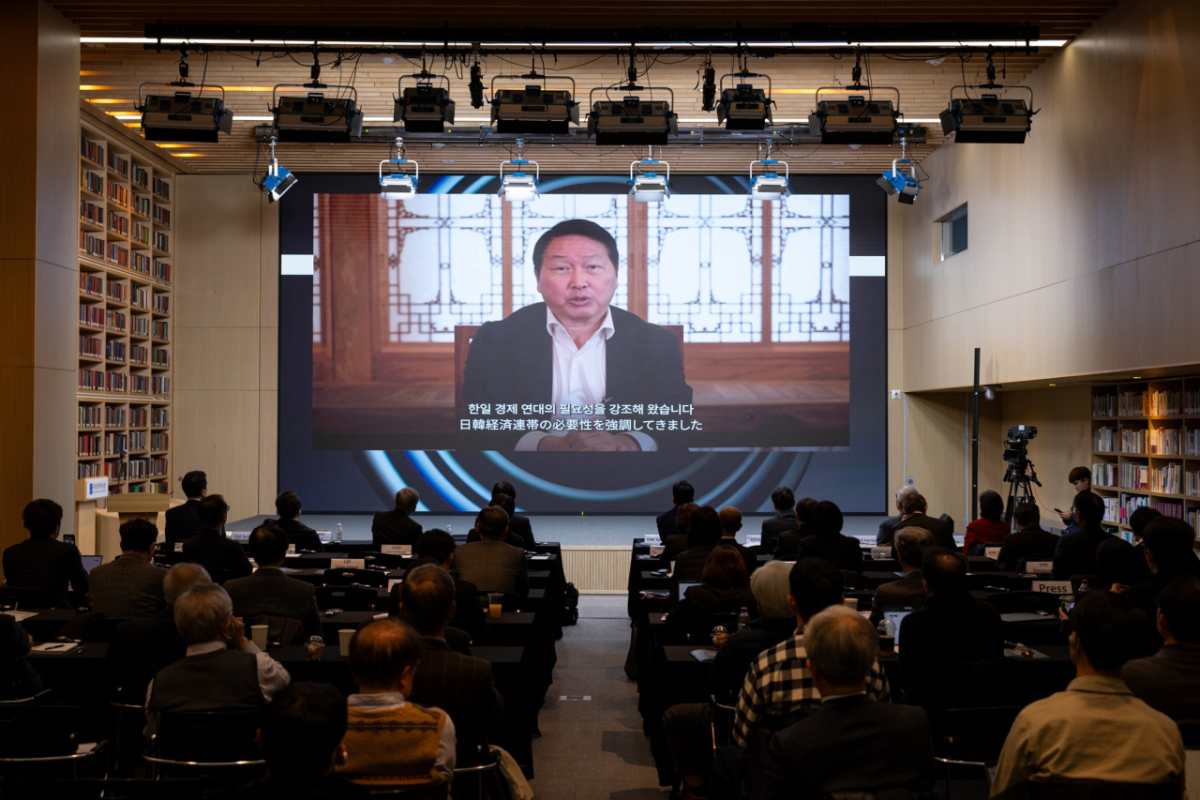
SK Group Chairman Chey Tae-won said he is preparing a permanent cooperation platform modeled on a "big tent" to bring together the capabilities of various stakeholders, including business communities, academia and research institutions in both South Korea and Japan, and provide a lasting foundation for bilateral economic cooperation.
The Choi Jong-hyun Academy said Chey made the remarks in a video keynote address at the "Conference on Mapping Out a Roadmap for Korea-Japan Economic Cooperation: From Vision to Action," held on Nov. 12 at the Korea Foundation for Advanced Studies conference hall in Gangnam District, Seoul.
The Choi Jong-hyun Academy was established by SK Group to carry on the management philosophy of its late former chairman, Chey Jong-hyun, who emphasized the importance of developing human resources as a contribution to the nation. Chey Tae-won currently serves as its chairman.
Chey proposed concretizing, in stages, the level of economic cooperation to be achieved in three years, the industries that will generate joint results and the institutional barriers that should be mitigated in five years, and the form of economic solidarity in which companies and citizens can feel tangible benefits in 10 years.
He emphasized that cooperation must be expanded starting from feasible areas, such as identifying industry-specific cooperation opportunities and lowering barriers that restrict the movement of labor and capital.
Chey said, "If the roadmap shows us the path we should take, the platform will serve as the foundation for gathering the strength to walk that path together," emphasizing the need to set the medium- and long-term direction of Korea-Japan economic solidarity while consolidating the capabilities of the cooperation stakeholders who will execute it.
This conference was jointly hosted by the Chong Shik Scholarship Foundation and the East Asia Institute, with participation from the Korean Society for Japanese Studies and Japan's Nakasone Peace Institute (NPI).
The Korea-Japan research team presented three major axes of cooperation: "Solidarity for Survival" centered on economic security and supply chain cooperation; "Solidarity for Innovation" for advanced technology and industrial innovation; and "Solidarity for Attraction" through cultural and human exchanges.
They argued that the scope of cooperation must be expanded to include joint procurement of energy and critical minerals, AI and semiconductor cooperation, strengthening digital industry competitiveness, as well as structural issues commonly faced by both countries, such as aging populations and regional decline.
Professor Son Yul at Yonsei University recommended pursuing both "Negative Integration," which lowers economic constraints such as tariff and non-tariff barriers, and "Positive Integration," which addresses common challenges such as low birth rates, aging populations, regional decline, and the supply of energy and critical minerals.
As a strategy to realize this, he presented "Solidarity for Survival," "Solidarity for Innovation," and "Solidarity for Attraction," and outlined a three-stage roadmap spanning approximately 20 years from 2026 to 2045.
Professor Lee Jung-hwan at Seoul National University emphasized the need to expand the scope of Korea-Japan AI (artificial intelligence) cooperation from bilateral technological collaboration to development cooperation targeting third countries.
Professor Lee explained that while Japan has played a leading role in third-country development cooperation based on its financial resources and long-standing project experience, in the field of AI, South Korea can also seek a more active role by leveraging its technological capabilities and resources.
Professor Fukuwaga Yukiko at Japan's Waseda University proposed expanding the scope of Korea-Japan economic cooperation from manufacturing-centered trade to the service, financial, and digital sectors. In particular, she emphasized cooperation opportunities in the service industry arising from the spread of AI, as well as the importance of cooperation in capital markets and financial services.
Professor Terada Takashi at Japan's Doshisha University called for the establishment of a "Korea-Japan Economic 3+3 Consultative Body" involving relevant government ministries in foreign affairs, industrial trade, and finance from both countries. This concept aims to comprehensively discuss investment and financial issues by including financial authorities in existing consultations centered on foreign affairs and industrial trade.

 in INDUSTRY
