

[For more diverse corporate information on the startups mentioned in this article, please visit the Unicorn Factory big data platform ‘Data Lab’.]
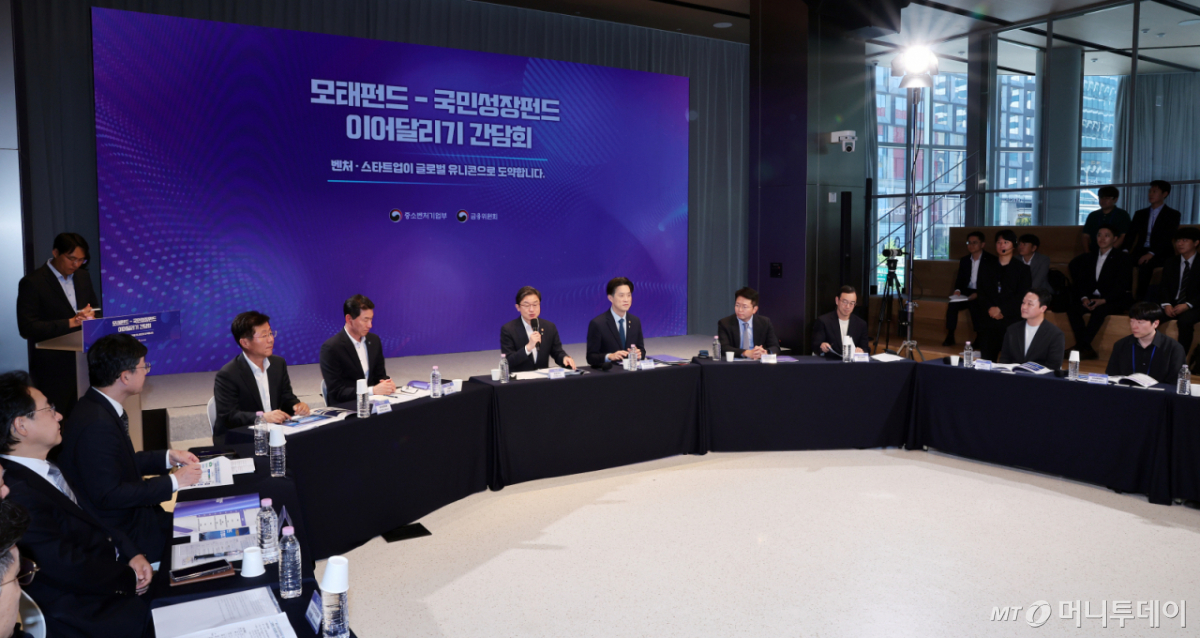
It was revealed that 70% of the 60th asset management companies, including accelerators (ACs) and venture capital firms (VCs), selected for the first regular investment project of the government’s fund of funds (Korea venture fund) failed to establish their sub-funds within the designated deadline. Analysis suggests that asset managers are facing severe difficulties in fundraising as matching funds from private limited partners (LPs) have concentrated on the large-scale policy finance vehicle, the “National Growth Fund.”
According to documents submitted by Korea Venture Investment and obtained by the office of People Power Party lawmaker Kang Seung-gyu on the 1st, 42 out of the 60th asset management companies selected for the first regular investment project under the jurisdiction of the Ministry of SMEs and Startups in April this year—accounting for 70%—failed to establish their sub-funds within the set deadline (three months after selection).
Considering the delays in fund establishment, Korea Venture Investment initially extended the deadline by two months. However, 23 of these firms (38.3%) ultimately failed to complete fund establishment even within this first extension period.
The fund of funds (Korea venture fund) revised its regulations last year to allow extensions of the establishment deadline for up to three months in total, through a maximum of two instances, such as “two months plus one month.” Consequently, if these 23 firms fail to secure private matching funds within the remaining one-month additional extension period, they will face penalties, including the return of their asset manager qualifications, in principle.
The venture investment industry points to the concentration of private funds into the National Growth Fund as the background for such large-scale establishment delays. It is reported that major private LPs, including financial holding companies and mutual aid associations, have flocked to the National Growth Fund due to its relatively high stability and profitability, causing the private matching funds intended for fund of funds (Korea venture fund) sub-funds to dry up.
A VC representative stated, “While major private LPs are lining up to entrust their funds to asset management companies selected for the National Growth Fund investment project, fund of funds (Korea venture fund) sub-funds are stuck because they cannot secure private matching funds.” The representative added, “The National Growth Fund is absorbing even the private capital that should go to the fund of funds (Korea venture fund), causing its delegated asset managers to struggle significantly with fund formation.”
In fact, it is reported that most of the large asset management companies selected for the National Growth Fund investment project have filled their funds up to the “establishment cap,” which reaches twice the target amount initially proposed in the investment project. The situation is one where liquidity is so abundant that asset managers must either reduce fund sizes or coordinate with private LPs regarding their investment requests.
Some market analysts also argue that policy funds have been released excessively, exceeding the market’s short-term absorption capacity. A venture industry official noted, “While the National Growth Fund, a core government flagship project, is investing approximately 2 trillion won, the fund of funds (Korea venture fund) has simultaneously poured out 2.6 trillion won, its largest scale ever.” The official pointed out, “With massive amounts of money released at once into a limited pool of private matching funds, establishment failures are occurring in a domino effect.”
On the other hand, the Ministry of SMEs and Startups, the competent authority, maintains that it is difficult to definitively attribute this fund establishment delay solely to the direct impact of the National Growth Fund.
A Ministry of SMEs and Startups official rebutted, “Even last year, when the National Growth Fund did not exist, the proportion of asset management companies that failed to meet the three-month establishment deadline was at a similar level to this year.” The official added, “While there may be differences depending on individual asset managers’ networks or the nature of their funds, it is an overgeneralization to interpret all asset managers’ establishment difficulties as being due to concentration in the National Growth Fund.”
The industry expresses concern that if delays in establishing fund of funds (Korea venture fund) sub-funds persist, the early-stage startup ecosystem could suffer direct damage. According to the Korea Venture Capital Association, new venture fund establishment amounts in the first half of this year reached 844 billion won, recording the second-highest level for a first-half period, indicating that overall liquidity in the venture investment market appears abundant on the surface.
An industry official expressed concern, “While abundant liquidity is mainly concentrated in late-stage scale-up phases, the execution of policy funds supplied to ‘market failure areas’—such as youth entrepreneurship, early-stage companies, and re-challenges—which the fund of funds (Korea venture fund) has focused on policy-wise, will inevitably be delayed for a considerable period.”
[MoneyToday Startup Media Platform Unicorn Factory]

 in FUTURE
