

[For more diverse corporate information on the startup featured in this article, you can view it on the Unicorn Factory big data platform 'Data Lab'.]
What is needed for AI (artificial intelligence) to make proper judgments? A high-performance model alone is not enough. For AI trained on past data to accurately understand and judge current reality, it needs the latest information connected and refined into accurate data. This is so-called "inference data."
BigValue, established in 2015, is a data tech company that has delved into this market. Initially known for its AI real estate price estimates, it is now expanding its business areas to finance, distribution, insurance, healthcare, pharmaceuticals, and the public sector. It collects public and private data and supplies it in a form that can be used immediately by AI and agents.
The CEO of Gureum BigValue said, "As AI services increase, the value of companies that stably supply high-quality data will also rise," adding, "I see the development of AI not as a threat to our business, but as an opportunity to create new customers."
Started in real estate, but the essence is 'data'

The company name BigValue carries the meaning of "finding value from big data." Although it started with the goal of data supply from the beginning, demand was initially concentrated in the real estate and collateral loan markets, leading to its natural perception as a proptech company.
A representative achievement is an AI price estimation system that automatically calculates prices for non-standard real estate such as villas and single-family homes. It connects Ministry of Land, Infrastructure and Transport transaction records, land information, building registers, etc., analyzing nearby transaction cases and individual characteristics. As financial institutions utilized this in collateral loan reviews, it laid the foundation for growth.
However, as the proptech image strengthened, limitations arose in expanding to other industries. BigValue redefined its corporate identity as "data tech" marking its 10th anniversary of establishment.
Koo (CEO) said it was "a return to the fundamentals," noting, "The technology remains the same, but customers needing data have expanded beyond the financial sector to public institutional investors, big tech, insurance, medical devices, and pharmaceutical companies. We judged that a brand confined to a specific industry could actually become a constraint on expansion."
This strategy translated into results. BigValue launched "BigValue Platform," a SaaS (Software as a Service) integrating over 1,000 types of spatial, population, and commercial data, and secured approximately 40 new clients in pharmaceuticals, healthcare, appraisal, licensed brokerage, commercial real estate, and internet banking after paid conversion.
Based on this, it achieved revenue of 6.3 billion won and an operating profit surplus last year. Revenue has increased for four consecutive years since 2021, setting a new record high. This year's target is revenue of 10 billion won.
"Providing data meal kits, not dirt-covered ingredients"

What BigValue focuses on is not training data used for AI to learn from the past, but inference data needed when trained AI judges current situations in actual work.
Source data generated by various institutional investors has different standards and update timings. When administrative districts or laws change, the timing of reflecting these changes varies by institutional investor. While problems may not surface when a person checks a few cases, if AI processes buildings nationwide at once, small errors can distort the entire result.
BigValue connects different data to the same target and filters out outliers and conflicts. It also possesses technology that divides national spatial data into 100–200m unit grids, enabling comparison of foot traffic, commercial districts, transportation, real estate, and policy data on the same standard.
Koo (CEO) compared this to a "meal kit." He said, "If other companies' data is 'ingredients freshly dug from the field with dirt on them,' we provide data that has been prepared and connected so it can be cooked immediately," explaining, "It is close to a meal kit equipped not only with good ingredients but also a recipe."
Data reliability is also a competitive advantage. By supplying data for long periods to customers with strict standards such as commercial banks and big tech companies, it has accumulated quality management know-how. Industry experts enter the client's work site to combine internal data with BigValue data and apply it to actual business processes, providing consulting services.
Koo (CEO) said, "Customers may know their own work well but not know which data should be connected where," adding, "We support them from defining problems together and creating solutions until they can continuously subscribe to the data."
Data subscription creates recurring revenue, unlike one-time training data. This is because today's decision-making requires today's data. He said, "Just as newspapers supply new articles every day, inference data must be continuously updated."
AI agents directly consume data… Expansion into public AX

BigValue focuses on technology that enables various AI models to interpret data more accurately, rather than developing its own LLM (Large Language Model). The AI real estate consultation service "Bokdeukbang Gae" also started as an experiment to research a data structure suitable for agent consumption.
Bokdeukbang Gae is AI-based, allowing users to see at a glance the complex they want, loan interest rates, housing subscription schedules, etc. Users input desired items in a chat, and the AI answers with results. This helps users accurately organize their needs before real estate transactions.
Koo (CEO) stated, "Initially, we connected existing integrated databases as-is, but the AI could not properly interpret the content," reporting, "When we divided the data into smaller units and changed it to a flexible structure, the quality of answers improved."
He said, "Through Bokdeukbang Gae, we are learning how to feed data to AI agents in a way that yields good answers," emphasizing, "Our role is not to create our own AI model, but to supply data that is easily readable by any model."
Absorb domestic demand first… 'Deep & Wide' strategy
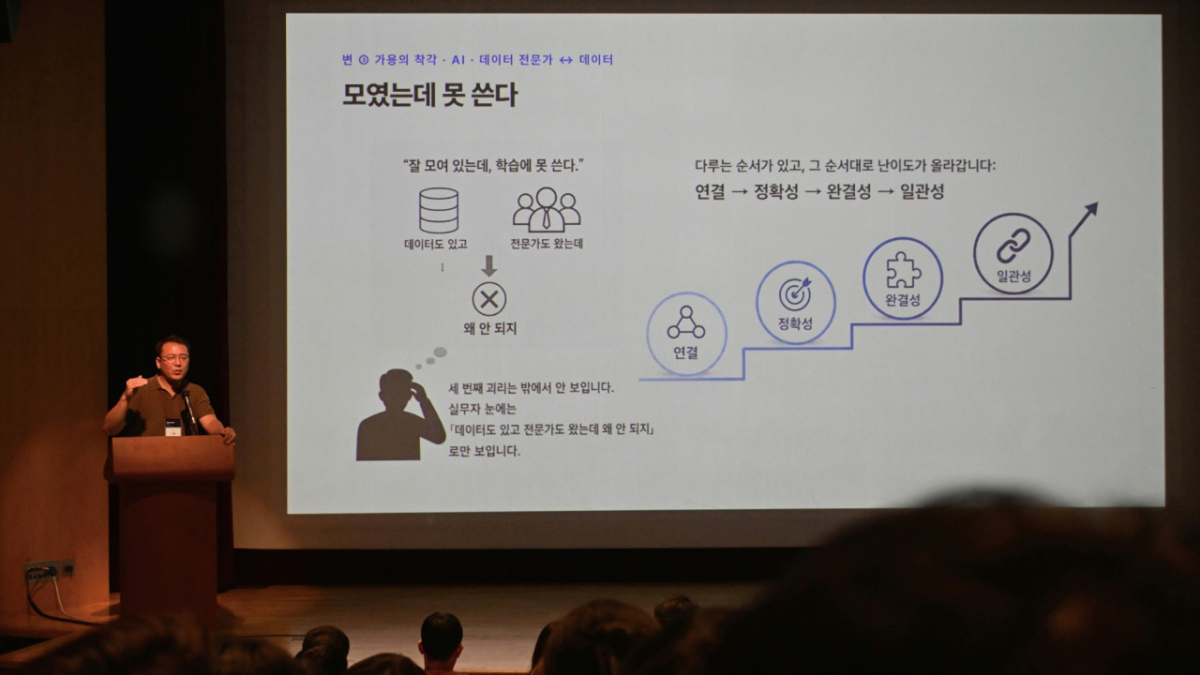
Public AX is also a major growth axis. The highly pathogenic avian influenza risk prediction model built with the Animal and Plant Quarantine Agency connects scattered information such as migratory bird movements, land around farms, vehicle movements, and weather to identify high-risk farms. It helps deploy limited quarantine resources for prevention rather than post-event response.
Koo (CEO) pointed out, "The success or failure of public AX depends not on how much AI is adopted, but on how well the data is prepared, whether the field trusts the results, and whether continuous improvement is possible," adding, "Simply putting unorganized internal documents into an LLM cannot become true AX."
BigValue plans to focus on the domestic market over overseas markets. This judgment stems from the fact that data contains each country's laws, systems, and cultural context, making it difficult to succeed by simply transferring technology. It will first absorb domestic demand with a 'Deep & Wide' strategy of digging deep into existing customers and expanding to new industries.
The destination Koo (CEO) envisions is a "data utility company." He said, "Just as electricity has become the foundation of all industries, I want to become a company that stably supplies data," emphasizing, "Like Kolmar Korea or Qualcomm, we will become an essential company behind numerous AI and services, even if not visible in the front."
He added, "BigValue's vision is 'Enriching the world with data,' abbreviated as Daeseupung," stating, "Helping better decision-making by preventing disasters with data and protecting socially vulnerable groups is the value BigValue wants to create."
[MoneyToday startup media platform 'Unicorn Factory']

 in FUTURE


