

[For more diverse corporate information on the startup featured in this article, visit the Unicorn Factory big data platform ‘Data Lab’.]

In the era of climate crisis, eco-friendly materials are always the path forward. However, the justification of carbon reduction often struggles to move beyond the laboratory. Materials are frequently too expensive, incompatible with existing production lines, or their physical properties fail to meet the demands of industrial applications. Kim Se-yoon, CEO of Composite Solutions, who previously worked at So Jae-gong-hak (Dr.) researching high-performance thermoplastic composites using fiber-reinforced composite materials and recycled PET, stated, “Good materials and sellable materials are not necessarily the same,” adding, “I started this company because I felt it was a waste to keep performance-verified materials confined to the lab.”
Composite Solutions develops self-reinforcing PET (srPET) composite materials that revive waste PET as high-value-added materials, as well as an eco-friendly flame-retardant solution called ‘EcoFlamix.’ Kim (CEO) said, “Our goal is to go one step beyond developing eco-friendly materials and create eco-friendly materials that industries can actually choose.”
Composite materials made by mixing glass fibers or carbon fibers into plastic resins are difficult to separate, making recycling challenging. srPET solves this problem by unifying the material into a single type. It uses two PET-based materials with different melting points. The high-melting-point PET acts as the reinforcing skeleton, while the low-melting-point PET melts when heated and serves as the matrix filling the spaces in between. Because the composition is unified, it can be recycled directly without a separation process.
The other pillar of the company’s technology, EcoFlamix, is a ‘flame-retardant technology’ that makes materials resistant to fire. Kim (CEO) approached this not as a single flame retardant, but as a platform that imparts flame-retardant functionality to various materials. First, it achieves flame-retardant performance using non-halogen systems, such as phosphorus-based and inorganic compounds, rather than environmentally burdensome halogen-based ones. After flame-retardant treatment, the original material’s physical properties must remain intact, and the process must also be compatible with subsequent steps such as coating, drying, and molding.
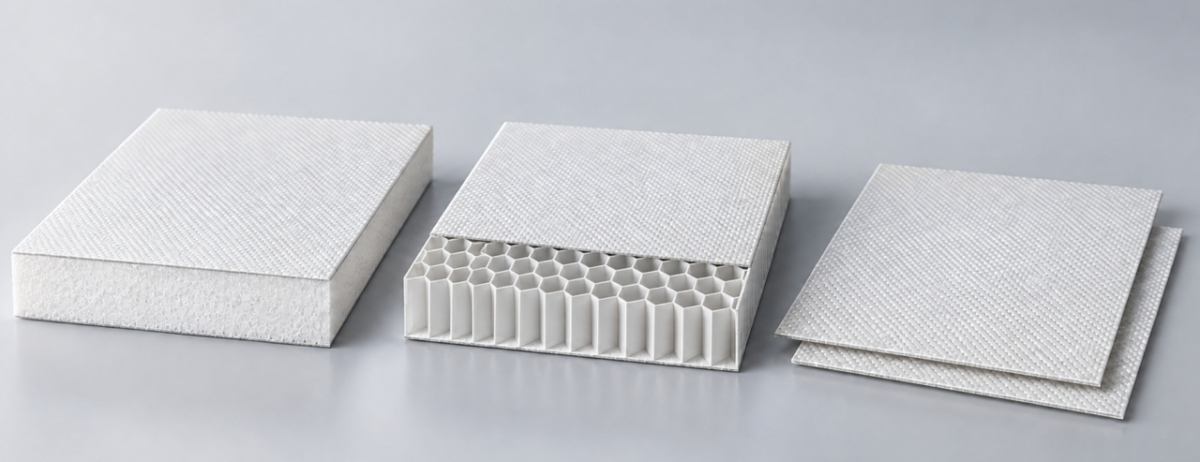
Kim (CEO) stated, “Our goal is not simply a material that does not catch fire easily,” adding, “We are creating a material system that simultaneously satisfies flame retardancy, material properties, processability, and environmental sustainability.”
Both products have moved beyond the laboratory stage of securing their targeted performance and are on the verge of commercialization. srPET is undergoing performance evaluation and process optimization for application to actual components in the automotive, aerospace mobility, and marine sectors. EcoFlamix is at the prototype stage, verifying formulation, application, and post-processing conditions tailored to the target materials and required performance.
Kim (CEO) noted, “As a researcher, my work started with the material itself, but now R&D begins with problems in the industrial field,” explaining, “Instead of asking companies to use it just because it has potential, we are taking an approach of verifying it together with demand-side companies to create a usable material.” The goal is to build a structure that progresses from identifying demand-side companies to joint verification, demonstration, and product application.
Kim (CEO) emphasized, “Environmental sustainability should not be the sole reason for purchase,” stating, “For long-term competitiveness, the material itself must possess sufficient performance, productivity, and economic viability, with the added value of recyclability and carbon reduction on top.”
Furthermore, __NAME_0__ said, “We aim to change the common perception in the materials market that ‘performance must be sacrificed for environmental and safety reasons,’” adding, “We want to present another option to companies considering new materials—one that allows them to have both performance and environmental sustainability.”
Meanwhile, Composite Solutions is participating in the fourth cohort of ‘Ocean Step,’ a marine and fisheries accelerator program hosted by the Ministry of Oceans and Fisheries and the Marine and Fisheries Technology Promotion Institute, and operated by Tap Angel Partners.
[MoneyToday startup media platform Unicorn Factory]

 in FUTURE

