

[For more diverse corporate information on the startups featured in this article, please visit the "Data Lab" of the Unicorn Factory big data platform .]
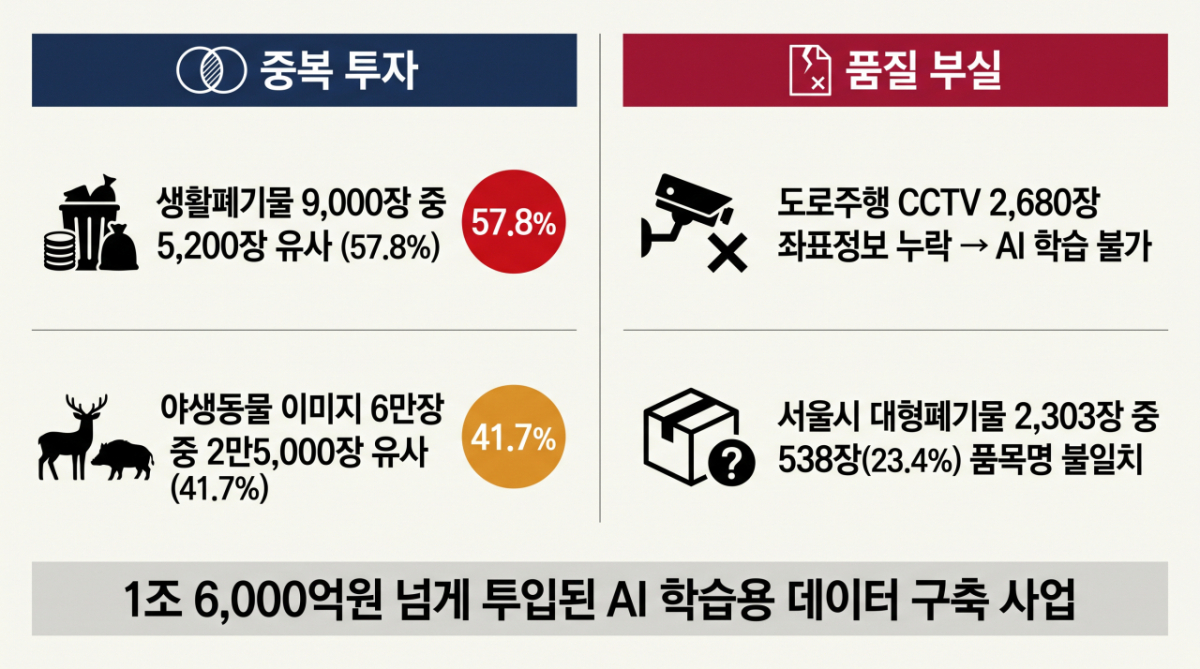
As the government's AI training data project, which has invested over 1.6 trillion won, has been criticized by the Board of Audit and Inspection for duplicate construction and poor quality management, verified data from startups actually operating services in the field is drawing attention as an alternative that can complement this project.
According to the "Audit Results on the Status of AI Industry Promotion" released by the Board of Audit and Inspection last August, the Ministry of Science and ICT spent a budget of 1.6328 trillion won from 2017 to 2024 to build 908 types of AI training data.
However, it was found that similar data had been duplicated in construction as public institutional investors pursued individual projects without checking already built data. Additionally, the quality of the AI training data built and released by public institutional investors was confirmed to be low.
According to the venture and startup industry on the 20th, startups that are already operating services based on AI and accumulating verified data existed in the areas of △household waste △concrete cracks △eggs △wildlife, which the Board of Audit and Inspection cited as examples of duplicate construction.
'Ppae-gi' accumulates 6 million waste data entries

A representative case in the household waste sector is the startup 'Gada', which operates the environmental resource data platform "Ppae-gi." Ppae-gi is a service that handles everything from item verification and fee payment to collection through a single app when citizens take photos of large waste items such as sofas or refrigerators to apply for disposal.
Ppae-gi has approximately 2.5 million cumulative members, with agreements in place with about 90 local governments nationwide. Approximately 300,000 disposal applications are received every month. In particular, the strength of the data accumulated by Ppae-gi is that it is linked to "actual transactions."
When a user uploads a photo of waste and selects an item, the photo is recorded along with the fee set by the Local Government, the amount actually paid, and whether collection has been completed. In effect, one photo becomes a single complete processing record. Thanks to this structure, it is difficult for incorrect data to remain.
For example, if a photo of a sofa is mistakenly applied as a "bed," the fee will not match, and the problem will immediately surface at the collection site. Errors are corrected as they occur. This means that the issue of "lack of third-party quality verification" pointed out by the Board of Audit and Inspection can be verified through hundreds of thousands of actual payments and collections every month.
The waste data secured in this way exceeds 6 million entries, and the item database reaches approximately 3,500 types. About 12% of waste disposal applications lead to second-hand transactions, resulting in a cumulative reduction of 17,000 tons of carbon dioxide and 4,500 tons of waste incineration.
Catches cracks down to 0.1 mm… Building infrastructure data with drones and robots
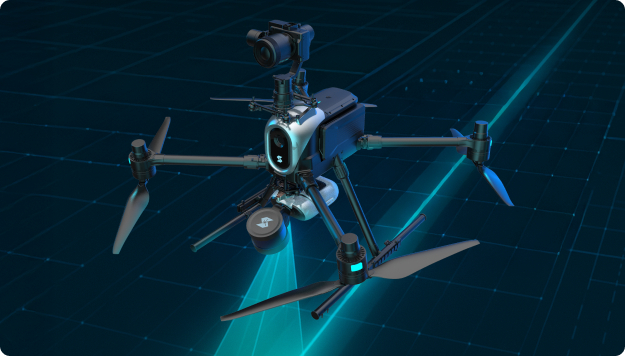
In the concrete crack sector, facility safety diagnosis startups are accumulating verified data. Sierra Base, which operates the AI drone-based safety diagnosis platform "SIRIUS," is a representative example.
Founded in 2019 by engineers from POSTECH, Sierra Base combines rotating LiDAR and AI crack analysis technology to detect even micro-cracks at the 0.1 mm level. Currently, major public institutional investors such as Korea Expressway Corporation and Korea Water Resources Corporation have adopted and are using SIRIUS.
Digital safety diagnosis solution company Comapper has commercialized "KO-Detect," an AI-based facility safety diagnosis platform that automatically detects and quantifies major damages such as cracks, white etching, spalling, rebar exposure, and corrosion by analyzing facility exterior images with AI.
KO-Detect detects structural defects with 0.1 mm precision and over 90% accuracy through AI. It is explained that costs can be reduced by more than 72% and time by more than 63% compared to existing methods. Additionally, it analyzes the trend of past and present damage in a time series and produces reports.
In the egg sector, Hanbat IoT is cited as a representative AI data company. Hanbat IoT developed the AI-based egg quality inspection equipment "EggScan" together with the Livestock Products Quality Evaluation Institute. This equipment determines 38 types of quality items such as cracks, foreign matter, and discoloration without breaking the eggs, using high-resolution cameras and AI analysis.
According to a case where the technology was applied to egg processed food manufacturer YJ Food, the time to inspect 300 eggs was reduced from 30 minutes to 14 minutes. The egg-related data accumulated by Hanbat IoT reached over 50 million entries as of the end of last year.
AI also applied to protecting endangered wildlife
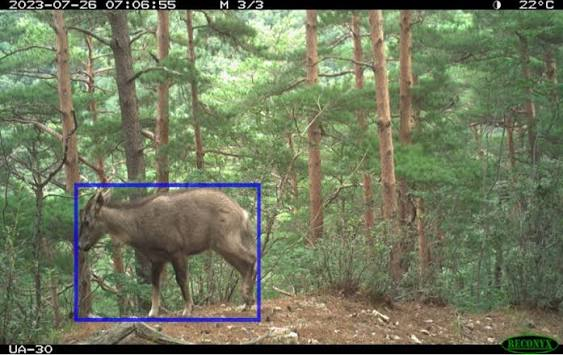
In the wildlife sector, vision AI company Sphere AX stands out. Sphere AX developed the automatic wildlife species identification system "Eco.AI" together with the National Institute of Ecology and a KAIST (Korea Advanced Institute of Science and Technology) research team.
This system automatically analyzes large amounts of photos taken by unattended sensor cameras using AI, automatically classifying them into 7 categories such as sika deer, wild boar, and deer species. The organized data is provided to researchers and is first being utilized in research on the sika deer, which is a Class I endangered species.
KAIST's Prof. Kim Chang-ik, who participated in the development of Eco.AI, evaluated it as "a case presenting the possibility that AI technology can be actively utilized for the protection of endangered species from the perspective of Anthropocene (, the period during which human activities have caused significant changes to Earth's natural environment) research."
The startup industry views the construction of the "AI Training Data Integrated Provision System" being promoted by the government as an institutional channel for using private field data in the public sector. This system will gather AI training data built by the government and data from private companies and universities in one place, allowing them to be searched, accessed, and utilized.
Expectations are emerging that once the system is built, the issues of duplicate investment and quality management pointed out by the Board of Audit and Inspection can be resolved by actively utilizing verified private data from the field instead of spending separate budgets to build new data.
In the case of Gada, it has revealed plans to go further and pursue data cooperation projects with the government and Local Government based on the waste data accumulated so far. Go Jae-sung, CEO of Gada, emphasized, "We will verify the quality of the data accumulated in the field so that the public can utilize it, systematically organize its characteristics, and cooperate."
[MoneyToday startup media platform 'Unicorn Factory']

 in FUTURE


