

[For more diverse corporate information on the startups mentioned in this article, please visit the Unicorn Factory big data platform ‘Data Lab’.]

KOSDAQ-listed venture capital firms are on high alert as concerns grow over possible designation as stocks under administrative watch. Their share prices have slumped, pushing them into penny stock territory, defined as below 1,000 won. Daesung Private Equity became the first listed VC to receive the designation this month, while SBI Investment is increasingly likely to become the second.
According to the venture investment industry on Monday, SBI Investment closed at 589 won per common share on Oct. 30, remaining below 1,000 won for 29 consecutive trading days. If the closing price of common shares remains below 1,000 won for 30 consecutive trading days, the company is designated as a managed stock under KOSDAQ listing regulations.
This regulation follows the 'delisting reform plan' implemented on July 1 this year. If the share price remains below 1,000 won for 30 consecutive trading days, the company is designated as a managed stock; if it fails to recover to above 1,000 won for 45 consecutive trading days within 90 trading days of designation, it enters the delisting process. On KOSDAQ, five companies—TKG Steel, Hyeongji Global, New Intec, Ice Cream Edu, and Barunson E&A—have had their trading suspended for this reason.
SBI Investment decided on a 5-for-1 stock consolidation on the 22nd to meet the requirements for eliminating penny stock status. The company plans to approve the agenda at the shareholders' meeting in December and complete the consolidation by January next year. The company had also decided on a 2-for-1 stock consolidation in February this year, completing it in May. However, the share price continued to fall even after the consolidation, causing it to become a penny stock again.
KOSDAQ listing regulations restrict consolidations to more than twice a year. However, the company stated that it did not set the consolidation timing for January next year to avoid this restriction. It explained that the previous consolidation (in May) was carried out before the new regulation took effect in July and therefore is not subject to the limit. An SBI Investment official said, "The schedule for this consolidation is a normal procedure following the predetermined shareholders' meeting schedule and trading suspension procedures, and we plan to completely resolve the penny stock risk through this."
The company maintains that dividends were legally impossible due to accumulated deficit funds accrued before the acquisition. The SBI Group acquired Korea Technology Investment in 2010 to secure management control. A company official said, "Without artificial accounting treatments such as capital reduction, we reduced the deficit fund from 80.9 billion won in 2018 to 9.6 billion won in the first half of this year using only profits generated from our core business," adding, "As operating profit in the first half reached 7.6 billion won, a 277% increase from the previous year, and the trend toward profitability continues, we will be able to establish a financial structure capable of implementing shareholder-friendly policies once all remaining deficit funds are resolved."
SBI Investment stated in a letter to shareholders on the 29th of last month, "We fully recognize that stock consolidation is not a measure that directly increases the substantive value of the company," adding, "As of the end of June this year, our assets under management were approximately 1.5 trillion won, we have secured management fees of around 10 billion won annually, and we have posted profits for three consecutive years since 2023." The company stated that, having been selected as an operator of the National Growth Fund this year, it aims to complete fund formation within the year and enhance investment asset recovery performance to lay the foundation for medium- to long-term shareholder returns.
The company also added that, from the perspective of shareholder returns, it burned all its treasury shares in August last month, and executives purchased treasury shares this month. If the deficit funds are resolved, there is a possibility that dividends, which have been on hold for a long time, will resume. SBI Investment's last dividend was during its era as Korea Technology Investment.
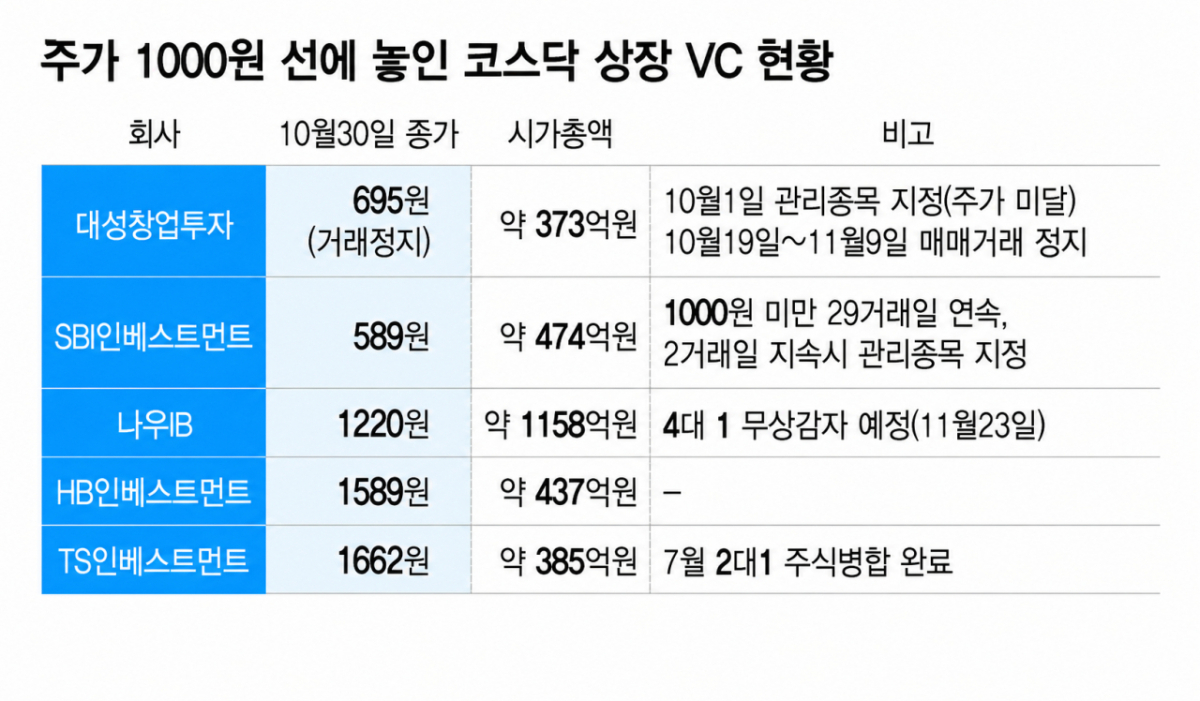
Movements to avoid penny stock status are spreading to other listed VCs as well. Now IB currently has a share price above 1,000 won, but decided on a 4-for-1 capital reduction on the 22nd last month. The company had performed a stock split in 2023 to increase the number of circulating shares, activate trading, and enhance shareholder value, but it faced the risk of becoming a penny stock due to the overlap of the delisting reform plan announced in February this year and the decline in KOSDAQ share prices. Now IB plans to convert the capital reduction gain of 35.6 billion won into retained earnings to use as a source for dividends.
In addition, HB Investment and TS Investment also have share prices slightly above 1,000 won, posing a risk of falling into penny stock territory. HB Investment also released a corporate value enhancement plan in May last month, outlining its policy to continue shareholder returns by maintaining a dividend payout ratio of over 50%. TS Investment voluntarily disclosed a 'corporate value enhancement plan' in July last month following a 2-for-1 stock consolidation. The company set a goal to raise its shareholder return rate to over 25% by 2028. It is also considering share buybacks of over 1.5 billion won this year and plans to continuously consider share buyback burn-offs thereafter.
However, even if listed VCs shed the penny stock label, it will be difficult for them to feel at ease. This is because KOSDAQ market capitalization requirements will be strengthened from the current 20 billion won to 30 billion won starting next July. Stock consolidation or capital reduction only changes the number of shares and par value; it does not increase market capitalization. Daesung Private Equity, which has already completed a 5-for-1 consolidation, has a market cap of approximately 37.3 billion won, meaning it would fail to meet next year's standards if its share price drops by just 20%. SBI Investment, with a market cap of around 47.4 billion won, and TS Investment, with a market cap of around 38.5 billion won, also face the challenge of managing their market capitalization.
There are also indications within the industry that par value consolidation is merely a temporary measure to address the penny stock issue, and that changes in share price management and shareholder return policies are also necessary. A VC official said, "Since there have been cases where share prices fell even after par value consolidation, I believe it is necessary to prepare substantive measures for enhancing shareholder value."
[MoneyToday startup media platform Unicorn Factory]

 in FUTURE

